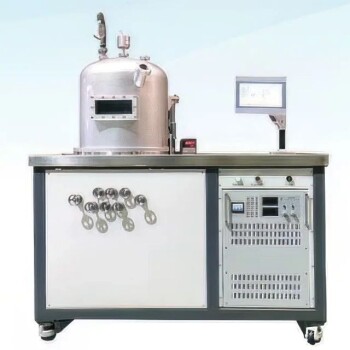
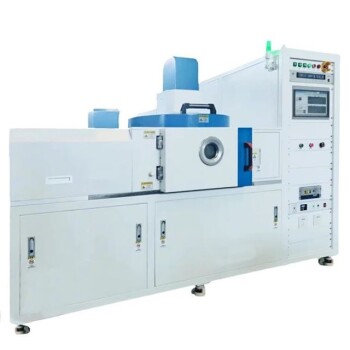
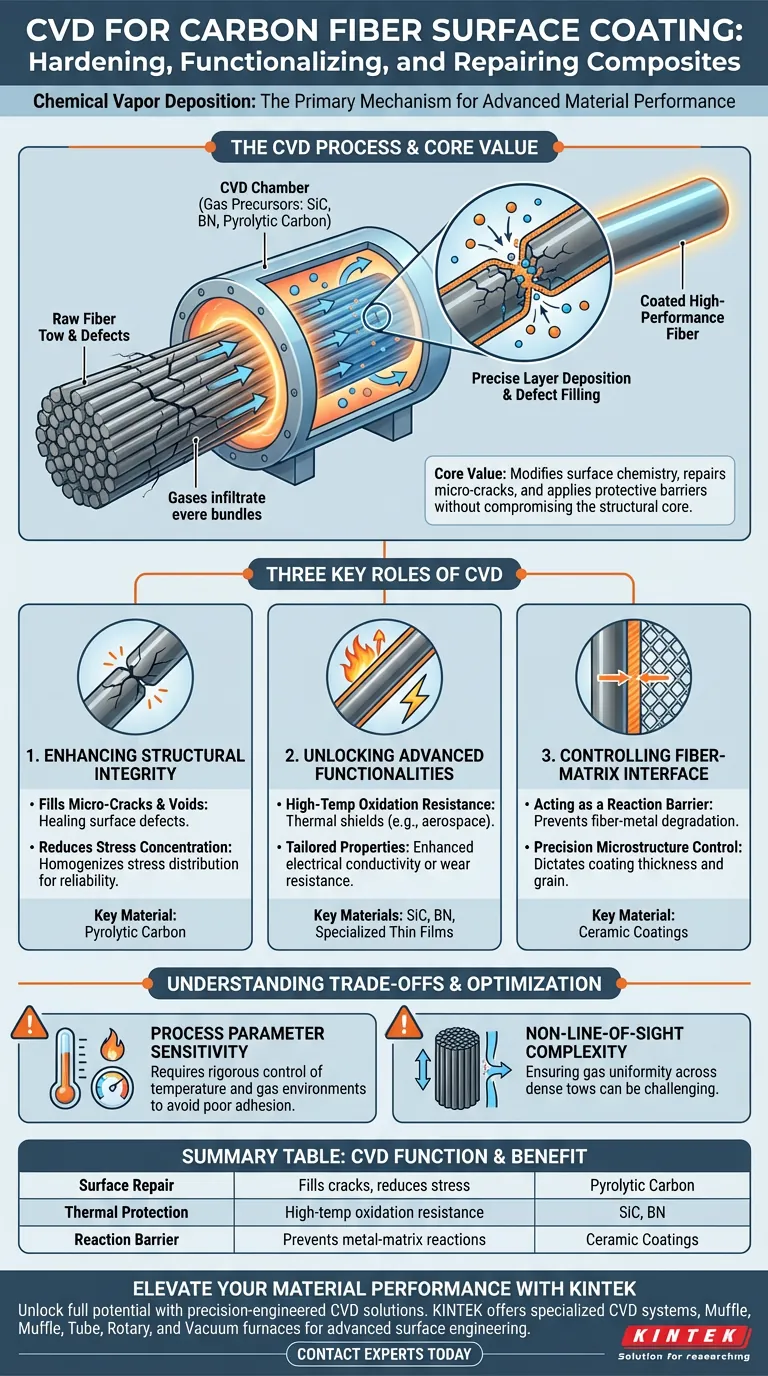
Chemical Vapor Deposition (CVD) equipment serves as the primary mechanism for hardening and functionalizing carbon fibers. It is used to deposit specialized layers—such as silicon carbide (SiC), boron nitride (BN), or pyrolytic carbon—directly onto the surface of graphitized fibers. This process is essential for repairing microscopic surface defects and enabling the fiber to survive in extreme composite manufacturing and operating environments.
The core value of CVD equipment lies in its ability to precisely modify the fiber's surface chemistry without compromising its structural core. By filling surface micro-cracks and applying uniform protective barriers, CVD transforms standard carbon fibers into high-performance reinforcements suitable for aerospace and thermal management applications.
Enhancing Structural Integrity
The surface of a raw carbon fiber is rarely perfect. CVD equipment addresses physical vulnerabilities that could lead to premature material failure.
Filling Micro-Cracks and Defects
Graphitized carbon fibers often contain inherent surface defects, such as micro-cracks or voids. CVD equipment introduces a precursor gas that infiltrates these microscopic imperfections. The deposited material fills these gaps, effectively healing the surface of the fiber.
Reducing Stress Concentration
Surface irregularities act as stress concentrators where cracks can propagate under load. By smoothing the surface profile with a deposited coating, CVD equipment homogenizes stress distribution. This significantly improves the overall mechanical reliability of the composite material.
Unlocking Advanced Functionalities
Beyond simple repair, CVD allows engineers to imbue carbon fibers with properties they do not naturally possess.
High-Temperature Oxidation Resistance
Carbon fibers degrade rapidly in oxygen-rich environments at high temperatures. CVD equipment applies ceramic coatings like SiC or BN that act as thermal shields. This allows the fibers to retain strength in aerospace engine components and thermal management systems.
Tailored Electrical and Wear Properties
Specific applications may require enhanced conductivity or resistance to abrasion. CVD enables the deposition of coatings that improve electrical conductivity or surface hardness. This versatility expands the utility of carbon fibers into complex electronic and tribological applications.
Controlling the Fiber-Matrix Interface
In composite materials, the interaction between the fiber and the surrounding matrix (polymer or metal) is critical.
Acting as a Reaction Barrier
In metal matrix composites, carbon fibers can react chemically with the molten metal, degrading the fiber. CVD coatings function as a diffusion barrier, preventing these detrimental interfacial reactions. This preserves the fiber's strength during the composite fabrication process.
Precision Microstructure Control
The performance of the coating depends heavily on its thickness and grain structure. CVD equipment offers precise control over process parameters like temperature and gas flow. This allows manufacturers to dictate the exact final diameter and microstructure of the fiber coating.
Understanding the Trade-offs
While CVD offers superior coating quality, it requires rigorous process management to ensure success.
Process Parameter Sensitivity
The quality of the coating is heavily dependent on maintaining precise gas environments and temperatures. Deviations in the reduction temperature (often between 300°C and 500°C for specific precursors) can lead to poor adhesion or aggregation. Operators must strictly monitor these variables to maintain the material's high specific surface area.
Non-Line-of-Sight Complexity
One major advantage of CVD is its ability to coat complex, non-line-of-sight geometries. However, ensuring gas uniformity across a dense bundle of fibers (tow) can be challenging. Inadequate gas flow distribution can result in uneven coating thickness across the inner filaments of a tow.
Making the Right Choice for Your Goal
To maximize the value of CVD equipment for your specific application, focus on the functional outcome you require.
- If your primary focus is High-Temperature Durability: Prioritize CVD processes capable of depositing uniform Silicon Carbide (SiC) or Boron Nitride (BN) to prevent oxidation.
- If your primary focus is Mechanical Reliability: Utilize CVD to deposit pyrolytic carbon for filling surface defects and reducing stress concentrations.
- If your primary focus is Metal Matrix Composites: Ensure your CVD setup is tuned to create dense, non-porous barrier coatings to prevent fiber-metal reactivity.
CVD equipment is not just a coating tool; it is an engineering instrument that redefines the performance limits of carbon fiber composites.
Summary Table:
| CVD Function | Benefit for Carbon Fibers | Key Coating Materials |
|---|---|---|
| Surface Repair | Fills micro-cracks and reduces stress concentration | Pyrolytic Carbon |
| Thermal Protection | Provides high-temperature oxidation resistance | SiC, BN |
| Reaction Barrier | Prevents degradation in metal matrix composites | Ceramic Coatings |
| Surface Engineering | Tailors electrical conductivity and wear resistance | Specialized Thin Films |
Elevate Your Material Performance with KINTEK
Unlock the full potential of your carbon fiber composites with precision-engineered CVD solutions. Backed by expert R&D and world-class manufacturing, KINTEK offers specialized CVD systems, Muffle, Tube, Rotary, and Vacuum furnaces designed to meet the rigorous demands of advanced surface engineering.
Whether you need to enhance thermal shielding, improve mechanical reliability, or develop custom interface barriers, our systems are fully customizable to your unique research and production needs.
Ready to optimize your fiber coating process? Contact our technical experts today to find the perfect high-temperature solution.
Visual Guide
References
- Advances in Acid and Post-Graphitization Treatments for Mesophase Pitch-based Carbon Fibers: A Review. DOI: 10.34257/gjsfrbvol25is1pg1
This article is also based on technical information from Kintek Furnace Knowledge Base .
Related Products
- Custom Made Versatile CVD Tube Furnace Chemical Vapor Deposition CVD Equipment Machine
- HFCVD Machine System Equipment for Drawing Die Nano Diamond Coating
- Multi Heating Zones CVD Tube Furnace Machine for Chemical Vapor Deposition Equipment
- MPCVD Machine System Reactor Bell-jar Resonator for Lab and Diamond Growth
- 915MHz MPCVD Diamond Machine Microwave Plasma Chemical Vapor Deposition System Reactor
People Also Ask
- What is a CVD tube furnace and what is its primary function? Discover Precision Thin-Film Deposition
- Why are CVD tube furnace sintering systems indispensable for 2D material research and production? Unlock Atomic-Scale Precision
- How does CVD tube furnace sintering enhance graphene growth? Achieve Superior Crystallinity and High Electron Mobility
- Which industries and research fields benefit from CVD tube furnace sintering systems for 2D materials? Unlock Next-Gen Tech Innovations
- How might AI and machine learning enhance CVD tube furnace processes? Boost Quality, Speed, and Safety