
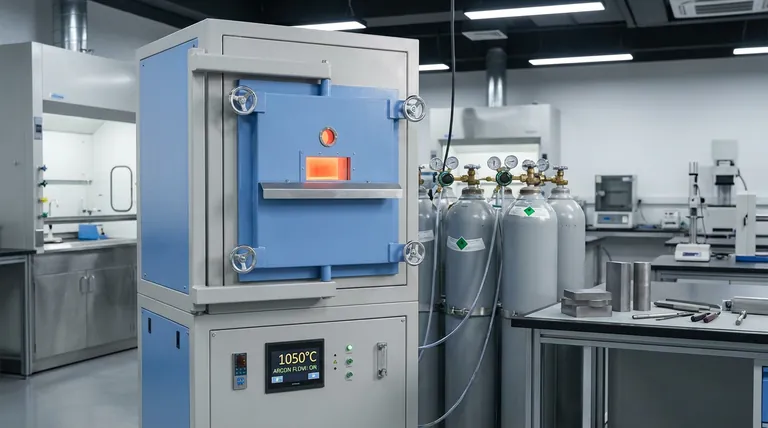
The argon atmosphere furnace acts as a critical safeguard during the solution and aging stages of Ti-6Al-7Nb heat treatment. By maintaining an inert environment at high temperatures, it prevents the alloy from reacting with atmospheric gases, which would otherwise compromise the material's mechanical integrity and surface quality.
Core Takeaway: An argon atmosphere furnace provides a high-purity, inert environment that prevents oxidation and hydrogen embrittlement while enabling the precise temperature control necessary to optimize the microstructure and reduce residual stresses in Ti-6Al-7Nb alloys.
Prevention of Atmospheric Contamination
Eliminating High-Temperature Oxidation
At a solution treatment temperature of 1050 °C, titanium alloys become highly reactive with oxygen. The argon furnace replaces air with high-purity argon gas, creating a protective shield that prevents the formation of an brittle "alpha case" or oxide scale on the alloy surface.
Avoiding Hydrogen Embrittlement
Titanium has a high affinity for hydrogen, which can lead to premature failure under stress. The inert argon environment ensures that hydrogen is not absorbed during the heating process, maintaining the ductility and fracture toughness of the Ti-6Al-7Nb alloy.
Thermal Optimization and Stress Relief
Precision Microstructure Control
The furnace allows for precise temperature regulation during both solution treatment and subsequent aging processes. This accuracy is vital for managing phase transformations, ensuring the final microstructure meets the specific requirements for biomedical or industrial applications.
Reduction of Residual Stresses
Ti-6Al-7Nb components, especially those produced via casting, often contain significant internal stresses. The controlled heating and cooling cycles within the argon furnace help homogenize the material, effectively reducing these residual stresses and improving dimensional stability.
Understanding the Trade-offs and Alternatives
Argon Atmosphere vs. Vacuum Environments
While argon furnaces provide excellent protection for heat treatment, they differ from vacuum arc furnaces used in the melting stage. Vacuum environments are superior for removing dissolved gases, but argon furnaces are often more cost-effective and practical for standard solution and aging cycles where gas removal is less critical than surface protection.
Limitations of Inert Gas Purity
The effectiveness of the furnace is entirely dependent on the purity of the argon gas. Even trace amounts of moisture or oxygen within the argon supply can lead to subtle surface contamination, requiring rigorous monitoring of the gas delivery system.
Comparison with Pre-heating Methods
Unlike muffle furnaces used for lower-temperature pre-heating (around 600 °C), argon furnaces are designed for the extreme temperatures required for phase changes. Using a standard muffle furnace for Ti-6Al-7Nb at 1050 °C would result in catastrophic oxidation due to the lack of an inert atmosphere.
How to Apply This to Your Project
Implementation Guidelines
- If your primary focus is surface integrity: Ensure the argon furnace maintains a positive pressure environment to prevent any atmospheric leakage during the 1050 °C solution treatment.
- If your primary focus is maximizing ductility: Prioritize the use of ultra-high-purity argon (99.999%) to eliminate the risk of hydrogen-induced cracking or embrittlement.
- If your primary focus is stress relief in complex castings: Utilize the furnace’s programmable controllers to implement slow, uniform cooling rates following the solution treatment.
The argon atmosphere furnace remains the definitive tool for maintaining the chemical purity and structural performance of Ti-6Al-7Nb alloys throughout the heat treatment cycle.
Summary Table:
| Feature | Role in Ti-6Al-7Nb Heat Treatment | Key Benefit |
|---|---|---|
| Inert Atmosphere | Displaces oxygen/nitrogen with high-purity argon | Prevents brittle alpha-case and oxidation |
| Hydrogen Control | Eliminates atmospheric hydrogen exposure | Avoids hydrogen embrittlement and ductility loss |
| Thermal Precision | Precise regulation for solution (1050°C) & aging | Optimizes microstructure and phase stability |
| Stress Relief | Controlled heating and cooling cycles | Reduces residual stresses in complex castings |
Elevate Your Alloy Performance with KINTEK
Precision heat treatment of Ti-6Al-7Nb requires more than just heat—it requires a perfectly controlled environment. Backed by expert R&D and manufacturing, KINTEK offers high-purity Argon Atmosphere, Vacuum, CVD, and Muffle systems designed to protect your materials from contamination and stress. Whether you need a standard solution or a custom furnace for unique lab requirements, our systems deliver the reliability your research demands.
Ready to optimize your thermal processes? Contact KINTEK today for a customized solution.
References
- Anjar Oktikawati, Agus Setiawan. Electrochemical characteristic and microstructure of Ti-6Al-7Nb alloy by centrifugal casting for orthopedic implant based on ageing time variations. DOI: 10.15587/1729-4061.2024.302614
This article is also based on technical information from Kintek Furnace Knowledge Base .
Related Products
- 1700℃ Controlled Inert Nitrogen Atmosphere Furnace
- 1400℃ Controlled Inert Nitrogen Atmosphere Furnace
- Mesh Belt Controlled Atmosphere Furnace Inert Nitrogen Atmosphere Furnace
- 1200℃ Controlled Inert Nitrogen Atmosphere Furnace
- Controlled Inert Nitrogen Hydrogen Atmosphere Furnace
People Also Ask
- How do controlled-atmosphere furnaces support polymer pyrolysis? Master SiC & Si3N4 Ceramic Conversion
- Why are controlled atmosphere high-temperature furnaces essential for the post-treatment annealing of oxide ceramic powders?
- What role does a high-temperature inert atmosphere furnace play in carbonization? Optimize Your Carbon Yield
- Why is an atmosphere-controlled furnace necessary for NMC811 synthesis? Optimize Battery Capacity & Structure
- How is atmosphere control managed during furnace operation? Master Precise Gas Environments for Superior Results









