
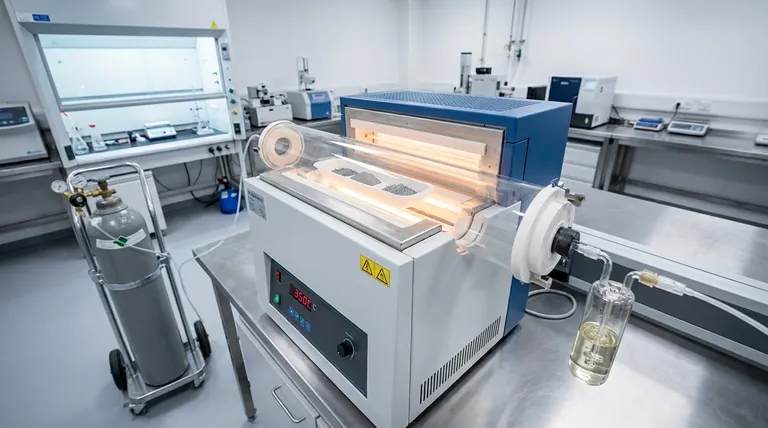
The primary function of a controlled atmosphere furnace with continuous argon flow is to establish a strictly inert environment that shields materials from atmospheric contamination. In the specific context of sintering Zn-SiC composites, this setup prevents the oxidation of zinc powder as temperatures rise to 350°C. By effectively displacing oxygen, the furnace ensures the zinc remains chemically pure, which is a prerequisite for successful sintering.
By maintaining a continuous flow of inert gas, the system eliminates the formation of oxide layers on particle surfaces. This removal of the "oxide barrier" is the defining factor that allows for true metallurgical bonding and structural integrity in zinc-based composites.
The Critical Challenge: Zinc Oxidation
Zinc’s Sensitivity to Oxygen
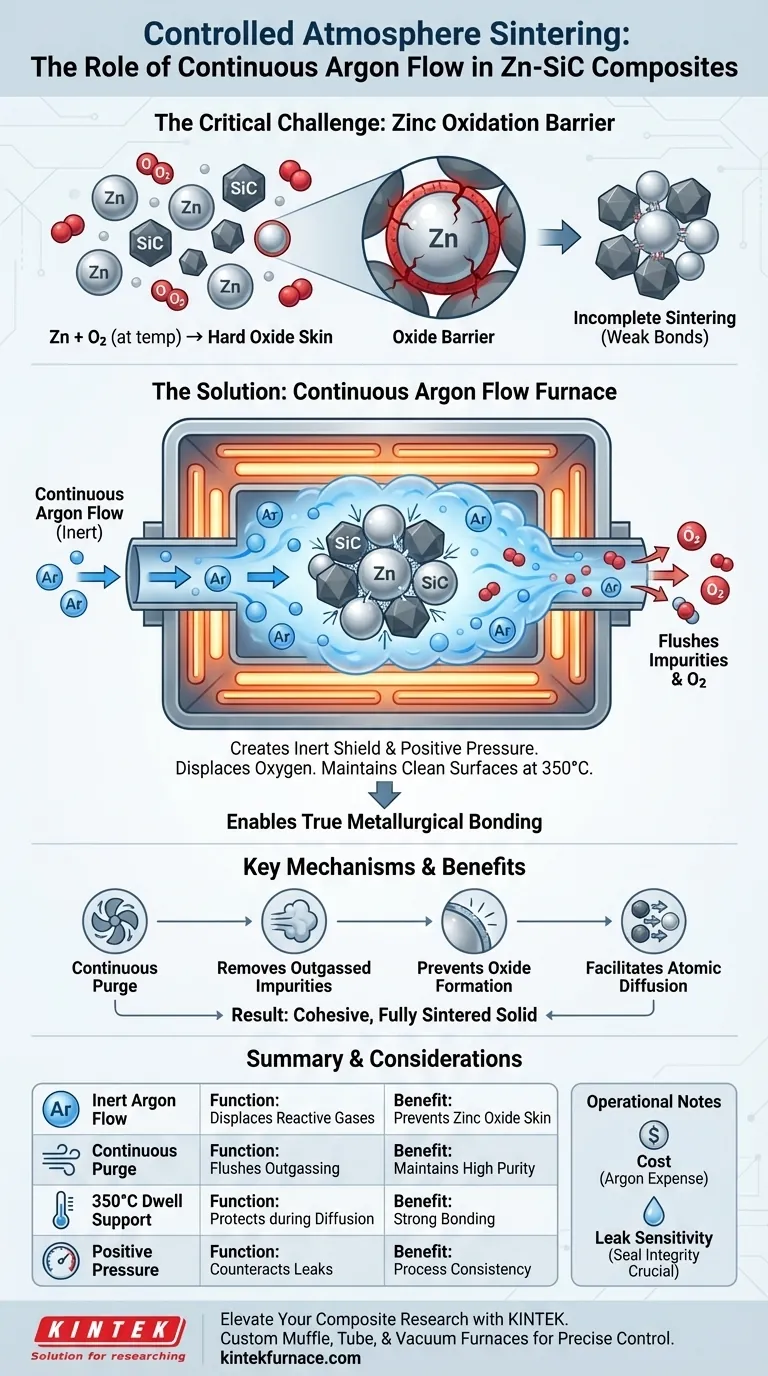
Zinc powder is highly reactive when exposed to oxygen, particularly as temperatures increase. Even before reaching the sintering target of 350°C, unprotected zinc particles will begin to react with the surrounding air.
The Barrier to Sintering
When zinc reacts with oxygen, it forms a hard oxide "skin" around each individual powder particle. This layer acts as a physical and chemical barrier.
If this oxide layer is allowed to form, the zinc particles cannot touch or fuse with one another or the silicon carbide (SiC) reinforcement. The result is incomplete sintering, leading to a composite with poor mechanical strength and low density.
How Continuous Argon Flow Solves the Problem
Creating an Inert Shield
Argon is a noble gas, meaning it is chemically inert and will not react with the zinc or the SiC. By filling the furnace chamber with argon, you create a neutral medium that supports heat transfer without chemical alteration.
The Importance of "Continuous" Flow
A static fill of argon is often insufficient because small leaks or outgassing from the material itself can reintroduce contaminants. A continuous flow actively purges the chamber.
This dynamic pressure ensures that any residual oxygen or volatile impurities released during heating are immediately flushed out of the system.
Facilitating Metallurgical Bonds
The ultimate goal of sintering is to create strong metallurgical bonds between particles.
Because the argon atmosphere prevents oxidation, the metal surfaces remain clean and active. This allows for atomic diffusion across particle boundaries at 350°C, resulting in a cohesive, fully sintered solid rather than a loosely packed aggregate.
Operational Constraints and Trade-offs
Process Cost and Complexity
While essential for quality, using continuous argon flow increases the operational cost of sintering. The consumption of high-purity argon represents a recurring expense compared to sintering in air (which is not an option for Zn).
Sensitivity to Leaks
The system relies entirely on the integrity of the furnace seals. Even a minor breach in the gas line or chamber seal can compromise the inert atmosphere.
If the flow rate is not sufficient to maintain positive pressure against a leak, oxygen ingress will occur, causing immediate degradation of the zinc powder.
Ensuring Success in Sintering Zn-SiC
To maximize the quality of your composite materials, consider the following regarding your atmosphere control:
- If your primary focus is mechanical strength: Prioritize high-purity argon and verify seal integrity to ensure zero oxidation, as this is the primary failure mode for bond strength.
- If your primary focus is process consistency: Implement flow monitoring to ensure the argon purge remains constant throughout the entire heating profile, specifically holding steady at the 350°C dwell time.
Effective sintering of zinc composites is impossible without total oxygen exclusion; the argon flow is not just an aid, but the fundamental enabler of the process.
Summary Table:
| Feature | Function in Zn-SiC Sintering | Benefit |
|---|---|---|
| Inert Argon Flow | Displaces oxygen and reactive gases | Prevents formation of zinc oxide 'skin' |
| Continuous Purge | Flushes out outgassed impurities | Maintains high-purity environment throughout cycle |
| 350°C Dwell Support | Protects surfaces during atomic diffusion | Facilitates strong metallurgical bonding |
| Positive Pressure | Counteracts potential chamber leaks | Ensures process consistency and material density |
Elevate Your Composite Material Research with KINTEK
Don't let oxidation compromise your structural integrity. KINTEK provides industry-leading Muffle, Tube, and Vacuum furnace systems specifically engineered for precise atmosphere control. Backed by expert R&D and manufacturing, our systems are fully customizable to meet the unique requirements of your Zn-SiC or advanced material sintering processes.
Ready to achieve zero-oxidation results?
Contact our specialists today to find the perfect high-temperature solution for your lab.
Visual Guide
References
- Fabrication and analysis of Zn-SiC metal matrix composites via advanced metallurgical processes. DOI: 10.33545/26174693.2025.v9.i7se.4834
This article is also based on technical information from Kintek Furnace Knowledge Base .
Related Products
- 1400℃ Controlled Inert Nitrogen Atmosphere Furnace
- 1700℃ Controlled Inert Nitrogen Atmosphere Furnace
- 1200℃ Controlled Inert Nitrogen Atmosphere Furnace
- Mesh Belt Controlled Atmosphere Furnace Inert Nitrogen Atmosphere Furnace
- Controlled Inert Nitrogen Hydrogen Atmosphere Furnace
People Also Ask
- How does oxygen partial pressure control affect ceramic sintering? Master Defect Chemistry
- Why is controlled-atmosphere heating required for functional ceramics and sensors? Master Defect Engineering
- How do controlled-atmosphere furnaces support polymer pyrolysis? Master SiC & Si3N4 Ceramic Conversion
- Why is thorough binder burnout necessary before sintering advanced ceramics? Ensure Peak Density & Zero Defects
- How does real-time dilatometric analysis in a controlled-atmosphere furnace optimize PZT ceramic sintering?



















