
In essence, retort furnaces are used for high-temperature material processing applications where controlling the atmospheric environment is as critical as controlling the temperature itself. Their primary functions include the specialized heat treatment of metals like titanium, bright annealing of stainless steel, furnace brazing, and the sintering of ceramics and powdered metals.
The defining feature of a retort furnace is its sealed inner chamber, or "retort." This design isolates the material from the furnace's heating elements and the outside air, enabling precise control over the atmosphere to prevent contamination and ensure superior material properties.
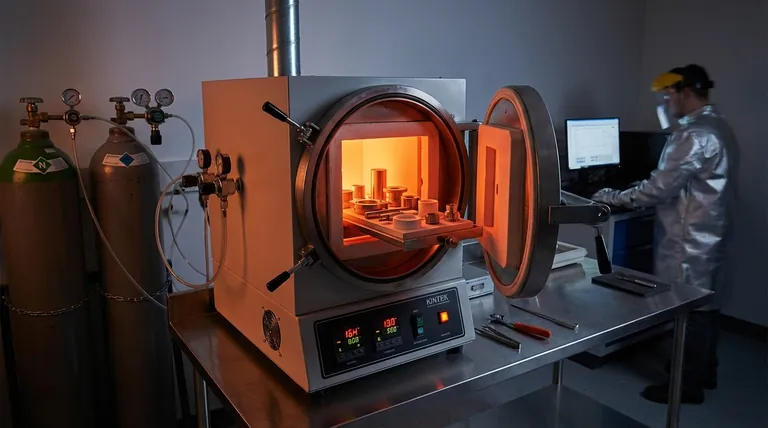
The Core Principle: A Controlled Environment
The value of a retort furnace is not just its ability to get hot, but its ability to create a pure, highly specific environment while it's hot. This is achieved through the design of the retort itself.
What is a Retort?
A retort is a sealed metallic or ceramic container placed inside the furnace's main heating chamber. Your workpiece goes inside the retort, not in the main chamber.
This creates a self-contained processing environment. Gases can be introduced into the retort (like nitrogen, argon, or hydrogen) or a vacuum can be pulled to create the ideal conditions for the task.
Why Atmospheric Control is Critical
Many high-temperature processes fail if the material reacts with oxygen or other elements in the air. The retort prevents this.
For example, bright annealing of stainless steel requires an oxygen-free atmosphere to prevent the formation of an oxide layer, preserving the metal's bright, clean surface.
Similarly, furnace brazing relies on a specific atmosphere to allow the filler metal to flow cleanly and bond components without oxidation, creating a strong, reliable joint.
Ensuring Temperature Uniformity
By containing the process within a retort, the furnace can deliver highly uniform and consistent heat to the workpiece.
This uniformity is crucial for processes like sintering, where fine powders are heated to bond together. Even small temperature variations can lead to inconsistent density and poor performance in the final ceramic or metal part.
Key Applications Across Industries
The unique capabilities of retort furnaces make them indispensable in several high-tech fields.
Metallurgy and Metal Treatment
This is a primary application area. Retort furnaces are used for sophisticated processes that go beyond simple heating.
Applications include annealing, hardening, and brazing reactive or high-value metals. The treatment of titanium parts, which are highly susceptible to contamination at high temperatures, is a classic use case.
Powder and Ceramic Processing
Retort furnaces are vital for manufacturing advanced materials from powders.
Powder metallurgy and ceramic sintering both involve heating compacted powders to just below their melting point. The controlled atmosphere inside a retort prevents unwanted chemical reactions and helps achieve maximum densification and strength in the final product.
Research and Development
In university and industrial labs, creating materials with novel properties requires absolute control.
Retort furnaces provide the pure, repeatable environment necessary for material synthesis, high-temperature experiments, and testing. This makes them a standard tool for scientists and engineers developing the next generation of materials.
Understanding the Trade-offs
While powerful, retort furnaces are not the universal solution for all heating tasks. Their specialized nature comes with clear trade-offs.
Complexity and Cost
The need for a sealed retort, gas-handling systems, and/or vacuum pumps makes these furnaces more complex and expensive than standard atmospheric furnaces.
Batch Processing Limitations
Most retort furnaces operate on a batch-by-batch basis. While ideal for high-value components, this can be less efficient for very high-volume, continuous production lines where a tunnel furnace might be more suitable.
Maintenance Demands
The retort itself is a consumable component. It is exposed to extreme thermal stress and can degrade, crack, or warp over time, requiring periodic inspection and replacement. The seals are also critical points of failure that demand regular maintenance.
Making the Right Choice for Your Goal
Selecting the correct thermal processing equipment depends entirely on the material requirements of your final product.
- If your primary focus is high-purity metal treatment: A retort furnace is essential for processes like bright annealing or brazing where preventing surface oxidation is non-negotiable.
- If your primary focus is advanced materials development: The precise atmospheric control of a retort furnace is critical for sintering advanced ceramics, powders, and composites to achieve their designed properties.
- If your primary focus is high-volume, low-cost heat treatment: A simpler, non-retort atmospheric furnace may be more cost-effective if strict atmospheric control is not your top priority.
Ultimately, choosing a retort furnace is a decision to prioritize atmospheric purity and process control above all else.
Summary Table:
| Application | Key Benefit | Common Industries |
|---|---|---|
| Bright Annealing | Prevents oxidation for clean metal surfaces | Metallurgy, Manufacturing |
| Furnace Brazing | Ensures strong, oxidation-free joints | Aerospace, Automotive |
| Sintering | Achieves uniform density in ceramics and powders | Powder Metallurgy, Ceramics |
| Titanium Treatment | Protects reactive metals from contamination | Medical, Aerospace |
| Material Synthesis | Provides pure environments for R&D | Research Labs, Universities |
Elevate your lab's capabilities with KINTEK's advanced retort furnaces! Leveraging exceptional R&D and in-house manufacturing, we offer high-temperature solutions like Muffle, Tube, Rotary, Vacuum & Atmosphere Furnaces, and CVD/PECVD Systems. Our deep customization ensures precise fit for your unique needs in metal treatment, ceramic sintering, and more. Contact us today to discuss how our furnaces can enhance your process control and material outcomes!
Visual Guide

Related Products
- Electric Rotary Kiln Continuous Working Small Rotary Furnace Kiln for Pyrolysis Plant Heating
- Electric Rotary Kiln Small Rotary Furnace Biomass Pyrolysis Plant Rotating Furnace
- Laboratory Vacuum Tilt Rotary Tube Furnace Rotating Tube Furnace
- Vacuum Sealed Continuous Working Rotary Tube Furnace Rotating Tube Furnace
- Split Multi Heating Zone Rotary Tube Furnace Rotating Tube Furnace
People Also Ask
- What are the advantages of electric rotary kilns compared to fuel-fired ones? Boost Precision and Efficiency in Your Process
- What materials can be processed in an electric rotary kiln? Versatile Solutions for Advanced Materials
- What advantages do electric rotary kilns offer over fuel-based kilns? Boost Efficiency and Purity in Your Process
- What are the primary applications of electric rotary kilns? Precision Thermal Processing for High-Value Materials
- How do electric rotary kilns achieve high thermal efficiency? Unlock Over 95% Thermal Efficiency



















