
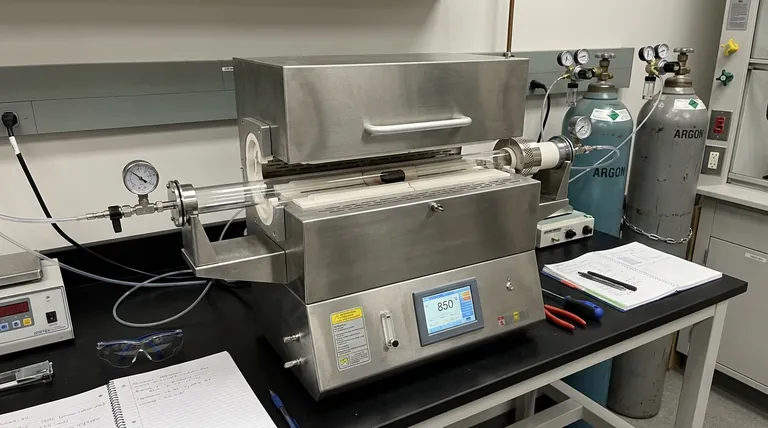
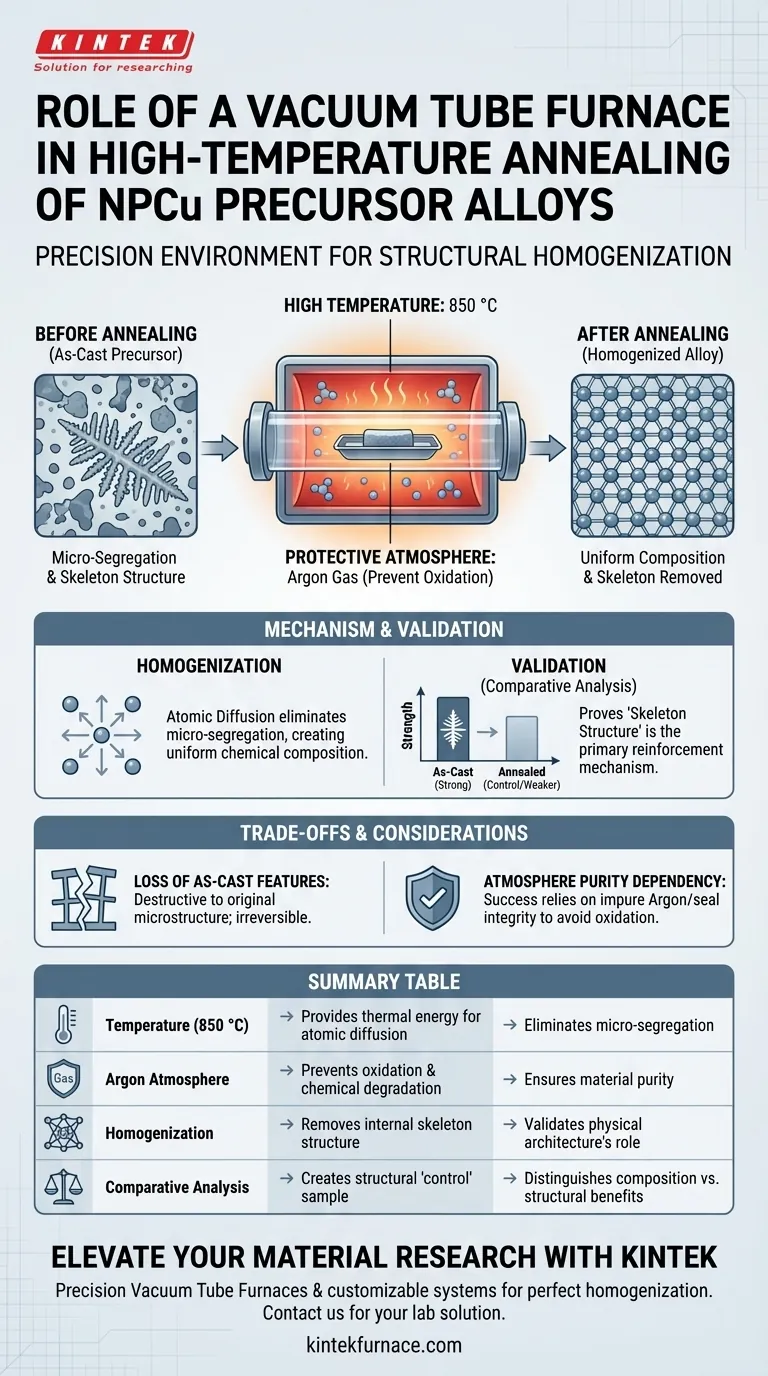
A Vacuum Tube Furnace acts as a precision environment for structural homogenization. In the processing of nanoporous copper (NPCu) precursor alloys, its primary role is to subject the material to high temperatures—specifically around 850 °C—under a protective argon atmosphere. This treatment is critical for eliminating micro-segregation that naturally occurs during the initial casting of the alloy.
By removing the solidification-induced skeleton structure through annealing, the furnace allows researchers to isolate variables. It proves that the skeleton structure, rather than just the alloy's chemical composition, is the primary mechanism responsible for the material's mechanical strength.
The Mechanism of Homogenization
Establishing the Protective Environment
To alter the internal structure of the alloy without degrading it, the Vacuum Tube Furnace creates a highly controlled setting.
The process utilizes a protective argon atmosphere to surround the sample. This inert gas prevents oxidation and other unwanted chemical reactions that would otherwise occur at high temperatures.
Eliminating Micro-Segregation
When alloys initially solidify, they often suffer from micro-segregation, where elements are unevenly distributed.
The furnace heats the precursor alloy to 850 °C, providing the thermal energy required for atoms to diffuse. This results in a uniform, homogenized material where the chemical composition is consistent throughout.
Validating Reinforcement Mechanisms
Removing the Skeleton Structure
A key objective of using the Vacuum Tube Furnace in this context is to alter the physical architecture of the alloy.
The high-temperature annealing process specifically targets and removes the solidification-induced skeleton structure. This structure is a natural byproduct of the casting process and is suspected to be a source of strength.
Enabling Comparative Analysis
Once the skeleton structure is removed via annealing, researchers can test the material's mechanical properties.
By comparing the annealed alloy (homogenized) against the original precursor (with the skeleton structure), scientists can definitively demonstrate the role of the structure. If the annealed version is weaker, it confirms that the skeleton structure is the primary reinforcement mechanism.
Understanding the Trade-offs
Loss of As-Cast Features
The annealing process is destructive to the original microstructure.
While this is intentional for creating a control group, it means the treated sample loses the unique characteristics derived from rapid solidification. You cannot revert the material to its "as-cast" state once annealed.
Dependency on Atmosphere Purity
The success of this process relies entirely on the integrity of the argon environment.
If the vacuum seal is compromised or the argon is impure, the high temperatures (850 °C) will lead to rapid oxidation rather than homogenization, ruining the sample and invalidating the comparison.
Applying This to Material Research
To effectively utilize a Vacuum Tube Furnace for NPCu precursor studies, align your process with your research objectives:
- If your primary focus is proving structural reinforcement: Anneal the precursor to remove the skeleton structure, creating a baseline "control" sample to compare against the strong, as-cast material.
- If your primary focus is alloy uniformity: Utilize the 850 °C argon environment to eliminate micro-segregation, ensuring consistent chemical properties across the sample.
This thermal treatment is the definitive step required to distinguish between strength derived from material composition and strength derived from physical structure.
Summary Table:
| Process Feature | Functional Role | Research Impact |
|---|---|---|
| Temperature (850 °C) | Provides thermal energy for atomic diffusion | Eliminates solidification-induced micro-segregation |
| Argon Atmosphere | Prevents oxidation and chemical degradation | Ensures material purity during high-heat cycles |
| Homogenization | Removes the internal skeleton structure | Validates the physical architecture's role in strength |
| Comparative Analysis | Creates a structural 'control' sample | Distinguishes composition benefits from structural benefits |
Elevate Your Material Research with KINTEK
Precision is the key to unlocking the secrets of alloy reinforcement. KINTEK provides state-of-the-art Vacuum Tube Furnaces and high-temperature systems designed to meet the rigorous demands of your laboratory research.
Backed by expert R&D and manufacturing, we offer fully customizable Muffle, Tube, Rotary, Vacuum, and CVD systems to ensure your annealing processes achieve perfect homogenization every time.
Ready to refine your thermal processing? Contact us today to find the ideal solution for your lab!
Visual Guide
References
- Haozhang Zhong, Ma Qian. Skeletal High‐Strength Nanoporous Copper and Metamaterials: The Hakka Tulou Design Heritage. DOI: 10.1002/adma.202503701
This article is also based on technical information from Kintek Furnace Knowledge Base .
Related Products
- Vacuum Hot Press Furnace Machine Heated Vacuum Press Tube Furnace
- Vacuum Sealed Continuous Working Rotary Tube Furnace Rotating Tube Furnace
- High Pressure Laboratory Vacuum Tube Furnace
- Laboratory Vacuum Tilt Rotary Tube Furnace Rotating Tube Furnace
- Magnesium Extraction and Purification Condensing Tube Furnace
People Also Ask
- Why use Vacuum Hot Press (VHP) for ZnS Ceramics? Achieve Superior IR Transparency and Mechanical Strength
- What safety features are incorporated in vacuum hot press furnaces? Ensure Operator and Equipment Protection
- What are the benefits of the vacuum environment system in a vacuum hot press furnace? Unlock High-Density Sintering
- How does the uniaxial pressure applied by a vacuum hot press furnace affect the microstructure of ZrC-SiC materials?
- How does a vacuum hot press furnace promote densification in the manufacturing of graphite flake/copper composites? Achieve Superior Composite Materials



















