
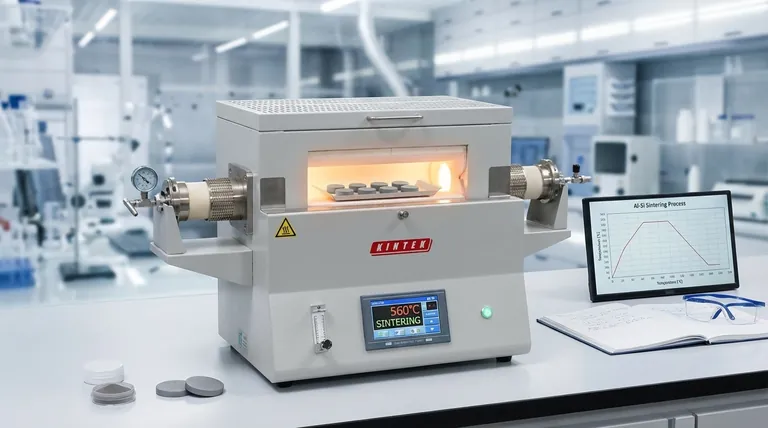
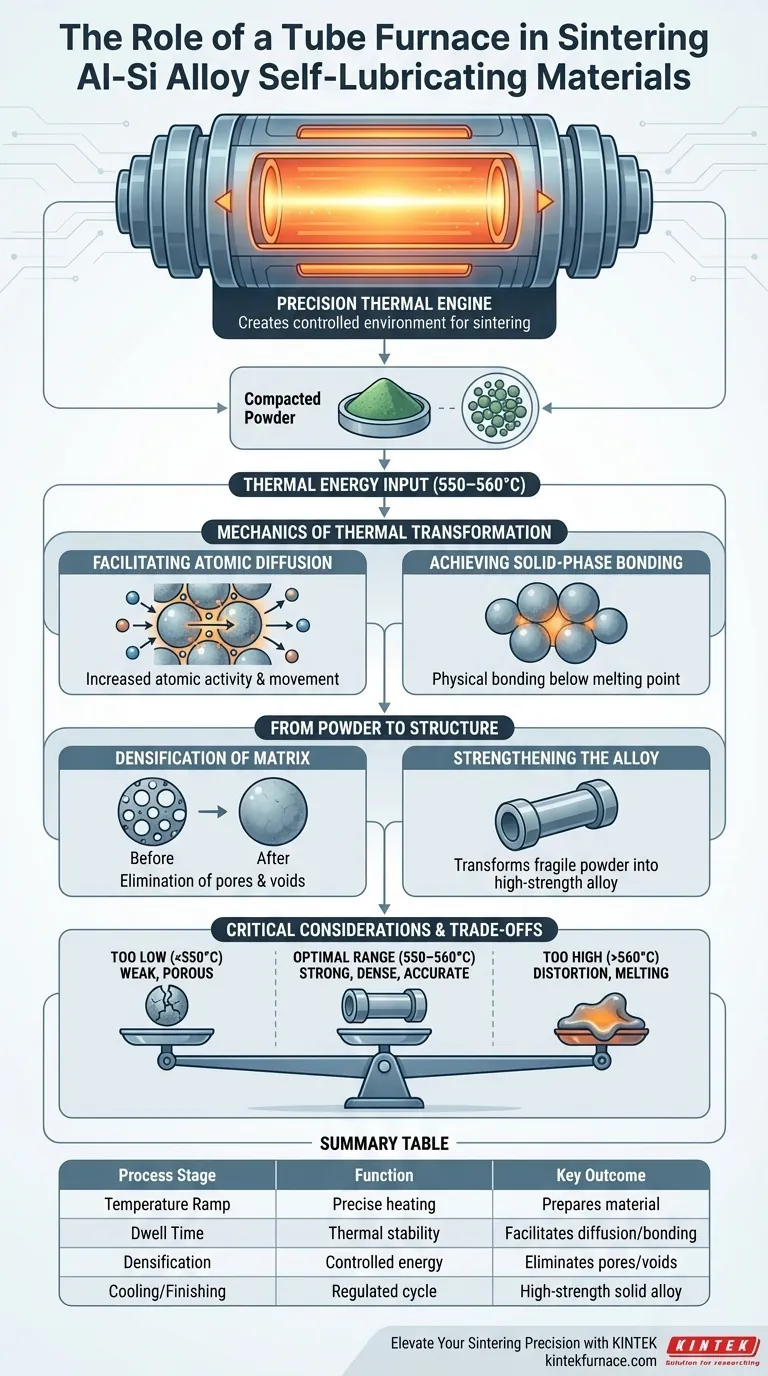
A tube furnace serves as the precision thermal engine required to sinter Al-Si alloy self-lubricating materials. Its primary function is to create a strictly controlled environment that raises the material to a specific temperature range—typically 550–560°C—to facilitate the transition from a compacted powder into a solid, functional component.
The furnace supplies the thermal energy necessary to trigger atomic diffusion and solid-phase bonding. By maintaining a set temperature for a specific duration, it transforms loose powder compacts into dense, high-strength alloy structures.
The Mechanics of Thermal Transformation
Precise Temperature Control
The fundamental role of the tube furnace is to reach and maintain the sintering point of the Al-Si alloy.
According to standard parameters, this target range is 550–560°C.
The furnace must hold this temperature with high stability to ensure the process occurs uniformly throughout the material.
Facilitating Atomic Diffusion
Sintering is not merely about heating; it is about energy transfer at the atomic level.
The thermal energy provided by the furnace increases the activity of the atoms within the metal powder.
This increased energy allows atomic diffusion to occur, where atoms move across the boundaries of the powder particles to create bonds.
Achieving Solid-Phase Bonding
Unlike casting, which involves full melting, this process relies on solid-phase bonding.
The tube furnace maintains the heat just below the melting point of the primary constituents.
This allows the particles to bond together physically without losing the component's overall shape.
From Powder to Structure
Densification of the Matrix
Before sintering, the material exists as "green" compacted particles with voids and air gaps.
The heat from the furnace drives the elimination of these pores, leading to densification.
This results in a material that is far less porous and significantly more robust than the initial powder compact.
Strengthening the Alloy
The ultimate goal of the tube furnace's cycle is structural integrity.
As the particles bond and the density increases, the mechanical properties of the alloy improve drastically.
This transforms a fragile powder form into a high-strength alloy structure capable of withstanding operational stress.
Critical Considerations and Trade-offs
The Risk of Temperature Deviation
The specific range of 550–560°C is a narrow operational window.
If the temperature is too low, atomic diffusion will be insufficient, resulting in a weak, porous part that may crumble under stress.
If the temperature is too high, you risk distorting the part or causing unwanted melting, which destroys the dimensional accuracy of the component.
Time vs. Microstructure
The duration for which the furnace maintains the temperature (dwell time) is as critical as the heat itself.
Insufficient time prevents full bonding, while excessive time can lead to "grain growth," which creates a coarse microstructure that may actually reduce the material's toughness.
Optimizing the Sintering Process
To ensure the production of a reliable self-lubricating Al-Si alloy, you must manage the thermal profile carefully.
- If your primary focus is Structural Density: Ensure the furnace maintains the upper end of the temperature range (near 560°C) to maximize pore elimination.
- If your primary focus is Dimensional Accuracy: Strictly monitor the furnace calibration to prevent exceeding the sintering point, which could cause warping.
Success depends on the furnace's ability to deliver consistent thermal energy to drive atomic bonding without compromising the material's shape.
Summary Table:
| Process Stage | Function of Tube Furnace | Key Outcome |
|---|---|---|
| Temperature Ramp | Precise heating to 550–560°C | Prepares material for atomic activity |
| Dwell Time | Maintaining thermal stability | Facilitates atomic diffusion and bonding |
| Densification | Controlled energy transfer | Eliminates pores and voids in powder compacts |
| Cooling/Finishing | Regulated thermal cycle | Results in high-strength, solid-phase alloy structure |
Elevate Your Sintering Precision with KINTEK
Maximize the structural integrity and dimensional accuracy of your Al-Si alloys with KINTEK’s industry-leading thermal solutions. Backed by expert R&D and manufacturing, KINTEK offers a comprehensive range of Tube, Muffle, Rotary, Vacuum, and CVD systems, all fully customizable to meet your unique lab and production requirements. Our high-temperature furnaces provide the stability and control necessary for critical processes like atomic diffusion and solid-phase bonding.
Ready to optimize your material performance? Contact us today to find the perfect furnace for your application.
Visual Guide
References
- Mohammed Jabbar Fouad, İbrahim İnanç. Manufacture of Self-Lubricating Mechanical Parts from Al-Si Alloy Matrix Hybrid Nanocomposites. DOI: 10.24874/ti.1752.09.24.02
This article is also based on technical information from Kintek Furnace Knowledge Base .
Related Products
- Vacuum Sealed Continuous Working Rotary Tube Furnace Rotating Tube Furnace
- 1400℃ High Temperature Laboratory Tube Furnace with Alumina Tube
- 1700℃ High Temperature Laboratory Tube Furnace with Alumina Tube
- Magnesium Extraction and Purification Condensing Tube Furnace
- High Pressure Laboratory Vacuum Tube Furnace
People Also Ask
- What is the purpose of rotary tube furnaces? Achieve Uniform Heat Treatment for Powders and Granules
- What are the key advantages of using a rotary tube furnace? Achieve Dynamic, Uniform Heating for Powders
- How does the amount of material processed vary between batch and continuous rotary tube furnaces? Scale Your Production Efficiently
- What are the advantages of rotary tube furnaces in fuel compatibility? Boost Efficiency and Cut Costs
- What is the temperature range of some rotary tube furnaces? Achieve Uniform Heating Up to 1200°C



















