
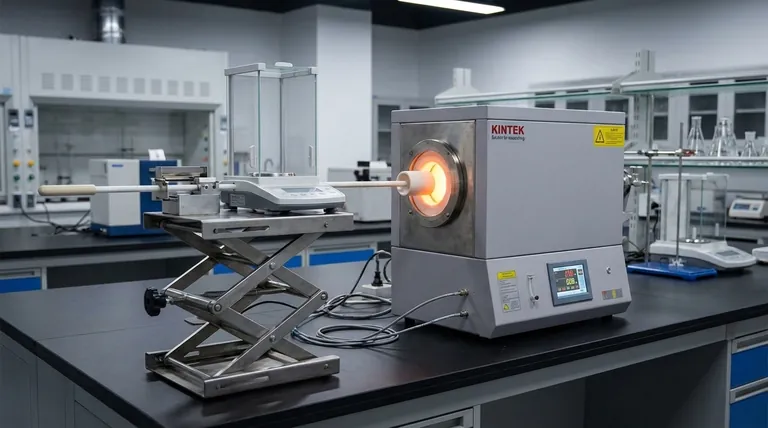
A scissor lift functions as the critical alignment foundation within a tube furnace’s thermogravimetric analysis system. It acts as an adjustable base for the weighing apparatus, providing the mechanical ability to raise or lower the entire setup with smooth, continuous motion. This mechanism allows researchers to control the precise depth of the feeding mechanism inside the furnace tube.
The scissor lift acts as the bridge between mechanical positioning and thermal precision. By enabling micro-adjustments, it ensures the sample resides exactly in the center of the constant temperature zone, which is the defining factor for generating repeatable experimental data.
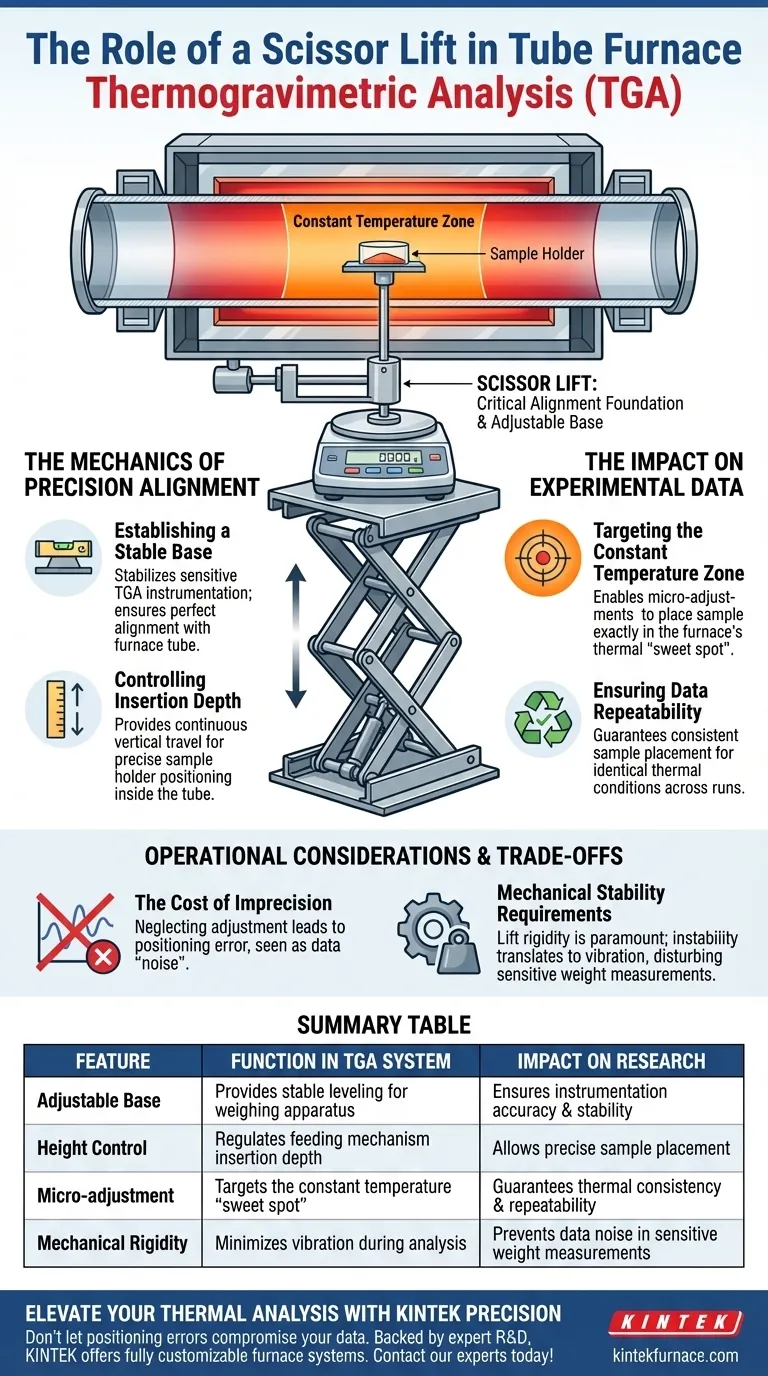
The Mechanics of Precision Alignment
Establishing a Stable Base
The primary role of the scissor lift is to serve as a leveling platform for the weighing system. It stabilizes the sensitive instrumentation required for thermogravimetric analysis, ensuring the equipment remains perfectly aligned with the furnace tube.
Controlling Insertion Depth
The lift provides the vertical travel necessary to manipulate the feeding mechanism. Through continuous, smooth height adjustments, the operator can dictate exactly how deep the sample holder penetrates the furnace.
The Impact on Experimental Data
Targeting the Constant Temperature Zone
Tube furnaces do not have uniform heat distribution across the entire length of the tube; they have a specific "sweet spot" known as the constant temperature zone. The scissor lift allows the user to physically navigate the sample into the dead center of this zone.
Ensuring Data Repeatability
In pyrolysis or combustion studies, even slight deviations in temperature can alter reaction kinetics. By using the lift to guarantee consistent sample placement, researchers ensure that the thermal conditions are identical for every run, leading to highly repeatable data.
Operational Considerations and Trade-offs
The Cost of Imprecision
While the scissor lift may seem like a passive component, neglecting its adjustment capabilities is a common source of error. Failing to utilize the micro-adjustment feature to find the thermal center often results in "noise" in the data that is actually just positioning error.
Mechanical Stability Requirements
Because the lift supports the weighing system, its own rigidity is paramount. Any instability or play in the scissor mechanism can translate into vibrations that disturb the sensitive weight measurements during the analysis.
Making the Right Choice for Your Goal
To maximize the reliability of your thermogravimetric analysis, consider how you utilize the lift's capabilities:
- If your primary focus is data repeatability: Calibrate the height of the scissor lift before every trial to ensure the sample returns to the exact same geometric coordinates within the tube.
- If your primary focus is accurate pyrolysis: Use the micro-adjustment feature to map the furnace's thermal profile, placing the sample precisely where the temperature is most stable.
By treating the scissor lift as a precision instrument rather than a simple stand, you eliminate spatial variables and ensure your results reflect true chemical behavior.
Summary Table:
| Feature | Function in TGA System | Impact on Research |
|---|---|---|
| Adjustable Base | Provides stable leveling for weighing apparatus | Ensures instrumentation accuracy and stability |
| Height Control | Regulates feeding mechanism insertion depth | Allows precise sample placement in furnace tube |
| Micro-adjustment | Targets the constant temperature "sweet spot" | Guarantees thermal consistency and repeatability |
| Mechanical Rigidity | Minimizes vibration during analysis | Prevents data noise in sensitive weight measurements |
Elevate Your Thermal Analysis with KINTEK Precision
Don't let positioning errors compromise your experimental data. At KINTEK, we understand that research excellence depends on the intersection of mechanical stability and thermal precision.
Backed by expert R&D and manufacturing, KINTEK offers Muffle, Tube, Rotary, Vacuum, and CVD systems, all of which are fully customizable to meet your unique laboratory requirements. Whether you need integrated scissor lifts for TGA or bespoke high-temperature configurations, our team is ready to deliver the perfect solution for your workflow.
Ready to achieve repeatable, high-accuracy results? Contact our experts today to discuss your custom furnace needs.
Visual Guide
References
- Beata Brzychczyk, L. J. Sikora. Modernization of a Tube Furnace as Part of Zero-Waste Practice. DOI: 10.3390/su17198940
This article is also based on technical information from Kintek Furnace Knowledge Base .
Related Products
- Slide PECVD Tube Furnace with Liquid Gasifier PECVD Machine
- Laboratory Muffle Oven Furnace with Bottom Lifting
- Vacuum Sealed Continuous Working Rotary Tube Furnace Rotating Tube Furnace
- Split Chamber CVD Tube Furnace with Vacuum Station CVD Machine
- Laboratory Vacuum Tilt Rotary Tube Furnace Rotating Tube Furnace
People Also Ask
- What are the main advantages of PECVD tube furnaces compared to CVD tube furnaces? Lower Temp, Faster Deposition, and More
- What is plasma in the context of PECVD? Unlock Low-Temperature Thin Film Deposition
- What are the typical conditions for plasma-enhanced CVD processes? Achieve Low-Temperature Thin Film Deposition
- What plasma source is used in PE-CVD tube furnaces? Unlock Low-Temperature, High-Quality Deposition
- What are the advantages of using a tube furnace CVD system for Cu(111)/graphene? Superior Scalability and Quality



















