
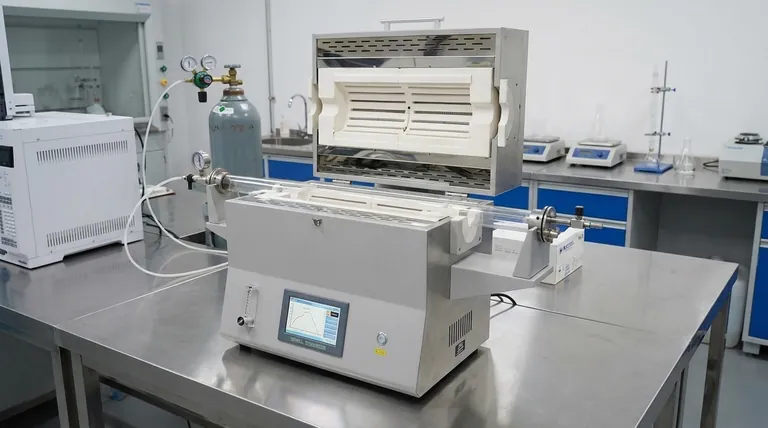
A programmable tube furnace functions as a high-precision thermal reactor designed to automate the complex remelting and isothermal treatment cycles of cast iron alloys. It executes specific heating, holding, and cooling profiles to stabilize samples within the solid-liquid two-phase region while preventing oxidation through a controlled inert atmosphere.
The core value of this equipment lies in its ability to maintain thermodynamic equilibrium, allowing for the controlled coarsening of austenite dendrites which is essential for accurate solute partitioning studies.
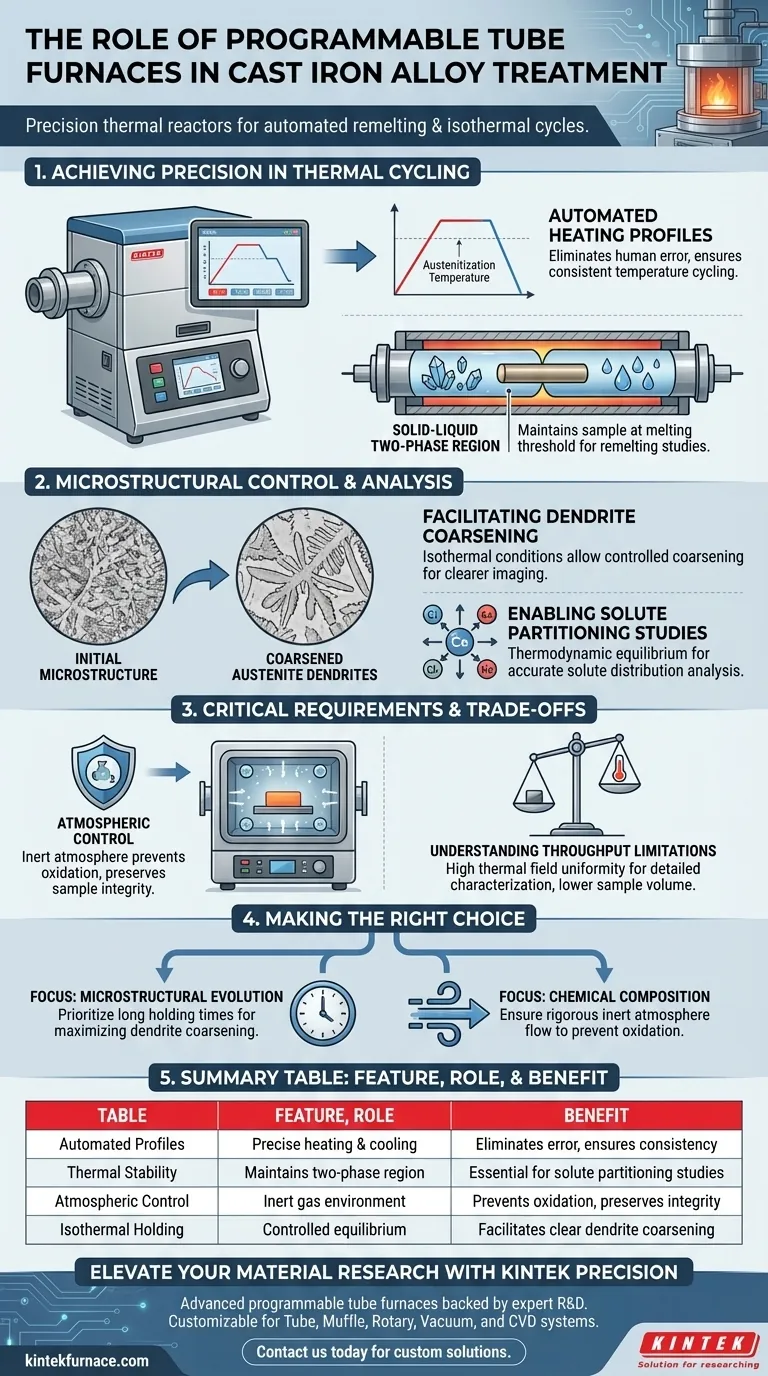
Achieving Precision in Thermal Cycling
Automated Heating Profiles
The primary function of the furnace is to remove human error from the thermal cycle.
By configuring exact heating and cooling curves, the system ensures the alloy reaches a predetermined austenitization temperature consistently every time.
Stabilizing the Two-Phase Region
For remelting studies, the alloy must be held in a state that is neither fully solid nor fully liquid.
The tube furnace maintains the sample precisely within the solid-liquid two-phase region. This stability is critical for studying how the material behaves at the threshold of melting.
Microstructural Control and Analysis
Facilitating Dendrite Coarsening
Once the thermal equilibrium is established, the microstructure begins to evolve.
The specific isothermal conditions allow austenite dendrites to coarsen over time. This controlled growth provides a larger, more distinct structure for analysis.
Enabling Solute Partitioning Studies
The ultimate goal of this thermal manipulation is often chemical characterization.
By establishing equilibrium, the furnace enables researchers to observe how different elements (solutes) distribute themselves between the solid and liquid phases.
Critical Requirements and Trade-offs
The Necessity of Atmospheric Control
Temperature control alone is insufficient for cast iron alloys.
The furnace must provide an inert atmosphere to prevent the sample from oxidizing during the high-temperature hold. Without this protective environment, surface degradation would compromise the solute analysis.
Understanding Throughput Limitations
While programmable tube furnaces offer high precision, they generally process small sample volumes.
This limitation is a trade-off for the exceptional uniformity of the thermal field. It is an instrument designed for detailed characterization rather than bulk processing.
Making the Right Choice for Your Goal
To maximize the utility of a programmable tube furnace for cast iron analysis, align your settings with your specific research objectives:
- If your primary focus is Microstructural Evolution: Prioritize long holding times within the two-phase region to maximize the coarsening of austenite dendrites for clearer imaging.
- If your primary focus is Chemical Composition: Ensure the inert atmosphere flow is rigorously maintained to prevent oxidation from skewing solute partitioning data.
Precision in the furnace settings directly correlates to the reliability of your thermodynamic data.
Summary Table:
| Feature | Role in Cast Iron Treatment | Benefit to Researcher |
|---|---|---|
| Automated Profiles | Precise heating & cooling curves | Eliminates human error & ensures consistency |
| Thermal Stability | Maintains solid-liquid two-phase region | Essential for accurate solute partitioning studies |
| Atmospheric Control | Inert gas environment | Prevents oxidation and preserves sample integrity |
| Isothermal Holding | Controlled thermodynamic equilibrium | Facilitates clear austenite dendrite coarsening |
Elevate Your Material Research with KINTEK Precision
Unlock the full potential of your alloy studies with KINTEK’s advanced programmable tube furnaces. Backed by expert R&D and world-class manufacturing, we provide high-precision thermal systems—including Tube, Muffle, Rotary, Vacuum, and CVD systems—specifically engineered to meet the rigorous demands of cast iron remelting and isothermal treatment.
Whether you need custom dimensions or specific atmospheric controls, our systems are fully customizable to suit your unique laboratory needs.
Ready to achieve superior microstructural control? Contact us today to consult with our specialists and find the perfect furnace solution for your research.
Visual Guide
References
- Ricardo Queirós, Attila Diószegi. Assessing Pore Formation due to Nitrogen Partitioning in a Hypoeutectic Cast Iron. DOI: 10.1007/s40962-024-01521-3
This article is also based on technical information from Kintek Furnace Knowledge Base .
Related Products
- Custom Made Versatile CVD Tube Furnace Chemical Vapor Deposition CVD Equipment Machine
- Vacuum Sealed Continuous Working Rotary Tube Furnace Rotating Tube Furnace
- Split Multi Heating Zone Rotary Tube Furnace Rotating Tube Furnace
- Multi Heating Zones CVD Tube Furnace Machine for Chemical Vapor Deposition Equipment
- Split Chamber CVD Tube Furnace with Vacuum Station CVD Machine
People Also Ask
- What is a CVD tube furnace and what is its primary function? Discover Precision Thin-Film Deposition
- Why are CVD tube furnace sintering systems indispensable for 2D material research and production? Unlock Atomic-Scale Precision
- How does CVD tube furnace sintering enhance graphene growth? Achieve Superior Crystallinity and High Electron Mobility
- Which industries and research fields benefit from CVD tube furnace sintering systems for 2D materials? Unlock Next-Gen Tech Innovations
- What is the working principle of a CVD tube furnace? Achieve Precise Thin Film Deposition for Your Lab



















