
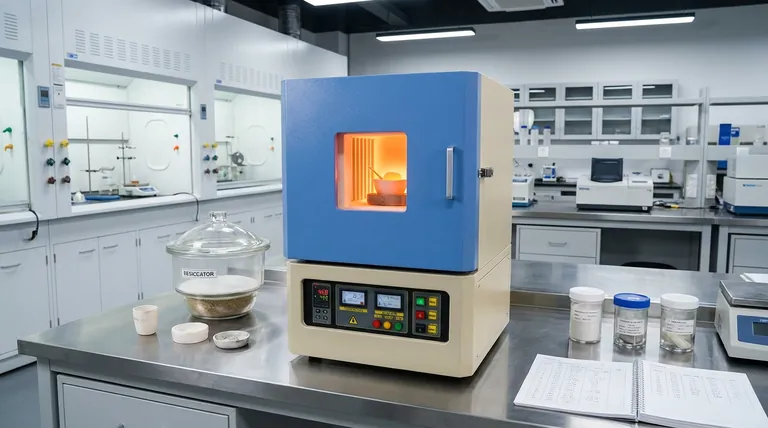
A high-temperature muffle furnace serves as the primary vessel for calcination, facilitating the essential phase transformation of raw precursors into functional ZnO/CuO nanocomposites. Specifically, it drives the thermal decomposition of hydroxide or carbonate precipitates in an air atmosphere, typically at temperatures around 450°C, to yield stable, highly crystalline metal oxides.
Core Takeaway The muffle furnace is not merely a heating element; it provides the oxidative environment necessary to dehydrate precursors and crystallize the material. This process optimizes the interfacial bonding between Zinc Oxide and Copper Oxide, creating the heterojunctions required for superior electrocatalytic activity.
The Mechanism of Transformation
Thermal Decomposition
The preparation of ZnO/CuO nanocomposites begins with precursor materials, often in the form of hydroxides or carbonates. The muffle furnace applies consistent heat to break these chemical bonds.
Complete Dehydration
As the furnace reaches temperatures such as 450°C, it ensures the total removal of water molecules and organic residues. This dehydration is the first step in converting the wet precipitate into a dry, solid-state material.
Oxidative Atmosphere
Unlike tube furnaces designed for inert or reducing gases, a muffle furnace typically operates in an air atmosphere. This oxygen-rich environment is critical for ensuring the precursors fully oxidize into their respective metal oxide phases (ZnO and CuO).
Structural Optimization and Performance
Achieving High Crystallinity
Heat treatment in a muffle furnace converts amorphous or semi-crystalline precursors into a highly ordered crystalline structure. High crystallinity is directly correlated with the stability and electronic properties of the final nanocomposite.
Forming Heterojunctions
The most critical role of the furnace is promoting interfacial bonding. By calcining the ZnO and CuO components together, the furnace energy forces the two oxides to form tight junctions.
Enhancing Electrocatalytic Activity
These junctions, known as heterojunctions, facilitate electron transfer between the two different oxides. This structural synergy is what ultimately boosts the material's performance in electrocatalytic applications.
Understanding the Trade-offs
Atmosphere Limitations
A standard muffle furnace is designed for heating in air. It is the ideal tool for oxidation reactions, such as forming ZnO and CuO. However, it is ill-suited for processes requiring reduction or inert environments.
Precision vs. Volume
While muffle furnaces are excellent for batch calcination of oxides, they generally lack the precise gas flow control of a tube furnace. If your synthesis requires a specific reducing atmosphere (e.g., hydrogen-argon mixtures) or carbonization in nitrogen, a muffle furnace cannot provide the necessary environmental control.
Making the Right Choice for Your Goal
To select the correct thermal treatment equipment, you must define the chemical pathway of your synthesis.
- If your primary focus is synthesizing pure metal oxides (ZnO/CuO): Use a muffle furnace to ensure complete oxidation, dehydration, and the formation of strong heterojunctions in an air atmosphere.
- If your primary focus is reduction or carbonization: Choose a tube furnace, as it allows for the precise control of inert or reducing gas mixtures necessary to prevent oxidation.
By utilizing the muffle furnace specifically for its oxidative capabilities, you ensure the successful phase transition and structural integrity of your ZnO/CuO nanocomposites.
Summary Table:
| Process Phase | Function of Muffle Furnace | Impact on Nanocomposite |
|---|---|---|
| Decomposition | Thermal breakdown of precursors | Converts hydroxides/carbonates into oxides |
| Dehydration | Total removal of water/organics | Ensures high purity and solid-state stability |
| Oxidation | Air-rich heating environment | Guarantees complete ZnO and CuO phase formation |
| Crystallization | High-temperature structural ordering | Enhances electronic properties and stability |
| Interface Bonding | Thermal energy for heterojunctions | Boosts electrocatalytic activity via electron transfer |
Elevate Your Material Synthesis with KINTEK
Achieve the precise thermal environments required for high-performance ZnO/CuO nanocomposites with KINTEK’s advanced heating solutions. Backed by expert R&D and manufacturing, KINTEK offers a comprehensive range of Muffle, Tube, Rotary, Vacuum, and CVD systems, all fully customizable to meet your unique lab requirements.
Whether you need the oxidative power of a muffle furnace for metal oxides or the inert atmosphere of a tube furnace for carbonization, our systems provide the temperature uniformity and durability your research demands.
Ready to optimize your calcination process? Contact us today to find the perfect furnace for your application!
References
- Facile Fabrication of a Nanocomposite Electrode for Enhanced Electrochemical Performance. DOI: 10.21203/rs.3.rs-7148554/v1
This article is also based on technical information from Kintek Furnace Knowledge Base .
Related Products
- 1700℃ High Temperature Muffle Oven Furnace for Laboratory
- 1800℃ High Temperature Muffle Oven Furnace for Laboratory
- 1400℃ Muffle Oven Furnace for Laboratory
- 1200℃ Muffle Oven Furnace for Laboratory
- High Temperature Muffle Oven Furnace for Laboratory Debinding and Pre Sintering
People Also Ask
- What is the primary function of a high-temperature laboratory muffle furnace in chemical synthesis? Achieve Precision.
- How does a high-temperature laboratory muffle furnace affect material properties? Transform Anodic Oxide Films Fast
- What role does a muffle furnace play in BCZY712 electrolyte powder production? Achieve Perfect Phase Purity
- How does the two-stage sintering process contribute to the synthesis of MeCuFeO3 perovskite? Optimize crystal purity.
- How does a muffle furnace impact Ni/MgAl2O4 catalysts? Optimize Stability and Catalytic Performance



















