
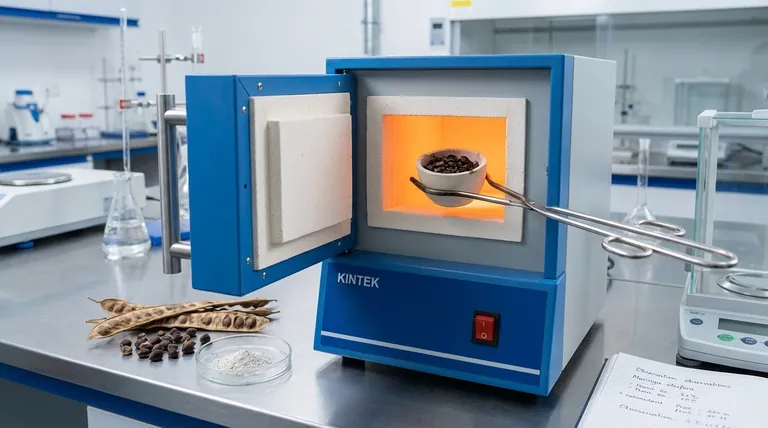
In the component analysis of Moringa oleifera seeds, the high-temperature muffle furnace serves a single, critical function: ash determination. By maintaining a constant, intense temperature of 600°C, the furnace completely incinerates organic material to isolate the seed's inorganic mineral components. This process is essential for quantifying the total mineral content, which standardized studies measure at approximately 3.25%.
The muffle furnace acts as a precision elimination tool, utilizing controlled thermal environments to strip away organic variables. This reveals the true inorganic baseline of the seed, a fundamental step for verifying nutritional density and purity.
The Mechanism of Separation
Controlled Incineration
The primary role of the muffle furnace is to subject the Moringa seed samples to a dry ashing process. Unlike open-flame combustion, the furnace provides a stable, enclosed thermal environment.
Thermal Decomposition
At a sustained temperature of 600°C, the furnace ensures the thorough oxidation and combustion of all organic matter (carbon-based components). This includes fats, proteins, and carbohydrates, which are converted into gases and removed from the sample.
Isolation of Inorganic Residue
Once the organic matter is eliminated, only the inorganic mineral residue remains. This residue, commonly referred to as "ash," represents the total mineral content of the seed, unadulterated by organic biomass.
Analytical Significance
Quantitative Evaluation
The immediate output of this process is a weight-based measurement. By comparing the weight of the pre-fired sample to the remaining ash, analysts can calculate the precise percentage of mineral content.
Benchmarking Nutritional Value
For Moringa oleifera seeds, this value is a critical quality indicator. Standardized studies utilize the muffle furnace to verify that the mineral content aligns with the expected benchmark of 3.25%.
Pre-requisite for Trace Analysis
While the muffle furnace provides the total mineral weight, it also prepares the sample for further investigation. The resulting ash is the pure substrate required to identify specific trace elements during subsequent chemical analyses.
Understanding the Trade-offs
Temperature Precision vs. Volatility
While 600°C is the standard for Moringa, deviating from this setting presents risks. If the temperature exceeds this limit, volatile minerals may vaporize, leading to artificially low results.
Incomplete Oxidation
Conversely, if the temperature fluctuates below the target or the duration is insufficient, organic carbon may remain in the ash (often visible as black specks). This results in an overestimation of mineral content and compromises data accuracy.
Making the Right Choice for Your Goal
To ensure accurate component analysis of Moringa oleifera seeds, apply the furnace capabilities as follows:
- If your primary focus is nutritional benchmarking: Ensure your furnace calibration holds exactly 600°C to validate the sample against the 3.25% standard.
- If your primary focus is further chemical profiling: Use the furnace solely as a preparation tool to produce clean, carbon-free ash for subsequent trace element testing.
Precision in the furnace ensures truth in the analysis.
Summary Table:
| Process Step | Temperature | Primary Function | Key Outcome |
|---|---|---|---|
| Dry Ashing | 600°C | Controlled incineration of organic matter | Complete oxidation of fats, proteins, and carbs |
| Mineral Isolation | 600°C (Stable) | Separation of inorganic residue | Pure ash substrate for nutritional benchmarking |
| Quantitative Analysis | N/A | Weight-based comparison | Verification of the 3.25% mineral content standard |
| Trace Preparation | N/A | Carbon-free sample preparation | Clean substrate for detailed chemical profiling |
Optimize Your Nutritional Analysis with KINTEK
Precision is the foundation of scientific truth. Whether you are benchmarking nutritional density or performing complex trace element profiling on samples like Moringa oleifera, KINTEK provides the high-performance thermal solutions you need.
Backed by expert R&D and world-class manufacturing, we offer a comprehensive range of Muffle, Tube, Rotary, Vacuum, and CVD systems. Our lab high-temperature furnaces are fully customizable to meet your unique research requirements, ensuring stable temperatures and repeatable results.
Ready to elevate your lab's accuracy? Contact our specialists today to find the perfect furnace for your specific application.
References
- Soudad Abdel Moneim. EFFECT OF MORINGA (MORINGA OLEIFERA LAM.) SEED OIL EXTRACTION METHODS ON ITS PHYSICOCHEMICAL PROPERTIES. DOI: 10.54910/sabrao2024.56.5.37
This article is also based on technical information from Kintek Furnace Knowledge Base .
Related Products
- 1700℃ High Temperature Muffle Oven Furnace for Laboratory
- 1800℃ High Temperature Muffle Oven Furnace for Laboratory
- 1200℃ Muffle Oven Furnace for Laboratory
- 1400℃ Muffle Oven Furnace for Laboratory
- High Temperature Muffle Oven Furnace for Laboratory Debinding and Pre Sintering
People Also Ask
- What is the primary function of a high-temperature laboratory muffle furnace in chemical synthesis? Achieve Precision.
- How does a high-temperature laboratory muffle furnace affect material properties? Transform Anodic Oxide Films Fast
- What role does a muffle furnace play in BCZY712 electrolyte powder production? Achieve Perfect Phase Purity
- How does the two-stage sintering process contribute to the synthesis of MeCuFeO3 perovskite? Optimize crystal purity.
- What is the role of a high-temperature muffle furnace in guava leaf carbonization? Master Precise Pyrolysis Control



















