
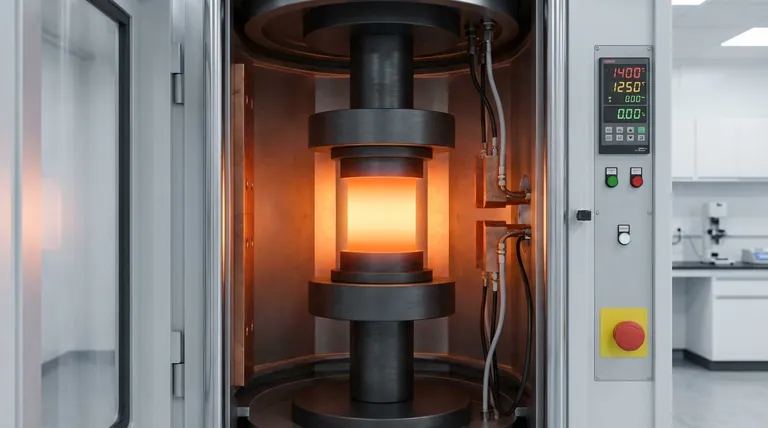
A high-purity graphite mold acts as a multifunctional reactor vessel that serves as the container, heating element, and pressure applicator simultaneously. In the Spark Plasma Sintering (SPS) of TiB2-SiC ceramics, it converts high-frequency pulsed current into intense thermal energy while transmitting massive mechanical force to densify the powder.
Core Takeaway The graphite mold is not a passive container; it is the active "engine" of the SPS process. By functioning simultaneously as an electrical resistor and a hydraulic piston, it creates the specific environment—temperatures exceeding 2000°C combined with high axial pressure—required to drive particle rearrangement and achieve near-theoretical density in refractory ceramics.
The Dual Role of Thermal and Electrical Conduction
Converting Current to Heat
In an SPS system, the graphite mold is the primary resistance heating element. High-frequency pulsed electric current flows directly through the conductive graphite.
Generating Joule Heat
Because graphite offers resistance to this electrical flow, it generates "Joule heat" within the mold walls itself. This thermal energy is immediately and directly conducted to the TiB2-SiC sample inside, allowing for extremely rapid heating rates that conventional sintering cannot match.
Withstanding Extreme Temperatures
TiB2-SiC ceramics require intense heat to sinter properly. The high-purity graphite mold is essential because it maintains structural integrity at temperatures exceeding 2000°C, a range where metal molds would melt or deform.
Mechanical Pressure and Densification
Transmitting Axial Force
While the mold heats the sample, it also serves as a mechanical transmission component. It endures thousands of Newtons of force from the system's hydraulic rams.
Acting as a Piston
The mold plunges act effectively as pistons, transferring this axial pressure (often up to or exceeding 30 MPa) directly into the ceramic powder.
Driving Particle Rearrangement
This mechanical pressure is critical for densification. It forces the powder particles to rearrange physically and helps overcome diffusion barriers, allowing the ceramic to reach full density at temperatures lower than would be required with heat alone.
Operational Trade-offs and Considerations
The Risk of Adhesion
At extreme temperatures, the ceramic sample can bond or stick to the graphite mold walls. To prevent this chemical interaction and ensure easy demolding, a layer of graphite paper is typically inserted between the powder and the mold.
Oxidation Sensitivity
While graphite is thermally robust, it oxidizes and degrades rapidly in air at high temperatures. Therefore, the SPS process must occur within a vacuum or an inert gas atmosphere to protect the structural integrity of the mold.
Making the Right Choice for Your Goal
To maximize the effectiveness of graphite tooling in your SPS process, consider these priorities:
- If your primary focus is Maximum Density: Ensure the mold design has sufficient wall thickness to withstand the maximum axial pressure (30+ MPa) without fracture during the hold time.
- If your primary focus is Sample Purity: Utilize high-quality graphite paper barriers to prevent carbon diffusion from the mold into the TiB2-SiC matrix.
The success of your sintering run depends entirely on the graphite mold's ability to maintain uniform pressure and conductivity under extreme thermal stress.
Summary Table:
| Function | Description | Key Benefit in SPS |
|---|---|---|
| Heating Element | Converts pulsed current into Joule heat via electrical resistance. | Enables rapid heating rates and temperatures >2000°C. |
| Pressure Applicator | Transmits hydraulic axial force (up to 30+ MPa) to the powder. | Drives particle rearrangement and lowers sintering temperature. |
| Reaction Vessel | High-purity structural container for refractory materials. | Maintains integrity under extreme thermal and mechanical stress. |
| Purity Barrier | Utilizes graphite paper to prevent chemical bonding/sticking. | Ensures clean demolding and prevents carbon contamination. |
Optimize Your Advanced Ceramics Sintering with KINTEK
Precision in SPS processing starts with the right equipment and tooling. Backed by expert R&D and manufacturing, KINTEK offers a comprehensive range of Muffle, Tube, Rotary, Vacuum, and CVD systems, all fully customizable to meet your unique laboratory and production needs. Whether you are sintering TiB2-SiC composites or developing next-generation refractories, our high-temperature solutions ensure uniform heating and reliable performance.
Ready to achieve superior material density? Contact KINTEK today to discuss your custom furnace requirements!
References
- German Alberto Barragán De Los Rios, Patricia Fernández‐Morales. Numerical Simulation of Aluminum Foams by Space Holder Infiltration. DOI: 10.1007/s40962-024-01287-8
This article is also based on technical information from Kintek Furnace Knowledge Base .
Related Products
- Spark Plasma Sintering SPS Furnace
- 2200 ℃ Graphite Vacuum Heat Treat Furnace
- Vacuum Heat Treat Sintering Furnace Molybdenum Wire Vacuum Sintering Furnace
People Also Ask
- Why is it necessary to maintain a high vacuum environment during the SPS of SiC? Key to High-Density Ceramics
- How does the heating mechanism of Spark Plasma Sintering (SPS) function? Enhance TiC/SiC Composite Fabrication
- What are the technical advantages of using an SPS sintering furnace? Elevate Al2O3-TiC Material Performance
- What are the steps in the discharge plasma sintering process? Master Fast, High-Density Material Consolidation
- What are the advantages of spark plasma sintering (SPS) over traditional forging? Precision Microstructural Control


