
High-temperature heating systems with precise control serve as the foundational mechanism for ensuring material fluidity during the aluminum melt infiltration process. By capable of generating temperatures up to 1350 °C and stabilizing the melt around 700 °C, these systems guarantee the low viscosity necessary for the metal to penetrate complex preform structures.
The core function of these systems is to achieve thermal equilibrium and low viscosity before infiltration begins. Without this precise thermal state, the molten aluminum cannot effectively fill fine gaps, compromising the density and structural integrity of the final aluminum foam.
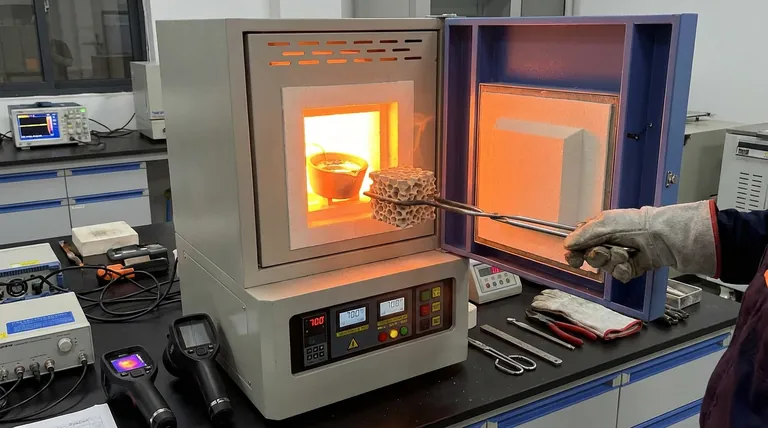
Optimizing Melt Properties
Managing Viscosity and Fluidity
The primary barrier to effective infiltration is the natural resistance of the molten metal to flow. To overcome this, heating systems must maintain the aluminum melt at approximately 700 °C.
At this temperature, the aluminum exhibits excellent fluidity and low viscosity. This state is essential for the metal to move freely without premature solidification or flow stagnation.
Achieving Thermal Equilibrium
It is not enough to simply reach a peak temperature; the system must stabilize the melt. Precise temperature control designs ensure the aluminum is fully liquefied and reaches thermal equilibrium.
This stabilization prevents thermal gradients within the melt. A uniform temperature profile ensures that the material properties remain consistent throughout the entire infiltration volume.
Facilitating Structural Infiltration
Enabling Micro-Gap Penetration
The goal of the infiltration process is to create a dense aluminum foam with high porosity. This requires the metal to fill fine gaps and cracks within the preform material.
By maintaining low viscosity, the heating system allows the molten aluminum to navigate these microscopic geometries. When the metal is sufficiently fluid, it prevents the formation of voids that would weaken the final structure.
Synergy with High-Gravity Fields
These heating systems do not operate in isolation. They function in tandem with the driving force of a high-gravity field.
While the high-gravity field provides the mechanical pressure to push the metal, the heating system ensures the metal is compliant enough to be pushed. This combination results in rapid and complete filling of the preform.
Critical Operational Factors
The Necessity of Precision
The window for effective infiltration is narrow. As indicated by supplementary data on melting furnaces, maintaining a melt within a tight range (e.g., 720±20 °C) is often required to establish the correct thermophysical state.
If the temperature drops too low, viscosity increases, and the metal will fail to infiltrate small cracks. Conversely, uncontrolled high temperatures can lead to unnecessary energy expenditure or material degradation.
Equipment Capability vs. Operational Needs
While systems may be rated for temperatures as high as 1350 °C, the operational "sweet spot" for infiltration is often significantly lower (around 700 °C).
The system's ability to reach high extremes is less about the infiltration temperature itself and more about the capacity to rapidly heat the charge and maintain stability against thermal losses during the process.
Making the Right Choice for Your Process
To maximize the quality of aluminum foam production, your heating strategy must align with your specific structural goals.
- If your primary focus is Complex Geometry: Prioritize systems with tight thermal stabilization to ensure the viscosity remains low enough to fill microscopic cracks without clogging.
- If your primary focus is Material Density: Ensure your heating capacity is paired with a high-gravity field mechanism, as heat alone cannot force the metal into the densest parts of the preform.
The most effective infiltration processes view temperature control not just as a heating method, but as a viscosity management tool.
Summary Table:
| Process Factor | Role of Heating System | Impact on Final Product |
|---|---|---|
| Viscosity Control | Maintains melt at ~700 °C for low resistance | Prevents voids; ensures fine gap penetration |
| Thermal Equilibrium | Eliminates temperature gradients within the melt | Consistent material properties and density |
| Fluidity Optimization | Stabilizes thermal state before infiltration | Enables rapid filling of complex preforms |
| Equipment Capacity | High-extremity (up to 1350 °C) heating power | Rapid heating and stability against thermal loss |
Elevate Your Material Infiltration with KINTEK Precision
Maximize the density and structural integrity of your aluminum foams with heating solutions designed for ultimate precision. KINTEK provides industry-leading Muffle, Tube, Rotary, Vacuum, and CVD systems, all engineered to deliver the precise thermal equilibrium and viscosity management your infiltration process demands.
Backed by expert R&D and manufacturing, our systems are fully customizable to meet your unique lab high-temp furnace needs. Don't let thermal instability compromise your material quality—Contact our experts today to find the perfect thermal solution for your complex preform challenges!
References
- Yuan Li, Zhancheng Guo. Preparation and Compression Behavior of High Porosity, Microporous Open-Cell Al Foam Using Supergravity Infiltration Method. DOI: 10.3390/ma17020337
This article is also based on technical information from Kintek Furnace Knowledge Base .
Related Products
- 1700℃ High Temperature Laboratory Tube Furnace with Alumina Tube
- 1400℃ High Temperature Laboratory Tube Furnace with Alumina Tube
- 1200℃ Muffle Oven Furnace for Laboratory
- Vacuum Induction Melting Furnace
- High Temperature Muffle Oven Furnace for Laboratory Debinding and Pre Sintering
People Also Ask
- How does zone-melting in tube furnaces synthesize bismuth micro-wires? Master Single-Crystal Thermoelectric Growth
- How are high-temp tube furnaces used to measure diffusion coefficients per Fick's law? Master Precision Annealing
- How do high-temperature laboratory tube furnaces ensure environmental stability? Precision Thermal Reduction Tips
- How are high-temperature laboratory tube furnaces applied in long-term vacuum homogenization heat treatments for intermetallic samples?
- How are high-temperature tube furnaces applied in testing ceramic-supported alloy membranes? Insights



















