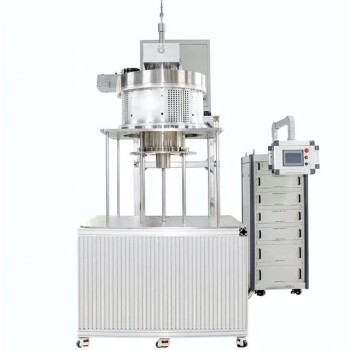
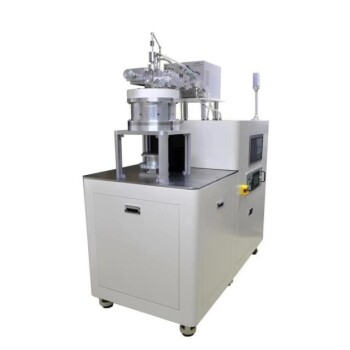
For consolidating alloy powders, Spark Plasma Sintering (SPS) delivers a step‑change in processing efficiency.
SPS dramatically outpaces conventional hot pressing by reducing the required sintering temperature by approximately 200°C, achieving full densification in under 30 minutes instead of hours, and preserving the fine, as‑synthesised microstructure without grain coarsening. The pulsed direct current generates instantaneous internal heat directly at the powder contact points, enabling rapid plastic deformation of phases like aluminium‑rich β‑NiAl and locking in stable, high‑performance microstructures.
The true power of SPS lies in its ability to bypass the classic trade‑off between density and grain size. By using pulsed DC to deliver instant Joule heating, SPS consolidates alloy powders at lower temperatures and in drastically shorter cycles than hot pressing – capturing strength‑critical microstructures that would otherwise be lost.
The Core Process Advantages: Speed, Temperature, and Microstructure Control
Ultra‑Fast Consolidation via Internal Joule Heating
Conventional hot pressing relies on external resistance elements to heat the entire furnace chamber, a slow process that forces the powder compact to endure prolonged high‑temperature exposure.
SPS inverts this dynamic by passing a pulsed direct current (thousands of amperes at a few volts) directly through the graphite die and the powder itself.
The powder particles become their own heating elements.
The current concentrates at the particle contacts, where electrical resistance is highest, creating intense, localized heat and plasma discharge.
This internal Joule heating mechanism enables heating rates of several hundred °C/min – far beyond what an external furnace can achieve.
The result is sintering that completes in just a few minutes, often under 15 minutes, rather than an hour or more.
For a CoCrFeMnNi high‑entropy alloy, this translates to near‑theoretical density with a holding time that never lets diffusion‑driven coarsening get started.
Lower Sintering Temperatures Preserve Critical Alloy Phases
The combination of pulsed current and simultaneous uniaxial pressure effectively lowers the energy barrier for densification.
The localized joule heating at asperities and the electromigration effects accelerate mass transport, meaning full densification can be achieved at significantly lower set‑point temperatures.
For MCrAlY‑type alloys, SPS reaches full density between 1173 K and 1273 K, while conventional hot pressing typically demands around 1473 K.
This ~200 K reduction keeps the material safely below the γ′ solvus temperature (~1140 °C), preventing the dissolution of strengthening phases.
Maintaining a stable blend of β‑NiAl and γ‑Ni phases is critical for high‑temperature oxidation and creep resistance.
Because SPS consolidates below the threshold where these phases dissolve or coarsen, the final component retains its designed phase architecture straight out of the die – no post‑sintering heat treatment is required.
Suppression of Grain Coarsening for Superior Mechanical Properties
Grain growth is a thermally activated process; every extra minute at high temperature allows boundaries to migrate and merge.
Conventional hot pressing’s long cycle inevitably coarsens the microstructure, softening the material. SPS short‑circuits this problem through extreme time compression.
The entire thermal cycle – heating, holding, and cooling – is over in less than 30 minutes.
For mechanically alloyed nanocrystalline powders, this rapid processing locks in the ultrafine grains achieved during milling. As a result, hardness and strength values remain close to the as‑milled state, even at near‑full density.
In aluminium‑rich β‑phase containing alloys, the localized current density encourages plastic deformation at particle contacts, closing pores by grain‑boundary sliding rather than bulk diffusion.
This “athermal” contribution further decouples densification from grain growth, enabling high density without sacrificing the fine grain size that drives strength.
The Underlying Mechanism: Why SPS Behaves Differently
Pulsed Current and Localized Overheating
The pulsed DC waveform does more than just heat.
Each pulse creates a momentary plasma discharge between particles, cleaning surface oxides and activating surfaces for bonding. This eliminates the need for chemical sintering aids or a preliminary cold compaction step.
The current is not uniform across the powder bed.
It concentrates at the narrowest constrictions – the particle‑particle contacts – creating microscopic hot spots while the bulk of the particle remains cooler. This gradient‑driven mass transport accelerates neck formation without raising the average temperature high enough to incite grain growth.
Pressure‑Assisted Densification Without Additives
SPS simultaneously applies high uniaxial pressure (often 40 MPa or more), enhancing particle rearrangement and plastic flow.
The pressure works synergistically with the current, allowing densification to proceed by grain‑boundary sliding and dislocation motion rather than lattice diffusion alone.
Because the entire process occurs inside a sealed graphite die, the atmosphere can be tightly controlled or a vacuum maintained.
No preliminary cold compaction, binders, or sintering additives are necessary, which preserves the chemical purity of the alloy and avoids contamination‑induced phase changes.
Understanding the Trade‑offs and Limitations
Sample Size and Geometry Constraints
The direct‑current heating path requires a conductive graphite die and punch set, which imposes strict limitations on component size and shape.
Typical SPS systems produce discs or simple cylindrical parts with diameters limited to a few tens of centimeters. Producing large, complex‑shaped structural components is not yet practical.
Scaling up to bigger parts introduces challenges in maintaining uniform current density and pressure distribution, often leading to density gradients.
For certain applications, a large‑scale hot isostatic press (HIP) or conventional hot press remains the only viable option.
Capital Cost and Throughput
An SPS system represents a significant capital investment, often substantially higher than a conventional hot press of comparable load capacity.
Additionally, the cycle‑by‑cycle, batch‑style operation limits throughput. While each cycle is fast, the number of parts per hour may be lower than a continuously operating furnace line.
For high‑volume production of standard alloys that do not require ultra‑fine microstructures, the economic case often still favours traditional hot pressing or sintering‑HIP routes.
SPS’s value is greatest where performance per part – not cost per part – is the deciding factor.
Potential Thermal Gradients
The rapid heating rates can create thermal gradients across the sample, especially in thicker sections.
If the die design and pulse parameters are not carefully optimised, the core may lag behind the surface temperature, resulting in inhomogeneous densification or residual stress. Process development and pyrometric control are essential to mitigate this risk.
Making the Right Choice for Your Consolidation Goal
The decision between SPS and conventional hot pressing should be driven by your specific performance targets and production realities. Use the following goals to guide your choice.
- If your primary focus is retaining nanocrystalline or ultra‑fine grain microstructures: SPS is the definitive path. Its rapid cycle locks in the high strength and hardness of the as‑milled powder, something a slow hot press cycle cannot replicate.
- If your primary focus is producing large, complex‑shaped components from standard alloy powders: Conventional hot pressing or HIP typically offers better scalability and lower tooling constraints, despite slower cycles and higher sintering temperatures.
- If your primary focus is processing temperature‑sensitive alloys that would lose critical phases at normal sintering temperatures: SPS’s ability to consolidate at temperatures ~200 °C lower is a unique advantage, preserving β‑NiAl, γ‑Ni, and other metastable phases without post‑processing.
- If your primary focus is rapid prototyping or small‑batch production of advanced metallic and ceramic composites: The single‑step, additive‑free nature of SPS drastically reduces development time and enables high‑density parts with minimal process optimisation.
SPS is not a universal replacement for hot pressing; it is a precision tool. Where it excels, it does so by fundamentally changing the rules of the sintering game – delivering full density at a fraction of the time and temperature, and preserving the microstructural features that give next‑generation alloys their edge.
Summary Table:
| Feature / Metric | Spark Plasma Sintering (SPS) | Conventional Hot Pressing |
|---|---|---|
| Heating Mechanism | Internal Joule heating via pulsed DC | External resistance heating elements |
| Relative Temperature | ~200 °C lower set-point | Higher baseline temperatures |
| Cycle Time | Ultra-fast (< 30 minutes) | Extended (several hours) |
| Microstructure Control | Suppresses grain growth; locks in fine grains | Prolonged heat risks grain coarsening |
| Sintering Additives | Not required (cleans surface oxides via pulse) | Often required for densification |
| Best Application | Nanocrystalline, high-entropy, & sensitive alloys | Large-scale, simple geometry components |
Ready to Elevate Your Materials Engineering & Sintering Capabilities?
Whether you are processing temperature-sensitive alloys, developing high-entropy materials, or optimizing advanced ceramics, KINTEK delivers the thermal processing equipment you need. We specialize in high-performance laboratory equipment and customizable high-temperature furnaces—including vacuum, muffle, tube, atmosphere, rotary, CVD, and induction melting systems—engineered to meet your exact research and production standards.
Contact KINTEK today to discuss your application with our technical specialists and find the ideal high-temperature furnace solution for your laboratory!
Related Products
- Spark Plasma Sintering SPS Furnace
- Dental Porcelain Zirconia Sintering Ceramic Vacuum Press Furnace
- Chairside Dental Porcelain Zirconia Sintering Furnace with Transformer for Ceramic Restorations
- 600T Vacuum Induction Hot Press Vacuum Heat Treat and Sintering Furnace
- Vacuum Hot Press Furnace Machine Heated Vacuum Press Tube Furnace
People Also Ask
- How does the heating mechanism of Spark Plasma Sintering (SPS) function? Enhance TiC/SiC Composite Fabrication
- Why is it necessary to maintain a high vacuum environment during the SPS of SiC? Key to High-Density Ceramics
- What are the technical advantages of using an SPS sintering furnace? Elevate Al2O3-TiC Material Performance
- What are the advantages of Spark Plasma Sintering (SPS)? Achieve Superior Microstructures
- What are the steps in the discharge plasma sintering process? Master Fast, High-Density Material Consolidation