
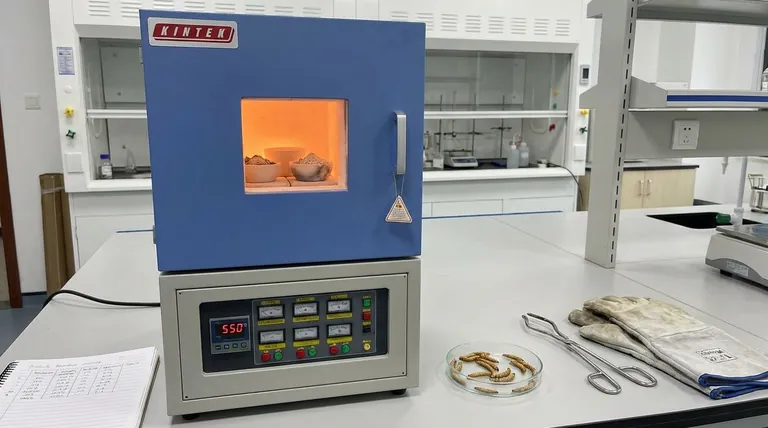
The key step performed by a Muffle Furnace in this analysis is the total mineralization of Tenebrio molitor larvae through high-temperature incineration. By maintaining a constant environment of 550 °C, the furnace effectively burns off all organic matter, isolating the residual ash required for accurate mineral quantification.
To accurately measure mineral content, you must eliminate organic interference. The Muffle Furnace achieves this by incinerating samples at 550 °C, separating the inorganic ash to reveal how environmental factors, such as rearing temperature, influence mineral accumulation.
The Mechanics of Mineralization
Thermal Decomposition
The Muffle Furnace creates a thermal environment that carbon-based biological tissues cannot withstand. By sustaining a temperature of 550 °C, the equipment ensures the complete combustion of the larvae's organic structure.
Isolation of Inorganic Ash
The goal of this high heat is to reduce the complex biological sample down to its elemental base. Once the organic matter is removed, only the residual ash remains. This ash represents the total mineral content of the sample, free from the interference of proteins, fats, or carbohydrates.
correlating Environment to Composition
Quantifying Rearing Effects
This mineralization step is critical for comparative biological studies. Researchers use the resulting ash data to determine how external rearing conditions alter the internal composition of the larvae.
The 28 °C Threshold
Specific studies utilize this method to track physiological changes based on temperature. For example, evidence shows a significant increase in ash proportion (mineral content) when Tenebrio molitor larvae are reared at temperatures reaching 28 °C. Without the precise ashing provided by the furnace, this correlation would be impossible to isolate.
Understanding the Trade-offs
Temperature Precision is Critical
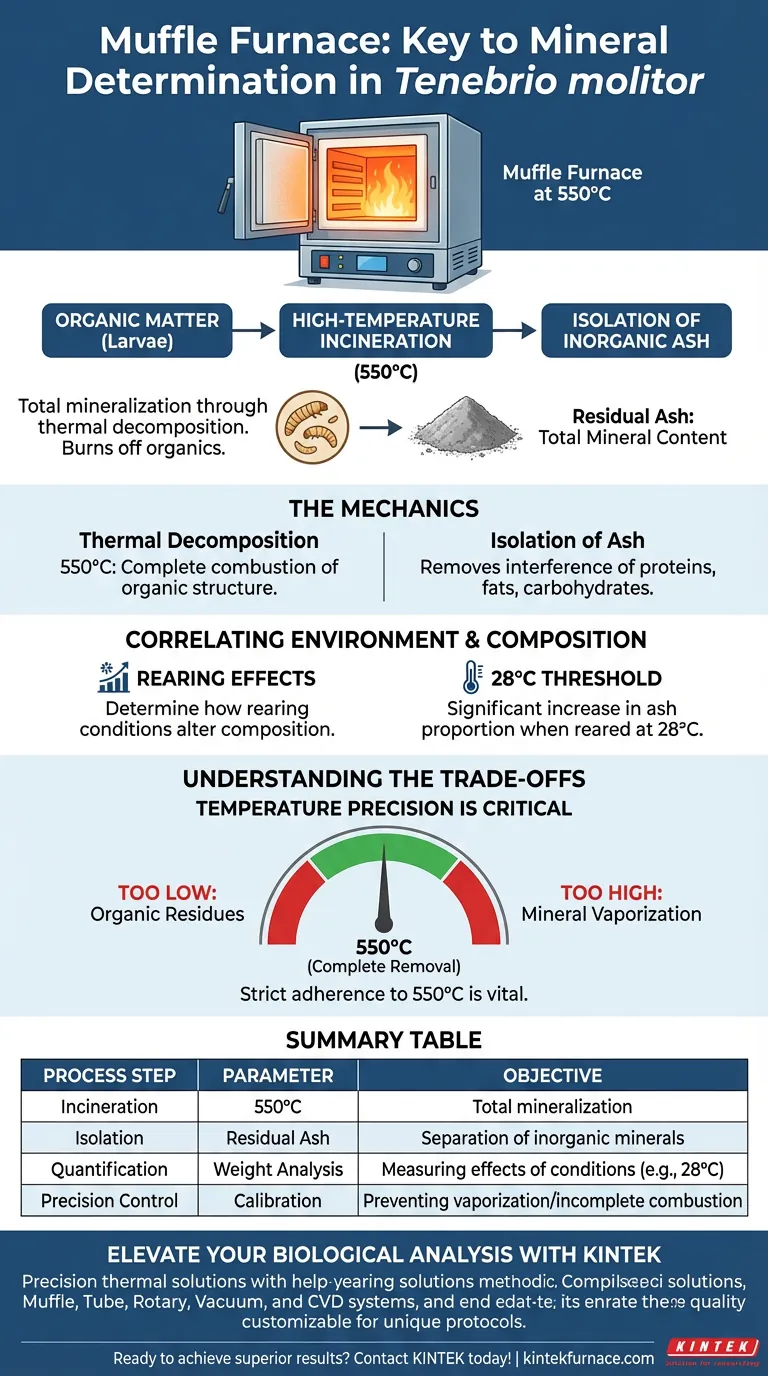
While the Muffle Furnace is a robust tool, it requires strict adherence to the 550 °C standard for this specific organism. If the temperature is set too low, organic residues will remain, artificially inflating the weight of the "mineral" content. Conversely, excessively high temperatures could cause volatile minerals to vaporize, leading to an underestimation of the total mineral content.
Making the Right Choice for Your Analysis
- If your primary focus is protocol standardization: Ensure your furnace is calibrated to exactly 550 °C to guarantee the complete removal of organic matter without compromising the inorganic matrix.
- If your primary focus is nutritional profiling: Use the ash content data specifically to evaluate how environmental variables, such as a 28 °C rearing temperature, enhance or deplete the mineral density of the larvae.
Precision in thermal processing is the only way to transform a biological sample into actionable chemical data.
Summary Table:
| Process Step | Parameter | Objective |
|---|---|---|
| Incineration | 550 °C | Total mineralization of organic matter |
| Isolation | Residual Ash | Separation of inorganic minerals from fats/proteins |
| Quantification | Weight Analysis | Measuring effects of rearing conditions (e.g., 28 °C) |
| Precision Control | Calibration | Preventing mineral vaporization or incomplete combustion |
Elevate Your Biological Analysis with KINTEK
Precision is paramount when transforming biological samples into actionable chemical data. KINTEK provides industry-leading thermal solutions, including Muffle, Tube, Rotary, Vacuum, and CVD systems, all engineered to maintain the strict temperature tolerances required for accurate ash determination and mineral profiling. Backed by expert R&D and manufacturing, our high-temp lab furnaces are fully customizable to meet your unique research protocols.
Ready to achieve superior mineralization results? Contact KINTEK today to discuss your laboratory needs!
Visual Guide
References
- Anežka Kopecká, Martin Kulma. Effect of Temperature on the Nutritional Quality and Growth Parameters of Yellow Mealworm (Tenebrio molitor L.): A Preliminary Study. DOI: 10.3390/app14062610
This article is also based on technical information from Kintek Furnace Knowledge Base .
Related Products
- 1400℃ Muffle Oven Furnace for Laboratory
- 1700℃ High Temperature Muffle Oven Furnace for Laboratory
- 1800℃ High Temperature Muffle Oven Furnace for Laboratory
- 1200℃ Muffle Oven Furnace for Laboratory
- High Temperature Muffle Oven Furnace for Laboratory Debinding and Pre Sintering
People Also Ask
- How does a high-temperature laboratory muffle furnace affect material properties? Transform Anodic Oxide Films Fast
- What is the primary function of a high-temperature laboratory muffle furnace in chemical synthesis? Achieve Precision.
- How is a laboratory high-temperature muffle furnace utilized to achieve the specific crystalline structure of LaFeO3 catalysts?
- What function does a muffle furnace perform in perovskite formation? Optimize Your Thermal Synthesis
- How does a laboratory high-temperature muffle furnace contribute to the final formation of Bismuth Oxide nanosheets?



















