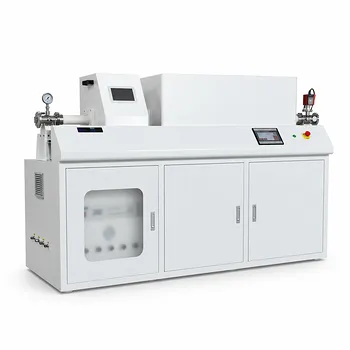
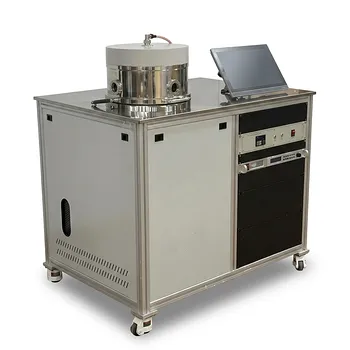
A high-precision gas-phase tube furnace serves as a controlled micro-reactor that replicates the complex thermochemical conditions of industrial combustion. By integrating precise gas flow control with stable thermal zones, it allows researchers to simulate specific oxidizing atmospheres (such as O2/CO2) and anaerobic environments. Its primary function is to provide a repeatable platform for studying mineral transformation, ash fusion behavior, and the synergistic reactions between different fuels like biomass and coal.
The tube furnace is the essential link between bench-scale experimentation and industrial application, providing the atmospheric and thermal precision necessary to isolate variables in biomass co-combustion. It transforms raw material analysis into predictable data regarding pollutant emissions and ash chemistry.
Precision Atmospheric Regulation
Simulation of Oxy-fuel and Oxidizing Environments
The furnace uses advanced gas-mixing systems to create specific atmospheric ratios, such as O2/CO2 or O2/N2. This capability is critical for replicating the chemical environment found inside industrial burners and boilers. By adjusting these ratios, researchers can observe how different oxygen concentrations affect the combustion rate of biomass blends.
Management of Inert and Reducing Conditions
Beyond oxidation, the furnace maintains strictly controlled anaerobic or oxygen-lean environments using high-purity nitrogen or argon. These conditions are necessary for studying biomass torrefaction and pyrolysis, which are common pre-treatment steps in co-combustion. This prevents unwanted oxidation while allowing for the analysis of carbonization and elemental doping.
Dynamic Gas Flow and Residence Time
The furnace ensures a constant and measurable flow rate of gases across the sample. This allows for the quantitative study of gas-solid reactions and the collection of flue gas components. Precise flow management is essential for calculating the removal efficiency of pollutants like SO2 and NOx under varying temperatures.
Thermal Environment Control
High-Temperature Stability for Ash Studies
The furnace provides a steady thermal environment, often reaching temperatures between 800°C and 1100°C, to simulate industrial grate furnaces or boilers. This stability is vital for investigating ash fusion behavior and mineral transformation mechanisms. Consistent heat ensures that the physical changes observed in the ash are due to chemical composition rather than temperature fluctuations.
Programmable Heating Ramps
Advanced controllers allow for specific heating rates, ranging from 1.5°C to 15°C per minute. This functionality enables researchers to simulate different thermal processing stages, from slow torrefaction to rapid combustion. Programmed ramping is key to understanding how the rate of temperature increase influences the porosity and nitrogen configuration of the resulting material.
Uniformity of the Reaction Zone
The horizontal or vertical tube structure is designed to provide a uniform temperature zone. This ensures that the entire biomass sample undergoes the same thermochemical decomposition simultaneously. Thermal uniformity is a prerequisite for achieving repeatable results in elemental composition and lattice doping studies.
Understanding the Trade-offs
Scale and Mass Transfer Limitations
While tube furnaces offer high precision, they operate at a much smaller scale than industrial facilities. The gas-solid contact in a fixed-bed tube furnace may not perfectly replicate the turbulence found in fluidized-bed or pulverized-coal boilers. Researchers must account for these mass transfer differences when extrapolating lab data to full-scale operations.
Residence Time Discrepancies
In a laboratory tube, the residence time of gases and particles is often longer or shorter than in a massive industrial furnace. This can lead to variations in the secondary cracking of volatiles or the extent of mineral reactions. It is critical to balance gas flow velocity with tube length to approximate realistic industrial residence times.
Sensor and Material Constraints
High-temperature operations, especially those involving corrosive biomass ash (rich in potassium or chlorine), can degrade the furnace tube over time. Choosing between quartz, alumina, or metallic tubes involves trade-offs between chemical inertness, thermal shock resistance, and maximum operating temperature.
How to Apply This to Your Project
Recommendations Based on Research Goals
- If your primary focus is ash deposition and slagging: Prioritize a furnace with high-precision O2/CO2 mixing and a stable 1100°C+ thermal zone to accurately observe mineral phase changes.
- If your primary focus is emission control (SO2/NOx): Ensure the furnace is integrated with a continuous flue gas analyzer and allows for the precise injection of catalysts or additives.
- If your primary focus is fuel upgrading (Torrefaction): Focus on a system that guarantees an oxygen-free environment through high-purity nitrogen purging and offers slow, programmable heating ramps.
- If your primary focus is material synthesis (N-doped carbon): Utilize the furnace's ability to decompose dopants like urea at specific temperatures under argon protection to ensure atomic-level integration.
By leveraging the atmospheric and thermal precision of a high-precision tube furnace, you can transform complex biomass co-combustion variables into actionable industrial insights.
Summary Table:
| Function | Key Feature | Primary Application |
|---|---|---|
| Atmospheric Control | O2/CO2/N2/Ar gas mixing | Oxy-fuel, torrefaction & pyrolysis simulation |
| Thermal Stability | 800°C – 1100°C+ steady zones | Ash fusion & mineral transformation studies |
| Heating Precision | 1.5°C to 15°C/min ramps | Simulating industrial heating processing stages |
| Flow Management | Constant gas-solid contact | Flue gas analysis (SO2/NOx) & emission control |
Optimize Your Biomass Research with KINTEK Precision
Ready to transform your bench-scale analysis into actionable industrial insights? KINTEK specializes in high-performance laboratory equipment, offering a comprehensive range of high-temperature furnaces, including tube, muffle, vacuum, CVD, and atmosphere-controlled systems.
Whether you are studying ash deposition, emission control, or material synthesis, our furnaces are fully customizable to meet your specific atmospheric and thermal ramp requirements.
Contact us today to discuss your unique needs and let our experts help you achieve the repeatable, high-precision results your project demands!
References
- Ziqiang Yang, Yitian Fang. Regulation Mechanism of Solid Waste on Ash Fusion Characteristics of Sorghum Straw under O2/CO2 Atmosphere. DOI: 10.3390/en16207052
This article is also based on technical information from Kintek Furnace Knowledge Base .
Related Products
- High Pressure Laboratory Vacuum Tube Furnace
- 1700℃ High Temperature Laboratory Tube Furnace with Alumina Tube
- Vertical Laboratory Quartz Tube Furnace Tubular Furnace
- Split Chamber CVD Tube Furnace with Vacuum Station CVD Machine
- 1400℃ High Temperature Laboratory Tube Furnace with Alumina Tube
People Also Ask
- What role does a high vacuum tube furnace play in Co-Al sintering? Master High-Purity Porous Material Synthesis
- What are the different types of tube furnaces available? Find the Perfect Fit for Your Lab's Needs
- What are the main advantages of vacuum tube furnaces in the market? Achieve Purity and Precision in Material Processing
- What is the role of a vacuum tube furnace during the final thermal treatment stage of Fe3O4@CSAC catalysts?
- Why is a laboratory tube furnace necessary for BiVO4/RGO synthesis? Achieve Precise Nano-Structure Control