
Vacuum resistance furnaces provide a dual-critical environment: thermal stability and atmospheric isolation. Specifically, they maintain a stable high temperature (typically around 800 °C) while simultaneously establishing a high-vacuum atmosphere to completely prevent oxidation during the solution treatment of Ti–50Zr alloys.
Core Takeaway The primary function of this environment is to facilitate a thermodynamic transition into the beta phase region without compromising the material's purity. By eliminating oxygen during extended holding periods, the furnace ensures the alloy's microstructure is primed for rapid quenching, free from surface degradation or embrittlement.
The Role of Atmospheric Isolation
Eliminating Oxidation Risks
The most critical environmental feature provided is a high-vacuum atmosphere. Ti–50Zr alloys contain highly reactive elements that chemically bond with oxygen and nitrogen almost instantly at elevated temperatures.
Preserving Surface Purity
By removing reactive gases, the furnace allows for extended holding periods without the formation of a brittle oxide layer (alpha case). This ensures that the material remains pristine, preventing surface defects that could initiate cracks or reduce mechanical performance.
Thermal Stability and Phase Control
Achieving the Beta Phase
The furnace provides the precise thermal energy required to drive the alloy's microstructure into the beta phase region. This is the foundational state necessary for the desired properties to be locked in during subsequent cooling steps.
Precise Temperature Regulation
Maintaining a stable temperature, such as 800 °C, is essential for homogeneity. The resistance heating mechanism ensures uniform heat distribution, preventing "cold spots" where the phase transformation might remain incomplete.
Operational Criticalities and Constraints
The Necessity of Time
The environment is designed to support long-duration solution treatments. Unlike rapid heating methods, this environment is optimized for equilibrium, allowing sufficient time for diffusion and structural changes to occur at the atomic level.
Vulnerability to Leaks
Because the process relies entirely on the absence of atmosphere, vacuum integrity is the single point of failure. Even minor leaks during the high-temperature hold can lead to gas-induced embrittlement, effectively ruining the alloy's ductility.
Making the Right Choice for Your Goal
When configuring your experimental setup for Ti–50Zr solution treatment, consider your specific objectives:
- If your primary focus is Microstructural Homogeneity: prioritize thermal stability at 800 °C to ensure a complete and uniform transition to the beta phase.
- If your primary focus is Surface Integrity: prioritize vacuum depth and leak rates to eliminate any trace of oxygen during the extended holding period.
Ultimately, the success of the treatment relies on balancing precise heat with an absolute void.
Summary Table:
| Feature | Environmental Contribution | Impact on Ti–50Zr Alloy |
|---|---|---|
| High Vacuum | Eliminates reactive gases (O2, N2) | Prevents oxidation and brittle alpha-case formation |
| Thermal Stability | Consistent 800 °C heating | Ensures complete transition to the beta phase region |
| Uniformity | Resistance heating mechanism | Promotes microstructural homogeneity across the sample |
| Atmospheric Isolation | Absolute void environment | Enables long-duration holding without surface degradation |
Elevate Your Material Research with KINTEK Precision
Maximize the potential of your Ti–50Zr alloys with high-performance heating solutions. Backed by expert R&D and manufacturing, KINTEK offers specialized Vacuum, Muffle, Tube, and CVD systems designed to meet the rigorous demands of solution treatments. Whether you require superior vacuum integrity to prevent embrittlement or precise thermal regulation for phase transitions, our customizable lab furnaces are built to your unique specifications.
Ready to ensure the purity and performance of your advanced materials?
Contact our specialists today to find your perfect furnace solution!
Visual Guide
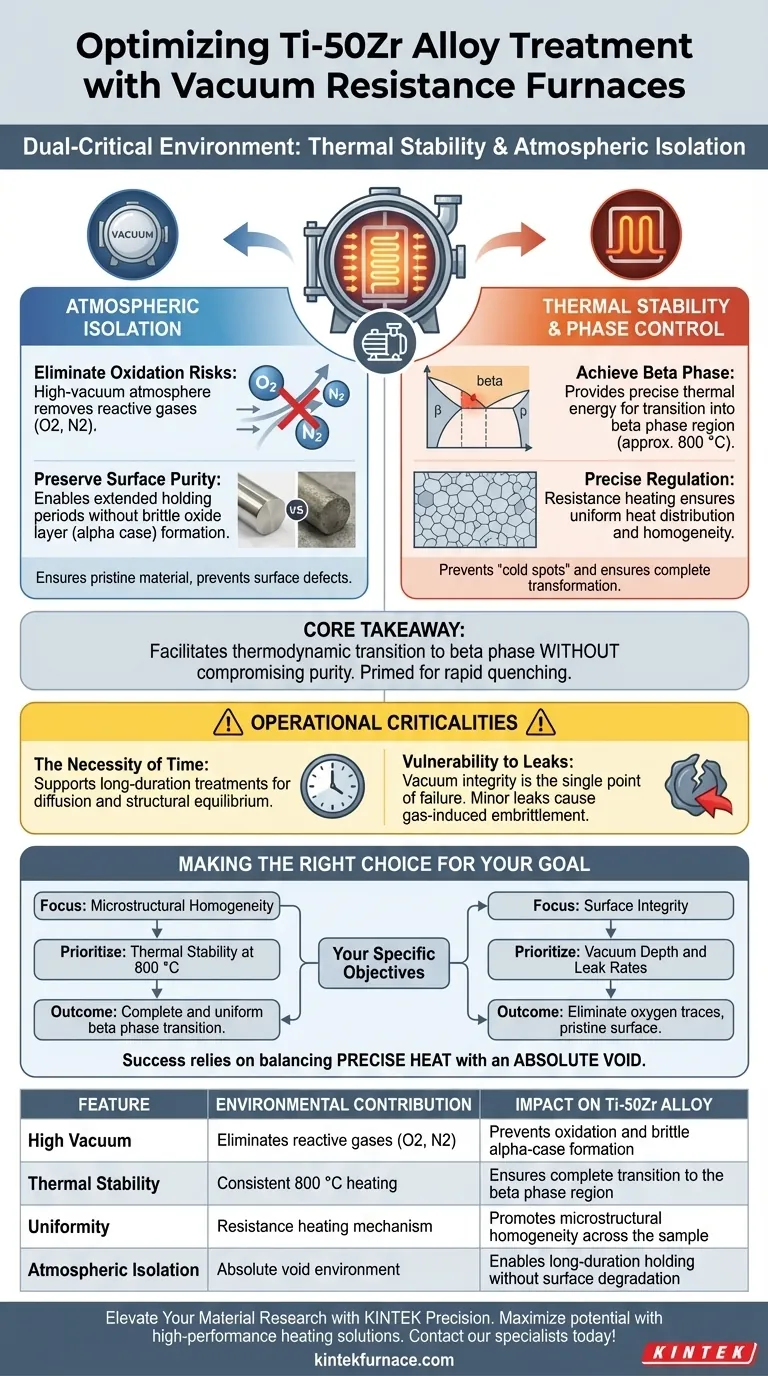
References
- Improved Strength and Corrosion Resistance of Ti–50Zr Alloy Through Heat Treatment. DOI: 10.1002/adem.202501828
This article is also based on technical information from Kintek Furnace Knowledge Base .
Related Products
- Vacuum Heat Treat Sintering Furnace with Pressure for Vacuum Sintering
- Molybdenum Vacuum Heat Treat Furnace
- Small Vacuum Heat Treat and Tungsten Wire Sintering Furnace
- High Pressure Laboratory Vacuum Tube Furnace
- Vacuum Heat Treat Sintering Furnace Molybdenum Wire Vacuum Sintering Furnace
People Also Ask
- What are the benefits of using vacuum heat treating furnaces for metal alloys? Achieve Superior Metal Properties and Performance
- What is one of the most important uses of vacuum heat treating furnaces in aerospace? Achieve Superior Strength in Aircraft Alloys
- How does vacuum heat treating affect the grain structure of metal alloys? Achieve Precise Microstructure Control
- What are the key components of a vacuum sintering furnace? Essential Parts for Precision Material Processing
- What is the purpose of setting a mid-temperature dwell stage? Eliminate Defects in Vacuum Sintering



















