
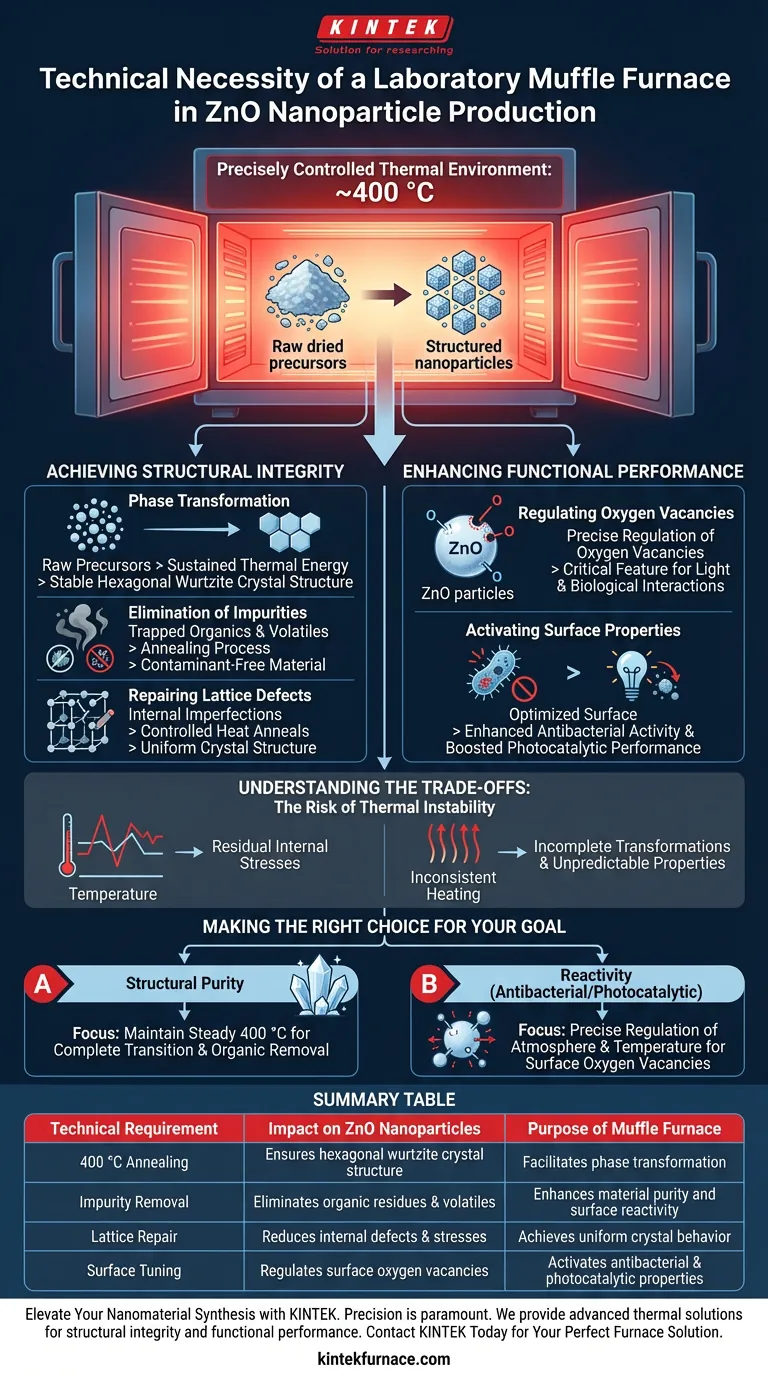
The technical necessity of a laboratory muffle furnace lies in its ability to provide a precisely controlled thermal environment—specifically around 400 °C—which is required to synthesize functional Zinc Oxide (ZnO) nanoparticles. This apparatus ensures the complete phase transformation of dried precursors into a stable hexagonal wurtzite crystal structure. Without this specific high-temperature annealing, the material would retain internal lattice defects and organic residues, rendering it ineffective for advanced applications.
The muffle furnace does more than simply dry the material; it acts as a structural regulator. By maintaining a stable 400 °C environment, it optimizes surface oxygen vacancies, which is the precise mechanism required to activate the ZnO nanoparticles' antibacterial and photocatalytic capabilities.
Achieving Structural Integrity
The primary role of the muffle furnace is to facilitate the crystallization process that turns raw chemical precursors into a usable semiconductor material.
Phase Transformation
Raw zinc precursors do not naturally possess the crystalline structure required for high performance.
The muffle furnace provides the sustained thermal energy needed to force a phase transition.
This converts the precursors into a thermodynamically stable hexagonal wurtzite crystal structure, which defines the physical properties of the final Zinc Oxide product.
Elimination of Impurities
During the initial synthesis stages, organic matter and volatiles are often trapped within the material.
The annealing process efficiently burns off these residual organics.
This purification prevents contaminants from interfering with the material's surface reactivity.
Repairing Lattice Defects
Synthesizing nanoparticles often introduces imperfections within the crystal lattice.
The controlled heat of the muffle furnace anneals these internal lattice defects.
This results in a more uniform crystal structure, which is essential for consistent material behavior.
Enhancing Functional Performance
Beyond basic structure, the muffle furnace is the tool used to "tune" the chemical behavior of the nanoparticle surface.
Regulating Oxygen Vacancies
For Zinc Oxide, performance is often dictated by the presence and arrangement of oxygen vacancies.
The muffle furnace allows for the precise regulation of these surface oxygen vacancies.
This regulation is not a defect to be removed, but a critical feature that dictates how the particle interacts with light and biological environments.
Activating Surface Properties
The specific arrangement of the crystal surface directly impacts its utility.
Properly annealed ZnO nanoparticles exhibit enhanced antibacterial activity.
Furthermore, this thermal treatment significantly boosts photocatalytic performance, allowing the particles to break down pollutants or react under light exposure effectively.
Understanding the Trade-offs
While the muffle furnace is essential, the process relies heavily on the precision of the parameters used.
The Risk of Thermal Instability
The benefit of the furnace is entirely dependent on its ability to maintain a stable thermal field.
Fluctuations in temperature or cooling curves can induce new residual internal stresses rather than relieving them.
Inconsistent heating can lead to incomplete phase transformations, resulting in a product with unpredictable electronic or optical properties.
Making the Right Choice for Your Goal
The parameters you set on your muffle furnace should be dictated by the specific properties you need to isolate in the Zinc Oxide.
- If your primary focus is Structural Purity: Ensure the furnace maintains a steady 400 °C to guarantee a complete transition to the hexagonal wurtzite structure and the total removal of organic matter.
- If your primary focus is Reactivity (Antibacterial/Photocatalytic): Prioritize the precise regulation of the annealing atmosphere and temperature to optimize the density of surface oxygen vacancies.
Success in ZnO production is not just about reaching high temperatures, but about utilizing the muffle furnace to architect the atomic structure of the material.
Summary Table:
| Technical Requirement | Impact on ZnO Nanoparticles | Purpose of Muffle Furnace |
|---|---|---|
| 400 °C Annealing | Ensures hexagonal wurtzite crystal structure | Facilitates phase transformation |
| Impurity Removal | Eliminates organic residues & volatiles | Enhances material purity and surface reactivity |
| Lattice Repair | Reduces internal defects and stresses | Achieves uniform crystal behavior |
| Surface Tuning | Regulates surface oxygen vacancies | Activates antibacterial & photocatalytic properties |
Elevate Your Nanomaterial Synthesis with KINTEK
Precision is paramount when synthesizing ZnO nanoparticles. KINTEK provides the advanced thermal solutions necessary to ensure structural integrity and functional performance in your lab. Backed by expert R&D and manufacturing, we offer high-performance Muffle, Tube, Rotary, Vacuum, and CVD systems, all fully customizable to meet your specific annealing requirements.
Ready to optimize your high-temperature processes? Contact KINTEK Today to Find Your Perfect Furnace Solution
Visual Guide
References
- Nives Matijaković Mlinarić, Klemen Bohinc. Poly(Allylamine Hydrochloride) and ZnO Nanohybrid Coating for the Development of Hydrophobic, Antibacterial, and Biocompatible Textiles. DOI: 10.3390/nano14070570
This article is also based on technical information from Kintek Furnace Knowledge Base .
Related Products
- 1200℃ Muffle Oven Furnace for Laboratory
- Laboratory Muffle Oven Furnace with Bottom Lifting
- 1400℃ Muffle Oven Furnace for Laboratory
- 1800℃ High Temperature Muffle Oven Furnace for Laboratory
- 1700℃ High Temperature Muffle Oven Furnace for Laboratory
People Also Ask
- What is the primary function of a high-temperature laboratory muffle furnace in chemical synthesis? Achieve Precision.
- How does a high-temperature laboratory muffle furnace affect material properties? Transform Anodic Oxide Films Fast
- How is a laboratory muffle furnace used in 3D-printed PP-CF cross-linking? Achieve Thermal Stability at 150 °C
- Why is a laboratory high-temperature muffle furnace required for LaNixFe1-xO3 catalysts? Optimize Two-Stage Synthesis
- What is the critical role of a laboratory high-temperature muffle furnace in TiO2/LDH? Unlock Superior Crystallization



















