
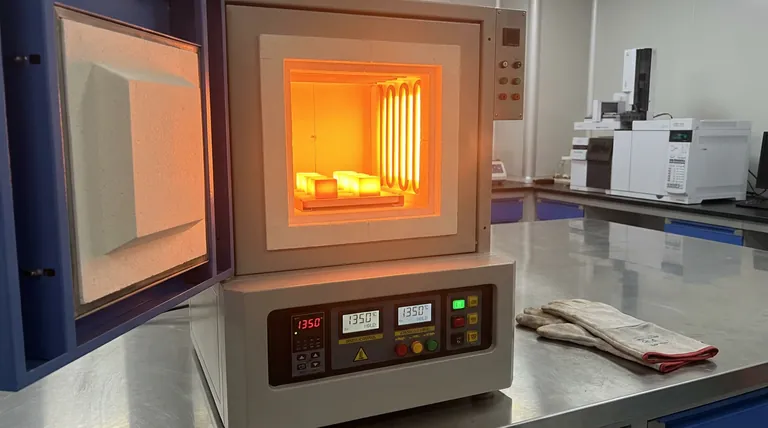
A high-temperature muffle furnace acts as a rigorous simulation chamber to validate the durability of Cr2AlC ceramics. It subjects the material to a controlled, static air environment at extreme temperatures ranging from 1000°C to 1400°C. By maintaining these conditions for durations often exceeding several hundred hours, researchers can directly observe how the material withstands high-temperature corrosion.
The Core Insight The primary purpose of this thermal testing is to verify the formation and stability of a protective alumina film on the ceramic's surface. This passive oxide layer is the critical mechanism that ensures the long-term reliability of Cr2AlC in practical, high-stress applications.
Simulating Real-World Environments
To determine if Cr2AlC ceramics are viable for industrial use, they must be tested against the specific conditions they will face in service.
Controlled Static Oxidation
The muffle furnace provides a stable, heated air atmosphere. This environment allows researchers to conduct static oxidation experiments.
Unlike dynamic testing, this method exposes the material to a constant, consistent oxidative stress. This establishes a baseline for how the material interacts with oxygen in the absence of mechanical wear.
Extreme Temperature Ranges
The evaluation takes place within a specific thermal window, typically between 1000°C and 1400°C.
Testing across this spectrum allows engineers to identify the exact temperature threshold where the material's performance begins to degrade. It confirms whether the ceramic can maintain structural integrity at the upper limits of its operating design.
Extended Duration Testing
Oxidation resistance is rarely about short-term survival; it is about longevity.
Experiments in the muffle furnace often last for several hundred hours. This extended timeframe is necessary to reveal slow-acting degradation mechanisms that would be invisible during shorter tests.
Evaluating the Protective Mechanism
The true measure of success for Cr2AlC ceramics is not just survival, but the quality of the oxide scale it generates.
Formation of Alumina Film
Under the heat of the muffle furnace, Cr2AlC reacts with oxygen to form an alumina (aluminum oxide) film on its surface.
This film acts as a barrier. The furnace test determines if this barrier forms quickly and uniformly enough to halt further oxidation of the internal material.
Assessing Continuity and Stability
The experiment specifically evaluates the continuity of this protective film.
If the film remains continuous without cracking or spalling (flaking off) after hundreds of hours, the material is deemed reliable. If the film breaks down, the underlying ceramic becomes vulnerable to rapid corrosion.
Understanding the Limitations
While a muffle furnace is the standard for oxidation screening, it is important to recognize the constraints of this specific testing method.
Static vs. Dynamic Conditions
A muffle furnace typically provides a static air environment.
Real-world applications, such as turbine engines, often involve high-velocity gas flows. Static testing may underestimate the erosion-corrosion effects caused by rapidly moving gases stripping away the protective alumina layer.
Thermal Cycling Variables
Static oxidation tests often hold a steady temperature for long periods.
However, practical applications involve rapid heating and cooling cycles. While some furnaces can program these cycles, a standard static test may not fully capture the mechanical stresses caused by thermal expansion and contraction.
Making the Right Choice for Your Goal
When designing your evaluation protocol for Cr2AlC ceramics, tailor your furnace parameters to your specific data needs.
- If your primary focus is material screening: Target the 1000°C to 1200°C range to verify basic film formation and material stability.
- If your primary focus is extreme limit validation: Push the temperature to 1400°C for extended durations to stress-test the continuity of the alumina film under maximum thermal load.
Reliability is proven not by the heat itself, but by the integrity of the protective layer that survives it.
Summary Table:
| Test Parameter | Range/Condition | Purpose in Oxidation Evaluation |
|---|---|---|
| Temperature Range | 1000°C to 1400°C | Determines degradation thresholds and thermal limits. |
| Test Environment | Static Air | Establishes a baseline for oxygen-material interaction. |
| Duration | 100+ Hours | Reveals long-term degradation and film stability. |
| Key Metric | Alumina Film Continuity | Evaluates the protective barrier's resistance to spalling. |
Optimize Your Material Testing with KINTEK Precision
Ensure the reliability of your advanced ceramics with high-performance thermal solutions. Backed by expert R&D and manufacturing, KINTEK offers a wide range of Muffle, Tube, Rotary, Vacuum, and CVD systems, all customizable to meet your specific research and industrial needs.
Whether you are conducting static oxidation screening or extreme limit validation, our lab high-temp furnaces provide the precise temperature control and uniform heating required for repeatable results. Contact us today to find the perfect furnace for your lab!
References
- Zhihui Li, Min Du. Reduced graphene oxide/MXene hybrid decorated graphite felt as an effective electrode for vanadium redox flow battery. DOI: 10.1039/d4ra01306a
This article is also based on technical information from Kintek Furnace Knowledge Base .
Related Products
- 1700℃ High Temperature Muffle Oven Furnace for Laboratory
- 1800℃ High Temperature Muffle Oven Furnace for Laboratory
- 1400℃ Muffle Oven Furnace for Laboratory
- 1200℃ Muffle Oven Furnace for Laboratory
- High Temperature Muffle Oven Furnace for Laboratory Debinding and Pre Sintering
People Also Ask
- What is the primary function of a high-temperature laboratory muffle furnace in chemical synthesis? Achieve Precision.
- How does a high-temperature laboratory muffle furnace affect material properties? Transform Anodic Oxide Films Fast
- What role does a muffle furnace play in BCZY712 electrolyte powder production? Achieve Perfect Phase Purity
- How does the two-stage sintering process contribute to the synthesis of MeCuFeO3 perovskite? Optimize crystal purity.
- What role does a muffle furnace play in sintering photocathodes? Enhance Electrode Conductivity & Catalytic Activity



















