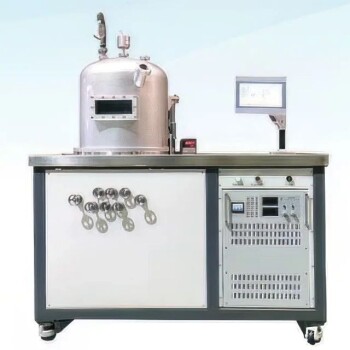
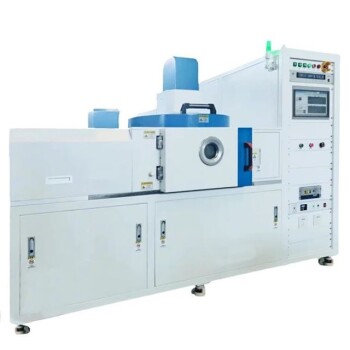
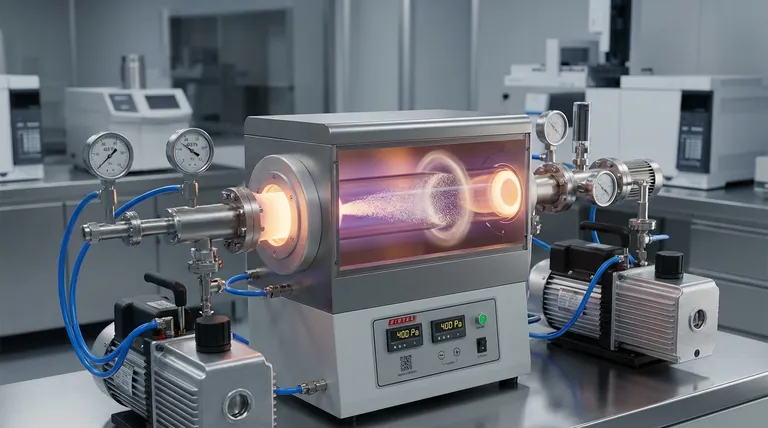
The vacuum pressure control system is the governing mechanism that ensures the Chemical Vapor Deposition (CVD) reactor operates at a precise low-pressure environment, typically around 400 Pa. This control is not merely about removing air; it is the primary lever for determining whether the coating material actually adheres to your target powder or is wasted as dust.
The vacuum system fundamentally alters the behavior of precursor molecules by increasing their mean free path. This suppresses the formation of waste byproducts in the gas (homogeneous nucleation) and forces the material to grow densely on the powder surface (heterogeneous nucleation).
The Physics of Low-Pressure Deposition
Extending the Mean Free Path
In a standard atmospheric environment, gas molecules are crowded and collide constantly. By reducing the pressure to approximately 400 Pa, the vacuum system significantly increases the mean free path of the precursor molecules.
Enhancing Molecular Transport
This increased distance between collisions allows precursor molecules to travel more freely. Instead of reacting prematurely with other gas molecules, they can reach the substrate surface efficiently.
Steering the Nucleation Process
Suppressing Homogeneous Nucleation
Without precise vacuum control, precursor molecules are prone to homogeneous nucleation. This occurs when molecules react with each other in the gas phase rather than on the target surface.
Preventing Byproduct Formation
When homogeneous nucleation occurs, the result is free-floating byproduct powder—essentially "dust"—rather than a coating. The vacuum environment minimizes these gas-phase collisions, preventing the waste of expensive precursor materials.
Promoting Heterogeneous Nucleation
The primary goal of the pressure control system is to facilitate heterogeneous nucleation. This ensures that the chemical reaction occurs specifically on the surface of the calcium carbonate template (the powder).
Ensuring Coating Density
By forcing the reaction to happen on the surface, the system encourages the silica to grow preferentially on the powder. This results in a dense, uniform shell rather than a loose or porous structure.
Understanding the Trade-offs
The Risk of Pressure Instability
If the vacuum pressure rises significantly above the optimal 400 Pa range, the mean free path decreases. This shifts the balance back toward gas-phase reactions, leading to a "dusty" process where the coating fails to adhere to the powder.
Balancing Reaction Speed and Quality
While lower pressures improve coating quality, they must be maintained precisely. Extreme deviations can alter the transport mechanics of the gas phase, potentially affecting the deposition rate or the structural integrity of the coating.
Optimizing Your Process Outcomes
If your primary focus is Material Efficiency:
- Prioritize vacuum stability to minimize homogeneous nucleation, which directly reduces the creation of wasted free-floating byproducts.
If your primary focus is Coating Quality:
- Ensure the pressure remains low (~400 Pa) to maximize the mean free path, guaranteeing a dense, continuous silica layer on the powder surface.
If your primary focus is Process Consistency:
- Monitor pressure trends strictly, as fluctuations dictate whether the reaction occurs in the empty space of the reactor or on the actual product.
Ultimate control over vacuum pressure is the difference between generating industrial waste and engineering a high-performance coated powder.
Summary Table:
| Feature | Impact on CVD Process | Benefit for Coated Powders |
|---|---|---|
| Pressure (~400 Pa) | Increases Mean Free Path | Enhances molecular transport to the substrate |
| Heterogeneous Nucleation | Promotes surface-specific growth | Ensures dense, uniform, and adherent shells |
| Suppression of Homogeneous Nucleation | Prevents gas-phase reactions | Eliminates "dust" and byproduct waste |
| Vacuum Stability | Maintains consistent deposition environment | Guarantees process repeatability and quality |
Elevate Your Material Engineering with KINTEK
Precision vacuum control is the boundary between high-performance coating and industrial waste. Backed by expert R&D and world-class manufacturing, KINTEK provides advanced CVD systems, Muffle, Tube, Rotary, and Vacuum furnaces designed to deliver the exact pressure environments your research demands. Whether you are coating sensitive powders or developing next-gen substrates, our customizable high-temp solutions ensure maximum material efficiency and coating density.
Ready to optimize your CVD process? Contact KINTEK today to discuss your unique needs.
References
- Hirokazu Katsui, Mikinori Hotta. Preparation of hollow silica particles by template method via chemical vapor deposition. DOI: 10.2109/jcersj2.23114
This article is also based on technical information from Kintek Furnace Knowledge Base .
Related Products
- HFCVD Machine System Equipment for Drawing Die Nano Diamond Coating
- RF PECVD System Radio Frequency Plasma Enhanced Chemical Vapor Deposition
- 915MHz MPCVD Diamond Machine Microwave Plasma Chemical Vapor Deposition System Reactor
- MPCVD Machine System Reactor Bell-jar Resonator for Lab and Diamond Growth
- Cylindrical Resonator MPCVD Machine System for Lab Diamond Growth
People Also Ask
- What is Hot-filament Chemical Vapor Deposition (HFCVD)? Achieve High-Quality Thin Films with Precision Control
- What are the equipment for chemical vapor deposition? A Guide to the 5 Essential Components
- What is the function of high-purity Argon (Ar) gas during CVD? Optimize Your Thin Film Uniformity and Purity
- What are the advantages of using Chemical Vapor Deposition (CVD) for coating turbine blades? Enhance Life & Performance
- What core function does CVD equipment serve in h-BN anti-corrosion? Master Precision Synthesis for High-Performance Films