
The primary role of an industrial-grade high-temperature box furnace is to provide a precise annealing environment for Ni-Ti-Hf-La alloys. Specifically, it maintains a stable constant temperature, typically at 850 °C, along with accurately controlled holding times. This controlled thermal exposure is the definitive step required to transition the alloy from a raw melted state into a usable material.
Core Takeaway: The furnace is not merely for heating; it is a tool for structural correction. Its function is to eliminate residual stresses caused by initial melting and to promote uniform phase distribution, which are prerequisites for achieving reliable processing performance.
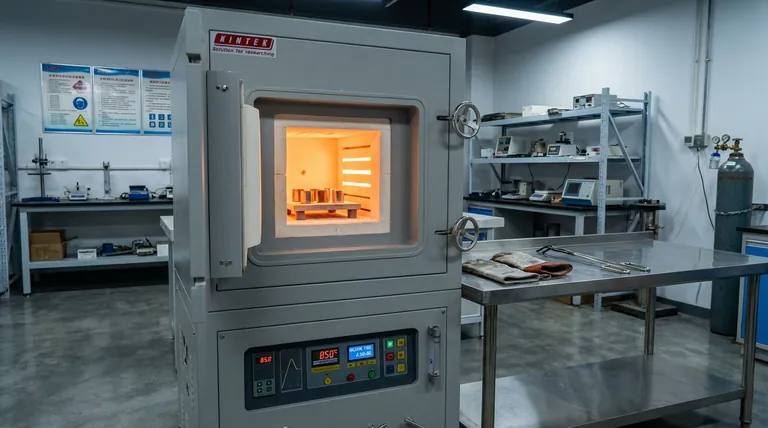
The Mechanics of Thermal Treatment
Precise Temperature Regulation
The furnace must provide a strictly controlled thermal environment. For Ni-Ti-Hf-La alloys, the target temperature is generally 850 °C.
Controlled Holding Times
Reaching temperature is insufficient; maintaining it for a specific duration is required. The box furnace ensures the alloy is held at temperature long enough to allow internal changes to occur without overheating or under-processing the material.
Critical Material Improvements
Eliminating Residual Stresses
During the initial melting and solidification process, Ni-Ti-Hf-La alloys develop significant internal tension.
This residual stress can lead to failure or warping during later manufacturing stages. The box furnace acts as a stress-relief mechanism, relaxing the material structure to a neutral state.
Homogenizing Phase Structures
Raw alloys often suffer from uneven internal structures.
The heat treatment promotes the uniform distribution of phase structures throughout the material. This uniformity is essential for ensuring the alloy behaves consistently under mechanical load.
Enhancing Processing Performance
The combination of stress relief and phase uniformity directly impacts how the material handles further work.
Without this annealing step, the alloy may be too brittle or unpredictable. The furnace treatment optimizes the alloy's overall properties, making it capable of undergoing further machining or shaping.
Understanding the Operational Requirements
The Necessity of Stability
The "industrial-grade" designation of the furnace is significant.
Standard furnaces may fluctuate, creating uneven thermal fields. For Ni-Ti-Hf-La alloys, the thermal field must be stable and constant to ensure that every part of the alloy receives the exact same treatment.
The Consequence of Inconsistency
If the temperature dips or spikes, or if holding times vary, the phase distribution will remain uneven.
This results in a material that may look correct on the surface but retains internal weaknesses that compromise its final application.
Making the Right Choice for Your Goal
To maximize the utility of your Ni-Ti-Hf-La alloy post-processing:
- If your primary focus is mechanical reliability: Ensure your furnace provides verified thermal uniformity to completely eliminate residual stresses from the melting process.
- If your primary focus is consistent machining: Prioritize precise control over holding times to guarantee the uniform phase distribution required for predictable processing performance.
The success of your alloy processing relies entirely on the stability and precision of this annealing stage.
Summary Table:
| Process Parameter | Target/Requirement | Critical Benefit |
|---|---|---|
| Annealing Temp | 850 °C | Eliminates residual internal stresses |
| Holding Time | Precisely Controlled | Ensures uniform phase distribution |
| Thermal Field | Industrial Stability | Prevents material warping and failure |
| End Result | Structural Correction | Optimizes alloy for machining & shaping |
Optimize Your Advanced Alloy Performance with KINTEK
Precision is the difference between a successful alloy and a failed component. Backed by expert R&D and manufacturing, KINTEK offers high-performance Muffle, Tube, Rotary, Vacuum, and CVD systems—all customizable to your specific thermal profiles.
Whether you are processing Ni-Ti-Hf-La alloys or developing new high-temp materials, our furnaces provide the verified thermal uniformity required for reliable phase distribution and stress relief.
Ready to elevate your lab's high-temperature processing? Contact our experts today to discuss your unique needs and find the perfect furnace solution.
References
- Microstructure, Phase Transformation, and Mechanical Properties of Ni-Ti-Hf-La Alloys. DOI: 10.3390/alloys4030014
This article is also based on technical information from Kintek Furnace Knowledge Base .
Related Products
- 1400℃ High Temperature Laboratory Tube Furnace with Alumina Tube
- 1700℃ Controlled Inert Nitrogen Atmosphere Furnace
- Controlled Inert Nitrogen Hydrogen Atmosphere Furnace
- 1400℃ Controlled Inert Nitrogen Atmosphere Furnace
- 1700℃ High Temperature Laboratory Tube Furnace with Alumina Tube
People Also Ask
- How does zone-melting in tube furnaces synthesize bismuth micro-wires? Master Single-Crystal Thermoelectric Growth
- How do high-temperature laboratory tube furnaces ensure environmental stability? Precision Thermal Reduction Tips
- How are high-temperature laboratory tube furnaces applied in long-term vacuum homogenization heat treatments for intermetallic samples?
- How are high-temp tube furnaces used to measure diffusion coefficients per Fick's law? Master Precision Annealing
- How are high-temperature tube furnaces applied in testing ceramic-supported alloy membranes? Insights



















