
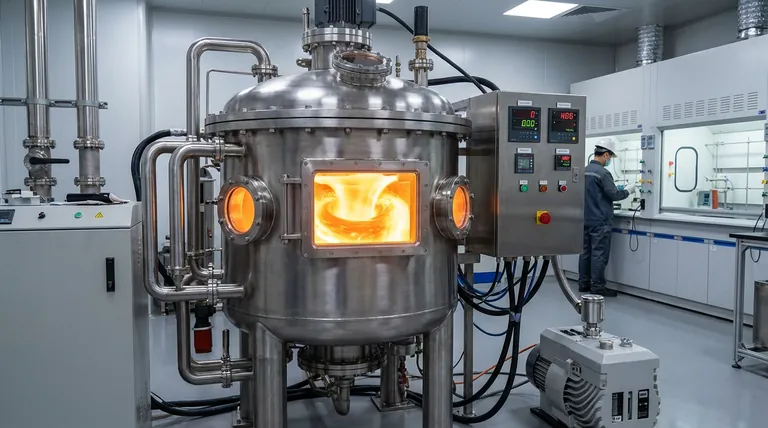
The primary role of the Vacuum Induction Melting (VIM) furnace is to synthesize the Fe3Al pre-alloy, which serves as the metallic matrix for the final composite. By melting aluminum blocks and iron powder at extreme temperatures between 1900 and 2000 °C, the furnace creates a homogeneous liquid alloy essential for the subsequent production of high-quality powders.
Core Takeaway: The VIM furnace acts as a critical purification stage, utilizing a vacuum environment to eliminate atmospheric contaminants and ensure chemical uniformity in the Fe3Al alloy before it is atomized.
The Mechanism of Synthesis
High-Temperature Alloying
The fundamental function of the VIM furnace in this context is to combine raw elemental materials. It melts aluminum blocks and iron powder together using electromagnetic induction.
To achieve a full alloy state, the furnace operates at temperatures ranging from 1900 to 2000 °C. This extreme heat ensures the complete melting and fusion of the iron and aluminum components.
Environmental Control
While melting, the furnace maintains a strict vacuum environment. This is the defining feature of the VIM process compared to standard induction melting.
The vacuum acts as an absolute barrier against atmospheric gases. It specifically excludes oxygen and nitrogen, which would otherwise react with the melt to form unwanted oxides or nitrides.
Establishing Material Quality
Ensuring Purity
The exclusion of impurity gases is critical for the performance of the final laser cladding layer. By preventing oxidation during the melting phase, the VIM furnace ensures the melt remains chemically pure.
This purity prevents the formation of inclusions that could weaken the structural integrity of the final Fe3Al/Cr3C2 composite.
Chemical Homogeneity
Beyond purity, the VIM process guarantees the uniformity of the alloy's chemical composition. The electromagnetic field used for heating naturally stirs the molten metal.
This stirring action ensures the iron and aluminum are evenly distributed throughout the melt. A uniform melt is a prerequisite for creating consistent pre-alloyed powders.
Foundation for Atomization
The Pre-Atomization Stage
It is important to understand that the VIM furnace is part of the pretreatment phase. It does not produce the final powder directly; rather, it produces the high-quality molten "feedstock."
This melt provides the foundation for gas atomization. The quality of the atomized Fe3Al powder is directly dependent on the purity and homogeneity of the melt achieved in the VIM furnace.
Understanding the Trade-offs
Process Specificity
The VIM furnace described here is specifically preparing the Fe3Al pre-alloy, not necessarily mixing in the Cr3C2 carbides at this stage.
If the Cr3C2 were introduced at these extreme temperatures (1900–2000 °C) without careful control, the carbides could dissolve or degrade. Therefore, the VIM is primarily for establishing the iron-aluminum matrix.
Energy and Complexity
Operating at 2000 °C under high vacuum requires significant energy and complex infrastructure. This makes the process more resource-intensive than standard melting techniques.
However, this cost is a necessary trade-off to achieve the purity required for aerospace or high-performance laser cladding applications.
Making the Right Choice for Your Project
The VIM furnace is an essential tool when material integrity is non-negotiable.
- If your primary focus is material purity: Ensure your VIM process maintains a rigorous vacuum to prevent oxide inclusions that degrade cladding performance.
- If your primary focus is powder consistency: Rely on the electromagnetic stirring of the VIM to guarantee the Fe and Al are perfectly mixed before atomization.
The VIM furnace transforms raw elements into a pristine, uniform alloy, laying the groundwork for a successful composite material.
Summary Table:
| Feature | Role in Fe3Al/Cr3C2 Preparation |
|---|---|
| Temperature Range | 1900 - 2000 °C for complete fusion of Fe and Al |
| Atmosphere Control | High vacuum environment to eliminate oxygen and nitrogen contamination |
| Mixing Action | Electromagnetic stirring for perfect chemical homogeneity |
| Primary Output | High-purity Fe3Al pre-alloy feedstock for gas atomization |
| Key Benefit | Prevention of oxide inclusions for superior laser cladding integrity |
Elevate Your Material Synthesis with KINTEK
Precision in laser cladding begins with the purity of your pre-alloy. Backed by expert R&D and world-class manufacturing, KINTEK offers high-performance Vacuum Induction Melting (VIM) systems, Muffle, Tube, and CVD furnaces specifically designed to meet the rigorous demands of advanced material research.
Whether you are synthesizing Fe3Al matrices or developing custom composite powders, our customizable high-temperature solutions provide the thermal stability and environmental control you need.
Ready to optimize your alloying process? Contact our engineering experts today to discuss your unique project requirements and discover the KINTEK advantage.
References
- Yaohui Wang, Guoqiang Chen. Effect of Process Parameters on the Microstructure and Wear Resistance of Fe3Al/Cr3C2 Composites. DOI: 10.3390/coatings14040384
This article is also based on technical information from Kintek Furnace Knowledge Base .
Related Products
- Vacuum Induction Melting Furnace
- 600T Vacuum Induction Hot Press Vacuum Heat Treat and Sintering Furnace
- Vacuum Heat Treat Sintering and Brazing Furnace
- Small Vacuum Heat Treat and Tungsten Wire Sintering Furnace
- Vacuum Heat Treat Sintering Furnace Molybdenum Wire Vacuum Sintering Furnace
People Also Ask
- What are the core functions of the High Vacuum Induction Melting (VIM) furnace? Optimize DD5 Superalloy Purification
- What is the role of VIM and directional solidification in aero-engine blade substrates? Engineering Extreme Durability
- What role does a Vacuum Induction Melting furnace play in the production of high-aluminum nickel-based superalloys?
- What are the technical advantages of using a Vacuum Induction Melting furnace in the development of advanced packaging steel?
- Why is a Vacuum Induction Melting furnace (VIM) used for Cu-Zn-Al-Sn alloys? Achieve Precision Composition Control



















