
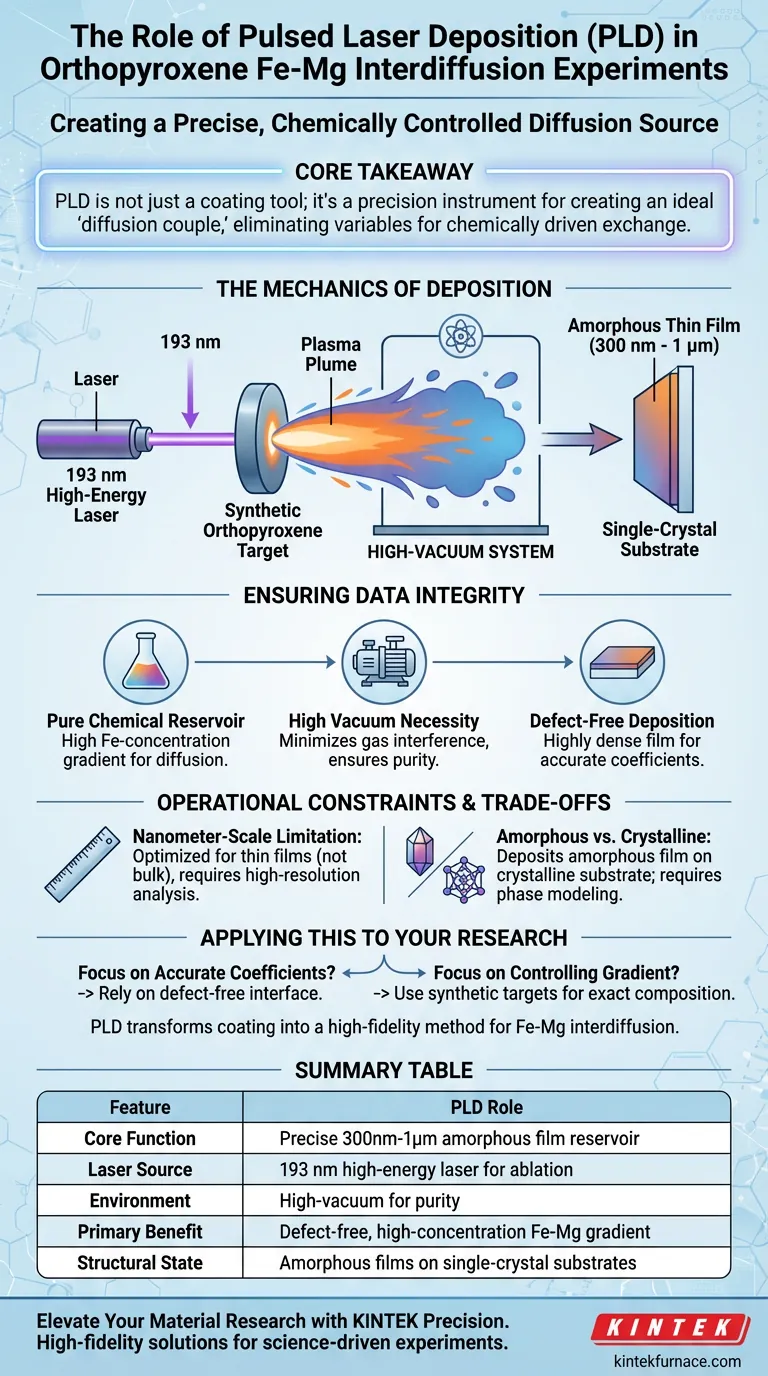
The primary role of a Pulsed Laser Deposition (PLD) system in these experiments is to fabricate a precise, chemically controlled "diffusion source" directly onto the sample surface. By utilizing high-energy 193 nm laser pulses to ablate synthetic orthopyroxene targets, the system deposits a thin, amorphous film (300 nm to 1 µm thick) onto single-crystal substrates, creating a high-concentration iron reservoir essential for driving the diffusion process.
Core Takeaway The PLD system is not merely a coating tool; it is a precision instrument used to create an ideal "diffusion couple." It eliminates experimental variables by producing a defect-free, chemically specific film that ensures the Fe-Mg exchange is driven solely by the intended chemical gradient, rather than by surface impurities or structural inconsistencies.
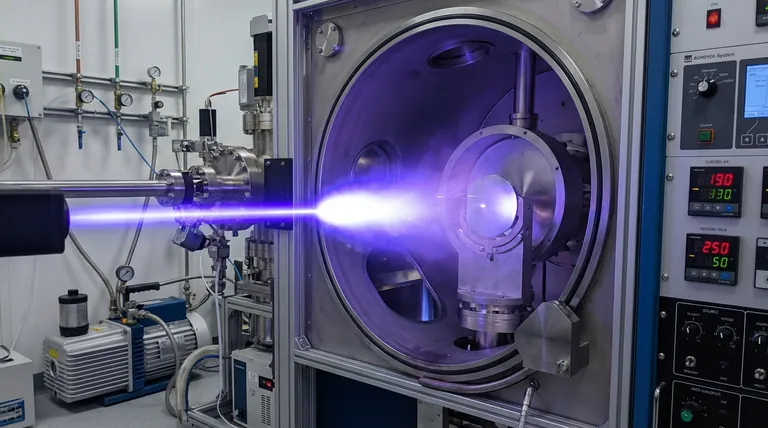
The Mechanics of Deposition
To understand the PLD's value, you must first understand how it manipulates material at the atomic level to create the experimental setup.
Laser Ablation and Plasma Formation
The process begins with a 193 nm wavelength laser. This high-energy beam strikes a synthetic orthopyroxene target.
The energy is so intense that it ablates the target material, instantly converting it into a plasma plume. This plume contains the atomic constituents of the orthopyroxene.
Controlled Film Growth
This plasma plume travels through the chamber and condenses onto a single-crystal substrate.
This results in the growth of an amorphous thin film. The system allows researchers to target a specific film thickness, typically falling between 300 nm and 1 µm.
Ensuring Data Integrity
The quality of the diffusion data is directly tied to the quality of the initial interface between the sample and the iron source.
Creating a Pure Chemical Reservoir
The primary purpose of this deposited film is to serve as a high-concentration iron reservoir.
For Fe-Mg interdiffusion to occur, there must be a strong chemical gradient. The PLD film provides this by placing a known, iron-rich composition in direct contact with the substrate.
The Necessity of High Vacuum
As noted in supplementary technical data, the PLD process occurs within a high-vacuum system.
This environment is critical because it minimizes interference from ambient gas molecules. It ensures that the atomic flux from the laser plume lands directly on the substrate without scattering.
Defect-Free Deposition
The combination of the vacuum environment and the ablation mechanics results in a highly dense, defect-free film.
This is vital for experiments. If the film were porous or filled with defects, the diffusion rates measured would be inaccurate, reflecting the poor quality of the contact rather than the intrinsic properties of the orthopyroxene.
Operational Constraints and Trade-offs
While PLD offers superior precision, it introduces specific operational requirements that must be managed.
Nanometer-Scale Limitation
PLD is optimized for nanometer-scale thin films. It is not designed to deposit bulk materials (millimeters thick).
Researchers must design their experiments to work within the 300 nm to 1 µm range. This requires high-resolution analytical tools to measure the subsequent diffusion profiles, as the diffusion distances will be relatively short compared to bulk couples.
Amorphous vs. Crystalline Structure
The PLD deposits an amorphous (non-crystalline) film onto a single-crystal substrate.
While this provides an excellent chemical reservoir, the interface is initially distinct structurally. Researchers must account for this phase difference when modeling the initial stages of the diffusion exchange.
Applying This to Your Research
When designing your experimental protocol, use the PLD system's capabilities to align with your specific data requirements.
- If your primary focus is determining accurate diffusion coefficients: Rely on the PLD to create a defect-free interface, ensuring that the measured exchange is not an artifact of poor surface contact.
- If your primary focus is controlling the chemical gradient: Use the PLD's ability to ablate synthetic targets to set the exact initial chemical composition of your iron reservoir.
Ultimately, the PLD system transforms a standard coating process into a high-fidelity method for initializing the chemical potential necessary to measure Fe-Mg interdiffusion with exactitude.
Summary Table:
| Feature | PLD Role in Fe-Mg Interdiffusion Experiments |
|---|---|
| Core Function | Deposits a precise 300 nm to 1 µm amorphous thin film as a chemical reservoir. |
| Laser Source | 193 nm high-energy laser for target ablation and plasma plume formation. |
| Environment | High-vacuum chamber to ensure purity and minimize atomic scattering. |
| Primary Benefit | Creates a defect-free, high-concentration Fe-Mg gradient for accurate coefficients. |
| Structural State | Produces amorphous films on single-crystal substrates for ideal diffusion couples. |
Elevate Your Material Research with KINTEK Precision
High-fidelity diffusion experiments demand absolute purity and control. KINTEK provides industry-leading laboratory solutions, including customizable CVD, Vacuum, and High-Temperature Furnace systems designed to meet the rigorous demands of advanced geochemical and material science research.
Backed by expert R&D and manufacturing, our equipment ensures your experiments are driven by science, not variables. Whether you need specialized high-temp furnaces or bespoke thin-film deposition environments, KINTEK is your partner in precision.
Contact KINTEK Experts Today to Discuss Your Unique Research Needs
Visual Guide
References
- Maria A. Dias, Ralf Dohmen. Experimental determination of Fe–Mg interdiffusion in orthopyroxene as a function of Fe content. DOI: 10.1007/s00410-024-02110-7
This article is also based on technical information from Kintek Furnace Knowledge Base .
Related Products
- RF PECVD System Radio Frequency Plasma Enhanced Chemical Vapor Deposition
- MPCVD Machine System Reactor Bell-jar Resonator for Lab and Diamond Growth
- HFCVD Machine System Equipment for Drawing Die Nano Diamond Coating
- 915MHz MPCVD Diamond Machine Microwave Plasma Chemical Vapor Deposition System Reactor
- Cylindrical Resonator MPCVD Machine System for Lab Diamond Growth
People Also Ask
- What is RF in PECVD? A Critical Control for Plasma Deposition
- What is the role of RF power in PECVD and how does the RF-PECVD process work? Master Thin Film Deposition Control
- What are the applications of plasma enhanced chemical vapor deposition? Key Uses in Electronics, Optics & Materials
- What are the key advantages of PECVD technology? Achieve Low-Temperature, High-Quality Thin Film Deposition
- How are deposition rates and film properties controlled in PECVD? Master Key Parameters for Optimal Thin Films










