
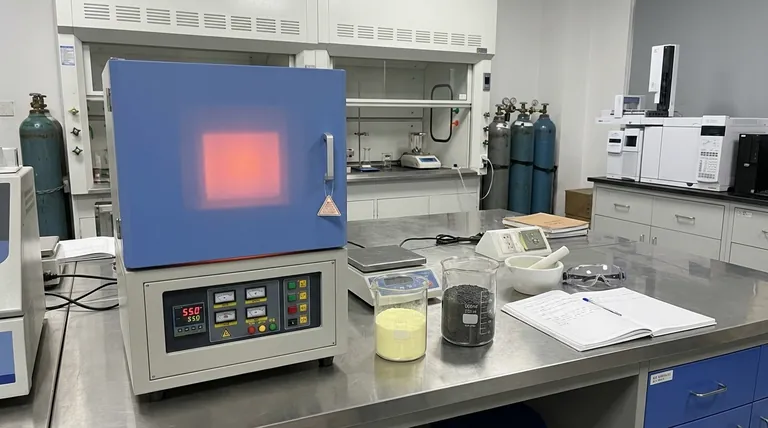
In the thermal treatment stage of nitrogen-doped carbon precursor synthesis, the primary role of a muffle furnace is to facilitate the precise thermal condensation of urea. By maintaining a stable air pyrolysis environment specifically at 550°C, the furnace transforms urea into high-purity bulk graphitic carbon nitride (g-C3N4). This intermediate material serves as the critical nitrogen and carbon source for subsequent synthesis steps.
Core Takeaway The muffle furnace acts as a stabilization chamber, isolating the urea precursors to enable a controlled phase transformation. Its ability to maintain a consistent 550°C temperature in an air atmosphere is the deciding factor in successfully producing the graphitic carbon nitride scaffold required for effective nitrogen doping.
The Mechanism of Thermal Condensation
Facilitating Air Pyrolysis
The synthesis of nitrogen-doped carbon precursors relies on air pyrolysis, a process where materials are decomposed by heat in the presence of oxygen.
The muffle furnace provides the specific oxidative environment required for this reaction. Unlike sealed vacuum furnaces, it utilizes ambient air conditions to drive the chemical changes necessary for this specific precursor stage.
Formation of g-C3N4
The ultimate goal of this thermal treatment is the production of graphitic carbon nitride (g-C3N4).
Through the application of sustained heat, the furnace drives the condensation of urea molecules. This creates a structured, high-purity bulk material that retains the nitrogen content essential for the final application.
Critical Operational Parameters
Precision Temperature Maintenance
Success in this synthesis depends on maintaining a constant temperature of 550°C.
The muffle furnace is designed to reach this set point and hold it for an extended period without significant fluctuation. This "soaking" period ensures the reaction propagates fully through the bulk material, preventing unreacted urea cores.
Controlled Heating Rates
The transformation from urea to g-C3N4 is sensitive to how quickly thermal energy is applied.
Muffle furnaces allow for programmable heating rates. By ramping up the temperature gradually, the furnace ensures the material undergoes thermal condensation rather than rapid, uncontrolled combustion.
Why a Muffle Furnace?
Uniform Heating Profile
Muffle furnaces utilize high-temperature heating coils embedded within insulating material (the "muffle").
This design isolates the chamber and ensures uniform heat distribution. This prevents hot spots that could degrade the precursor or cold spots that would result in incomplete synthesis.
Environmental Stability
The insulation capability of a muffle furnace prevents heat from escaping, stabilizing the internal environment.
This stability is critical for reproducibility. It ensures that the thermal history of the sample—how long it spent at specific temperatures—is consistent from batch to batch.
Understanding the Trade-offs
Atmosphere Control Limitations
While this specific urea synthesis requires an air environment, standard muffle furnaces are generally limited to ambient atmospheres.
If your subsequent synthesis steps require an inert atmosphere (such as Nitrogen or Argon) to prevent oxidation of the final carbon product, a standard muffle furnace will be insufficient without a specialized retort modification or gas injection system.
Cooling Rate Sensitivity
The crystallinity of the final product can be influenced by how the material cools.
While muffle furnaces excel at heating, their insulation causes them to retain heat for long periods. If your protocol requires rapid quenching to freeze a specific structure, the natural cooling rate of a muffle furnace (often around 3°C to 5°C per hour unless opened) may be too slow.
Making the Right Choice for Your Goal
To ensure high-quality precursor synthesis, align your furnace operations with your specific outcomes:
- If your primary focus is Purity: Ensure your furnace is calibrated to hold exactly 550°C, as deviations can lead to incomplete condensation or material degradation.
- If your primary focus is Reproducibility: rigorous adherence to a specific heating ramp rate is necessary to ensure the graphitic structure forms consistently across different batches.
Precise thermal management transforms simple urea into the complex graphitic scaffold necessary for high-performance nitrogen-doped materials.
Summary Table:
| Feature | Role in Precursor Synthesis | Impact on g-C3N4 Quality |
|---|---|---|
| Temperature Stability | Constant 550°C maintenance | Ensures complete conversion of urea and high purity |
| Heating Rate Control | Programmable thermal ramping | Prevents uncontrolled combustion; ensures structured condensation |
| Heating Uniformity | Isolated muffle chamber | Eliminates hot/cold spots for a consistent graphitic scaffold |
| Environment | Ambient Air Pyrolysis | Drives the oxidative chemical changes needed for nitrogen doping |
Elevate Your Precursor Synthesis with KINTEK
Precise temperature control at 550°C is the difference between successful nitrogen doping and material degradation. KINTEK provides high-performance heating solutions tailored for advanced material science. Backed by expert R&D and manufacturing, KINTEK offers Muffle, Tube, Rotary, Vacuum, and CVD systems, all customizable for your unique lab requirements.
Whether you are synthesizing g-C3N4 or complex carbon scaffolds, our equipment ensures the thermal stability and reproducibility your research demands. Contact our specialists today to find the perfect furnace for your synthesis protocol!
References
- Samantha N. Lauro, C. Buddie Mullins. Copper shape-templated N-doped carbons: exercising selective surface area control for lithium-ion batteries & beyond. DOI: 10.1039/d4ta00427b
This article is also based on technical information from Kintek Furnace Knowledge Base .
Related Products
- 1400℃ Muffle Oven Furnace for Laboratory
- 1700℃ High Temperature Muffle Oven Furnace for Laboratory
- 1800℃ High Temperature Muffle Oven Furnace for Laboratory
- 1200℃ Muffle Oven Furnace for Laboratory
- High Temperature Muffle Oven Furnace for Laboratory Debinding and Pre Sintering
People Also Ask
- How does a high-temperature laboratory muffle furnace affect material properties? Transform Anodic Oxide Films Fast
- What is the primary function of a high-temperature laboratory muffle furnace in chemical synthesis? Achieve Precision.
- What is the role of a laboratory high-temperature muffle furnace in H13 steel treatment? Optimize Tool Performance
- What is the purpose of using a laboratory high-temperature muffle furnace for drying Fe-Ni-Co catalysts? Boost Purity
- How is a laboratory high-temperature muffle furnace utilized to achieve the specific crystalline structure of LaFeO3 catalysts?



















