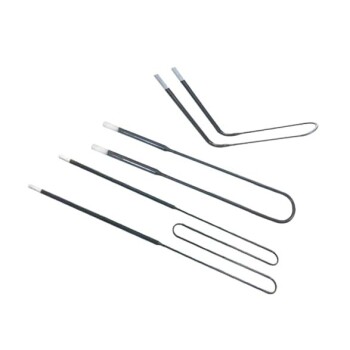
The B-type thermocouple acts as the high-precision feedback mechanism required to control rapid heating and thermal stability during the processing of liquid aluminum alloys. It specifically enables the management of critical temperature gradients at operational temperatures reaching 760 degrees Celsius.
In aluminum alloy impurity evaporation, success depends on adhering to strict thermal profiles. The B-type thermocouple provides the stable thermoelectric potential output necessary to drive precise heating rates and maintain the constant temperature cycles required for effective impurity separation.
Delivering Precision in High-Heat Environments
Ensuring Stability at Elevated Temperatures
Processing liquid aluminum alloys requires sustained operations at high temperatures, often reaching 760 degrees Celsius.
At this specific thermal range, the B-type thermocouple is selected because it provides a highly stable thermoelectric potential output. This stability is crucial for preventing sensor drift, which could lead to inaccurate readings and compromised alloy quality.
Facilitating Rapid Heating Rates
Efficiency in impurity evaporation often dictates a need for aggressive thermal ramping.
The B-type thermocouple allows temperature controllers to execute precise, rapid heating rates, such as 32 degrees Celsius per minute. This capability ensures the material reaches the target temperature quickly without sacrificing control or safety.
Managing Thermal Cycles and Gradients
Maintaining Constant Temperature Cycles
Once the target temperature is reached, the process often requires holding the alloy at a constant heat for a specific duration.
The B-type sensor provides the accurate data stream necessary for controllers to maintain these constant temperature cycles. This ensures that the evaporation process occurs uniformly across the batch.
Controlling Specific Temperature Gradients
The evaporation of impurities is physically driven by specific temperature gradients within the melt.
By providing high-precision feedback, the B-type thermocouple enables the system to manage these gradients effectively. This level of control is essential for ensuring that impurities are separated efficiently from the aluminum alloy.
Understanding Operational Requirements
Dependence on Controller Capability
While the B-type thermocouple provides precise data, it is only one part of the control loop.
To achieve a heating rate of 32 degrees Celsius per minute, the temperature controller and heating elements must be robust enough to act on the sensor's feedback immediately. Using a high-precision sensor with an inadequate control system will result in performance bottlenecks.
Optimizing Your Evaporation Process
To fully leverage the capabilities of a B-type thermocouple in your aluminum processing, align your system configuration with your specific goals:
- If your primary focus is process speed: Verify that your heating elements have the power density to match the sensor's tracking capability of 32 degrees Celsius per minute.
- If your primary focus is alloy purity: Calibrate your temperature controller to prioritize the stability of the constant temperature cycles provided by the sensor's output.
Precise thermal monitoring is the foundational step in transforming raw aluminum melt into a high-purity alloy.
Summary Table:
| Feature | Specification/Benefit |
|---|---|
| Optimal Operating Temp | Up to 760°C (Process Specific) |
| Heating Rate Support | Up to 32°C per minute |
| Key Performance Factor | Stable thermoelectric potential output |
| Primary Function | Managing thermal gradients & constant cycles |
| Process Impact | Efficient impurity separation & alloy purity |
Enhance Your Aluminum Processing with KINTEK Precision
Don't let sensor drift or thermal instability compromise your material quality. KINTEK provides industry-leading thermal solutions backed by expert R&D and world-class manufacturing. Whether you need Muffle, Tube, Rotary, Vacuum, or CVD systems, our high-temperature lab furnaces are fully customizable to meet your specific temperature gradient and heating rate requirements.
Ready to optimize your evaporation process? Contact our experts today to discover how our high-precision equipment can deliver the stability and control your laboratory demands.
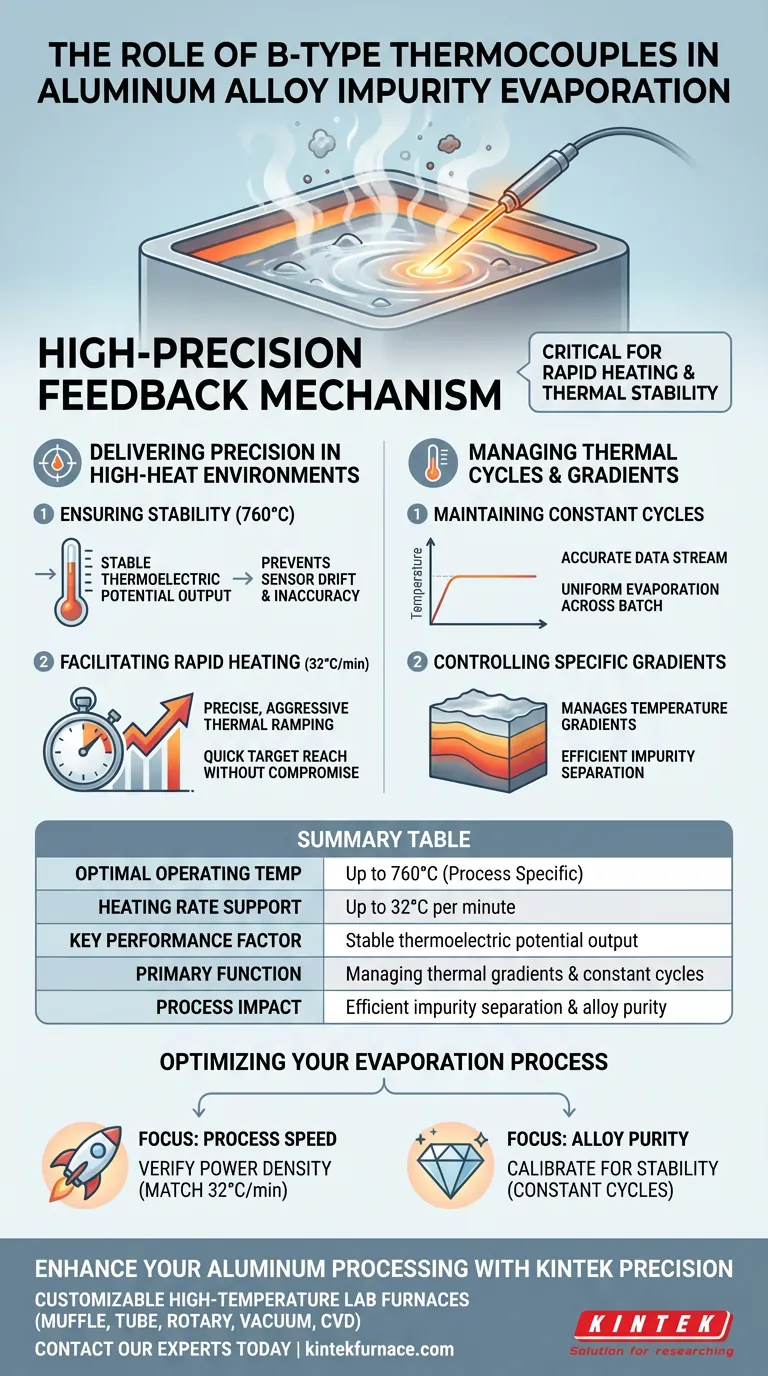
Visual Guide
References
- Aleksandar M. Mitrašinović, Milinko Radosavljević. Modeling of Impurities Evaporation Reaction Order in Aluminum Alloys by the Parametric Fitting of the Logistic Function. DOI: 10.3390/ma17030728
This article is also based on technical information from Kintek Furnace Knowledge Base .
Related Products
- Multi Zone Laboratory Quartz Tube Furnace Tubular Furnace
- Multi Heating Zones CVD Tube Furnace Machine for Chemical Vapor Deposition Equipment
- High Temperature Muffle Oven Furnace for Laboratory Debinding and Pre Sintering
- Vertical Laboratory Quartz Tube Furnace Tubular Furnace
- 1700℃ High Temperature Laboratory Tube Furnace with Alumina Tube
People Also Ask
- What temperature-related capabilities make multi zone tube furnaces valuable for research? Unlock Precision Thermal Control
- What environmental protection applications utilize multi zone tube furnaces? Unlock Precision in Waste Treatment and Green Tech
- What role do multi zone tube furnaces play in new energy research? Unlock Precise Thermal Control for Innovation
- Why are multi zone tube furnaces particularly useful for nanomaterial research? Unlock Precise Thermal Control for Advanced Synthesis
- What are the main applications of multi zone tube furnaces in university laboratories? Unlock Precision in Material Science and Energy Research