
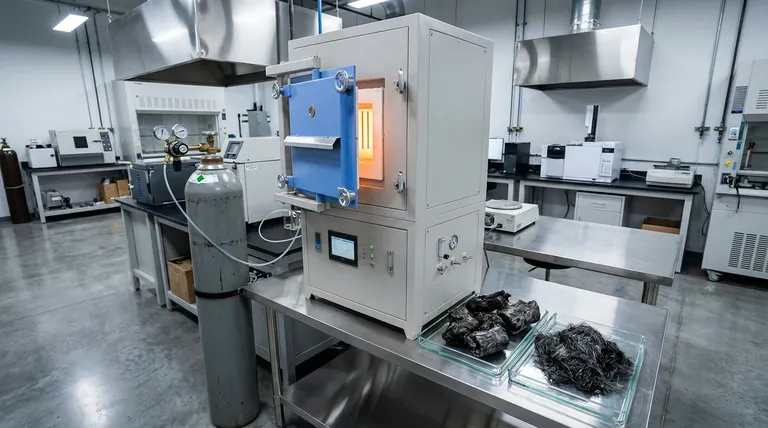
The primary purpose of a high-temperature atmosphere furnace in this context is to act as a rigorous final polishing step for recycled carbon fibers. It serves to thermally degrade and remove any polymer residues or adhesives that remain on the fibers following the initial solvolysis (chemical decomposition) process.
Core Insight: While chemical cleaning removes the bulk of the matrix, the high-temperature furnace ensures total purity. By operating in an inert environment, it strips away binding agents to separate fibers into individual filaments without compromising the structural integrity of the carbon itself.
The Mechanics of Secondary Cleaning
Targeting Stubborn Residues
Initial recycling methods, such as solvolysis, are effective at breaking down the bulk resin matrix. However, they often leave behind trace amounts of adhesive or polymer.
The high-temperature furnace addresses this by heating the material to approximately 600°C. At this specific temperature, these persistent organic residues are thermally degraded and removed completely.
The Critical Role of Nitrogen
This thermal cleaning does not occur in standard air; it takes place within an inert nitrogen environment.
This distinction is vital because carbon fibers are susceptible to oxidation and degradation if exposed to oxygen at high temperatures. The nitrogen atmosphere acts as a protective shield, allowing the heat to destroy the resin without burning or damaging the carbon fiber itself.
Why Fiber Separation Matters
Achieving Filamentization
One of the main goals of this process is the physical separation of fiber bundles.
As the furnace burns off the remaining adhesives, the bonds holding the bundles together are broken. This results in the release of individual filaments, transforming the material from clumps into discrete, usable strands.
Ensuring Uniform Dispersion
The quality of the final recycled product depends heavily on how well these filaments can be distributed.
Clean, individual filaments are essential for uniform dispersion in subsequent manufacturing stages, such as wet-laid papermaking. If the fibers remain bundled or sticky due to residue, the resulting material will have inconsistent mechanical properties.
Understanding the Operational Trade-offs
Energy Intensity
While effective, adding a thermal step at 600°C significantly increases the energy footprint of the recycling process. It transforms a chemical process into a hybrid chemical-thermal one, which may impact the overall sustainability calculation.
Process Sensitivity
The requirement for an inert nitrogen atmosphere adds operational complexity. If the inert environment is breached or strictly controlled, oxygen ingress at these temperatures could rapidly degrade the mechanical strength of the recycled fibers.
Optimizing for Material Quality
When evaluating the necessity of this secondary cleaning step, consider the requirements of your final application:
- If your primary focus is mechanical performance: Ensure the nitrogen atmosphere is strictly monitored to prevent oxidation, which preserves the fiber's original strength.
- If your primary focus is manufacturing consistency: You cannot skip this step; the complete removal of adhesives is the only way to guarantee the uniform dispersion required for high-quality remanufacturing.
Ultimately, this thermal treatment is what differentiates partially cleaned waste from high-performance recycled feedstock ready for new applications.
Summary Table:
| Feature | Description |
|---|---|
| Primary Goal | Complete removal of residual resins and adhesives via thermal degradation |
| Process Temperature | Approximately 600°C |
| Atmosphere Type | Inert Nitrogen (to prevent carbon fiber oxidation) |
| Physical Result | Separation of bundles into individual, discrete filaments |
| Key Benefit | Ensures uniform dispersion for high-quality remanufacturing |
Elevate Your Fiber Recycling Precision with KINTEK
Don't let residual resins compromise the mechanical integrity of your recycled materials. KINTEK’s high-temperature atmosphere furnaces are engineered to provide the precise thermal control and strictly inert environments required for superior carbon fiber filamentization.
Backed by expert R&D and world-class manufacturing, we offer customizable Muffle, Tube, Rotary, and Vacuum CVD systems tailored to your unique lab or production needs. Whether you are optimizing solvolysis recovery or advancing sustainable material science, KINTEK provides the reliability you need to turn waste into high-performance feedstock.
Ready to optimize your thermal cleaning process? Contact KINTEK today to discuss your custom furnace solution!
References
- Tekin Özdemir, Dirk Heider. Carbon Fiber Composites Recycling Technology Enabled by the TuFF Technology. DOI: 10.3390/recycling9010011
This article is also based on technical information from Kintek Furnace Knowledge Base .
Related Products
- 1700℃ Controlled Inert Nitrogen Atmosphere Furnace
- 1400℃ Controlled Inert Nitrogen Atmosphere Furnace
- 1200℃ Controlled Inert Nitrogen Atmosphere Furnace
- 1700℃ High Temperature Muffle Oven Furnace for Laboratory
- 1800℃ High Temperature Muffle Oven Furnace for Laboratory
People Also Ask
- How do controlled-atmosphere furnaces support polymer pyrolysis? Master SiC & Si3N4 Ceramic Conversion
- Why are controlled atmosphere high-temperature furnaces essential for the post-treatment annealing of oxide ceramic powders?
- What role does a high-temperature inert atmosphere furnace play in carbonization? Optimize Your Carbon Yield
- Why is an atmosphere-controlled furnace necessary for NMC811 synthesis? Optimize Battery Capacity & Structure
- How is atmosphere control managed during furnace operation? Master Precise Gas Environments for Superior Results



















