
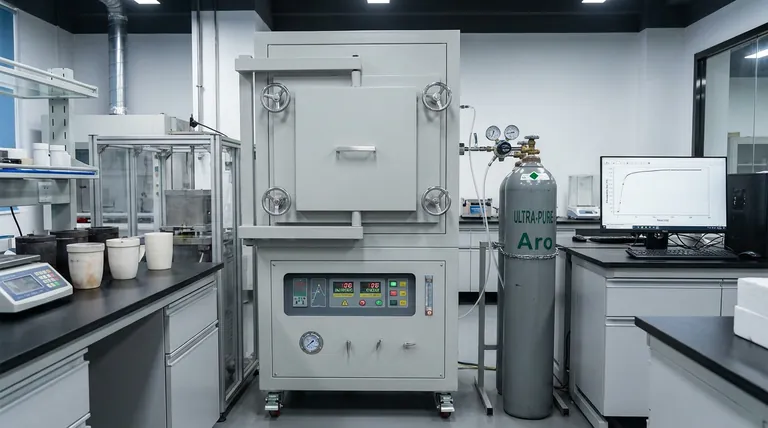
The primary purpose of performing multiple argon gas flushing cycles is to systematically purge residual oxygen and moisture from the furnace chamber before the melting process begins. By alternating between high-vacuum pumping and backfilling with ultra-pure argon, you establish a pristine inert atmosphere that prevents the reactive elements in the Sm-Co-Fe alloy from oxidizing.
The core objective is metallurgical integrity: this process eliminates contaminants that would otherwise react with Samarium, thereby preserving the alloy's intended chemical composition and critical magnetic phase structure.
The Chemistry of Contamination
Protecting Reactive Rare Earths
Samarium (Sm), a key component in Sm-Co-Fe alloys, is classified as a highly active metal. It has a strong affinity for oxygen and will react rapidly at high melting temperatures if the atmosphere is not controlled.
The Role of Inert Argon
Argon acts as a protective shield. By filling the chamber with this inert gas, you create a barrier that physically separates the molten metal from any remaining trace contaminants on the furnace walls or in the atmosphere.
Removing Stubborn Moisture
Simple vacuuming is often insufficient to remove water vapor adsorbed onto chamber walls. The flushing cycle—introducing dry argon and then pumping it out again—helps to desorb and carry away this moisture effectively.
Preserving Alloy Performance
preventing Phase Degradation
The formation of oxides, such as Samarium Oxide, is detrimental to the alloy. These oxides are non-magnetic inclusions that disrupt the magnetic phase structure, significantly lowering the final performance of the material.
Ensuring Chemical Accuracy
Precise alloy design relies on specific ratios of Sm, Co, and Fe. If the Samarium is consumed by oxidation (turning into slag rather than staying in the alloy), the final chemical composition will deviate from the design, leading to unpredictable properties.
Common Pitfalls to Avoid
The "Single Cycle" Mistake
A single flush is rarely sufficient to reach the low partial pressures of oxygen required for high-quality magnetic alloys. You must rely on multiple dilution cycles to statistically reduce contaminants to acceptable trace levels.
Argon Purity Levels
The effectiveness of this process is entirely dependent on the quality of the gas used. Using industrial-grade argon rather than ultra-pure argon can inadvertently introduce the very moisture and impurities you are trying to remove.
Making the Right Choice for Your Goal
To ensure the highest quality Sm-Co-Fe production, apply the flushing process with the following goals in mind:
- If your primary focus is Maximum Magnetic Performance: Prioritize the removal of all oxygen to prevent the formation of rare earth oxides that degrade the magnetic phase.
- If your primary focus is Chemical Consistency: Use rigorous flushing to prevent the loss of active elements like Samarium, ensuring your final alloy matches your initial calculations perfectly.
Control the atmosphere, and you control the quality of the alloy.
Summary Table:
| Key Factor | Impact on Sm-Co-Fe Alloys | Role of Argon Flushing |
|---|---|---|
| Oxygen Presence | Forms Sm-oxides, degrading magnetic phase | Displaces oxygen to prevent oxidation |
| Moisture/Water Vapor | Causes contamination and porosity | Desorbs moisture from chamber walls |
| Reactive Elements | Loss of Samarium (Sm) via slag formation | Maintains chemical composition integrity |
| Inclusions | Creates non-magnetic impurities | Ensures a clean, high-purity melt environment |
Elevate Your Alloy Quality with KINTEK Precision
Don't let oxidation compromise your magnetic materials. Backed by expert R&D and manufacturing, KINTEK offers high-performance Vacuum, Tube, and Muffle furnaces specifically designed for sensitive processes like Sm-Co-Fe alloy melting.
Our systems provide the precise atmosphere control needed for rigorous argon flushing cycles, ensuring your alloys maintain their intended chemical accuracy and magnetic performance. Whether you need a standard setup or a customizable system for unique metallurgical needs, KINTEK is your partner in laboratory excellence.
Contact KINTEK today to optimize your melting process!
References
- Zhi Hong Zhu, Jiashuo Zhang. Effect of Fe Content on Phase Behavior of Sm–Co–Fe Alloys During Solidification and Aging. DOI: 10.3390/ma18081854
This article is also based on technical information from Kintek Furnace Knowledge Base .
Related Products
- Split Chamber CVD Tube Furnace with Vacuum Station CVD Machine
- 1200℃ Controlled Inert Nitrogen Atmosphere Furnace
People Also Ask
- What role does a Tube Furnace play in the CVD growth of carbon nanotubes? Achieve High-Purity CNT Synthesis
- What are the operational and maintenance requirements for a CVD tube furnace? Ensure Precision for Thin Film Deposition
- How does a CVD tube furnace achieve high purity in gate media preparation? Master Precision Control for Flawless Films
- What are the advantages of using a CVD tube furnace for preparing gate dielectrics? Achieve High-Quality Thin Films for Transistors
- How might AI and machine learning enhance CVD tube furnace processes? Boost Quality, Speed, and Safety

