
The primary purpose of flushing a tube furnace with high-purity argon for several hours is to achieve the complete displacement of atmospheric air. This extended purging process removes reactive gases from the chamber, establishing an inert environment with an extremely low oxygen partial pressure. This is the foundational step required to prevent uncontrolled oxidation during the heating and melting phases of high silicon steel experiments.
By eliminating atmospheric interference, you ensure that the chemical reactions within the furnace occur strictly between your added silicon sources and the pre-set oxygen within the steel. This isolation is the only way to guarantee the reliability and accuracy of your equilibrium data.
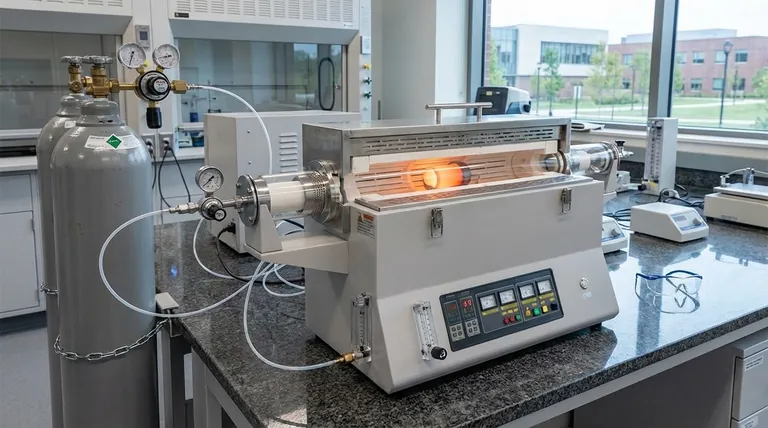
The Mechanics of Atmosphere Control
Displacing Atmospheric Contaminants
The air inside a standard furnace contains significant amounts of oxygen and nitrogen.
For high-precision experiments, simply introducing argon is not enough; you must flush the volume continuously for an extended period, often up to six hours. This duration ensures that gas pockets in "dead zones" within the furnace are thoroughly swept out and replaced by high-purity argon.
Establishing Low Oxygen Partial Pressure
The ultimate goal of this process is to reduce the oxygen partial pressure to a negligible level.
By filling the chamber with high-purity argon, you create a protective "blanket" around the sample. This inert atmosphere acts as a barrier, preventing the surrounding environment from interacting with the molten steel.
Safeguarding Chemical Equilibrium
Preventing Uncontrolled Oxidation
Molten steel is highly reactive to oxygen.
Without a strictly inert atmosphere, atmospheric oxygen would react indiscriminately with the steel melt during heating. This "uncontrolled" oxidation introduces external variables that make it impossible to distinguish between reactions caused by the atmosphere and those occurring within the material itself.
Controlling Silicon Interactions
In these experiments, you typically add specific silicon sources, such as high-purity silicon or ferrosilicon.
The experimental design relies on these additives reacting only with the pre-set oxygen content already present in the steel melt. If external oxygen is present, the silicon will react with it instead, altering the intended chemical balance and invalidating your control parameters.
Guaranteeing Data Reliability
Scientific validity in thermodynamic studies relies on closed systems.
The reliability of your equilibrium data depends entirely on the exclusion of external factors. Thorough argon flushing ensures that the results you observe are a true reflection of the steel's internal thermodynamics, rather than a byproduct of atmospheric contamination.
The Risks of Shortcuts
The Cost of Incomplete Flushing
It is often tempting to shorten the flushing time to accelerate the experimental timeline.
However, insufficient flushing leaves residual oxygen that acts as a hidden variable. This can lead to non-repeatable results, forcing you to discard data and restart experiments, which ultimately costs more time than the initial flushing period.
Material Waste
High-purity silicon and ferrosilicon reagents are valuable.
If the atmosphere is not fully inert, these reagents are consumed by reacting with the remaining air rather than the steel. This not only wastes materials but fails to achieve the specific deoxidation or alloying targets of the experiment.
Ensuring Experimental Success
To obtain valid results in high silicon steel melting, apply the following guidelines to your process:
- If your primary focus is Thermodynamic Accuracy: Adhere strictly to the extended flushing duration (e.g., six hours) to ensure the oxygen partial pressure is low enough to prevent external interference.
- If your primary focus is Material Purity: View the argon flush as a critical purification step that prevents the formation of unwanted oxide inclusions derived from atmospheric oxygen.
The time invested in flushing the furnace is not a delay; it is the fundamental control measure that validates the integrity of your entire experiment.
Summary Table:
| Feature | Importance in Silicon Steel Melting |
|---|---|
| Purge Duration | 6+ hours ensures removal of gas from "dead zones" |
| Gas Choice | High-purity argon creates a stable inert protective blanket |
| Oxygen Control | Achieves ultra-low partial pressure to prevent oxidation |
| Data Integrity | Guarantees reactions occur only between pre-set elements |
| Material Savings | Prevents waste of high-purity silicon and ferrosilicon reagents |
Achieve Unmatched Experimental Precision with KINTEK
Don't let atmospheric contamination compromise your thermodynamic data. Backed by expert R&D and world-class manufacturing, KINTEK offers high-performance Muffle, Tube, Rotary, Vacuum, and CVD systems, all customizable to meet your unique high-temperature research needs.
Whether you are conducting silicon steel melting or advanced material synthesis, our furnaces provide the atmosphere control and thermal stability you require. Contact us today to discuss your custom furnace requirements and see how our expert laboratory solutions can elevate your research outcomes.
References
- Sanjay Pindar, Manish M. Pande. Influence of Ferrosilicon Addition on Silicon-oxygen Equilibria in High-silicon Steels. DOI: 10.2355/isijinternational.isijint-2024-018
This article is also based on technical information from Kintek Furnace Knowledge Base .
Related Products
- Vacuum Sealed Continuous Working Rotary Tube Furnace Rotating Tube Furnace
- 1400℃ High Temperature Laboratory Tube Furnace with Alumina Tube
- 1700℃ High Temperature Laboratory Tube Furnace with Alumina Tube
- Magnesium Extraction and Purification Condensing Tube Furnace
- High Pressure Laboratory Vacuum Tube Furnace
People Also Ask
- What is the purpose of rotary tube furnaces? Achieve Uniform Heat Treatment for Powders and Granules
- What are the key advantages of using a rotary tube furnace? Achieve Dynamic, Uniform Heating for Powders
- How does the amount of material processed vary between batch and continuous rotary tube furnaces? Scale Your Production Efficiently
- What are the advantages of rotary tube furnaces in fuel compatibility? Boost Efficiency and Cut Costs
- What is the temperature range of some rotary tube furnaces? Achieve Uniform Heating Up to 1200°C



















