
The primary purpose of introducing high-purity nitrogen during the cooling phase is to create an inert protective atmosphere that isolates the sample from reactive elements. By displacing water vapor and air immediately after the experiment, the nitrogen prevents the sample from undergoing secondary oxidation while it remains hot but is no longer under test conditions.
The Integrity of Your Data Depends on the Cooling Phase
Ideally, your results should capture a snapshot of the sample exactly as it existed at the experimental temperature. Nitrogen acts as a chemical "freeze frame," ensuring that mass gain and microstructural data are not corrupted by unintended reactions during the cooldown.
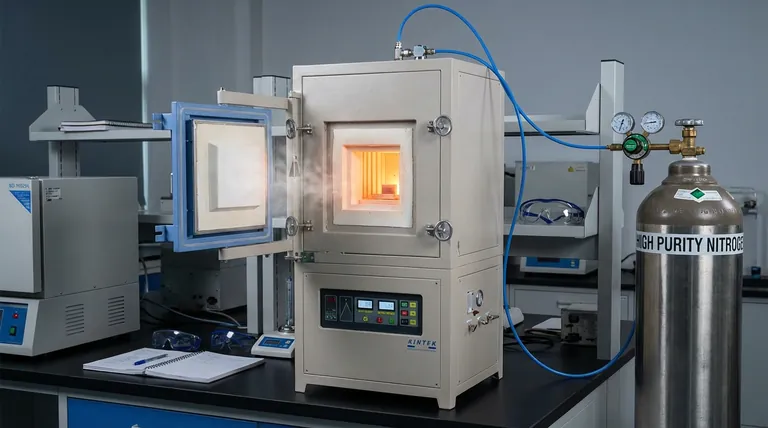
Preserving Experimental Integrity
Preventing Unintended Reactions
Once the heating source is turned off, the sample does not instantly become inert. It remains at high temperatures for a significant period, making it highly susceptible to further chemical changes.
Without a protective atmosphere, the hot sample would continue to react with any remaining oxidants or atmospheric oxygen. Introducing high-purity nitrogen effectively halts these reactions, ensuring the chemical state of the sample remains static during the temperature drop.
Isolating from Atmospheric Moisture
Air contains moisture that can drastically alter the surface chemistry of a heated sample.
The nitrogen purge acts as a physical barrier, effectively isolating the solid samples from the ambient environment. This prevents humidity from inducing secondary reactions that would otherwise skew your analysis of the final phase state.
Ensuring Data Accuracy
Validating Mass Gain Data
In oxidation experiments, the primary metric is often the mass gained by the sample as it reacts with oxygen.
If oxidation continues during the "non-prescribed" cooling process, the final weight will include reactions that occurred outside your experimental parameters. Nitrogen ensures the recorded mass gain reflects only the reaction at the specific experimental temperature.
Protecting Microstructural Evidence
The microstructure of a material evolves based on temperature and exposure to reactants.
Allowing the sample to oxidize during cooling can create surface artifacts or phase changes that did not exist at the target temperature. Nitrogen protection ensures that subsequent physical and chemical analyses reveal the true microstructure resulting from the experiment, not the cooling ramp.
Common Pitfalls to Avoid
The Importance of Purity
Not all nitrogen supplies are created equal. Using low-grade nitrogen can introduce trace amounts of oxygen or moisture into the furnace.
If the gas is not high-purity, you risk causing the exact secondary oxidation you are trying to prevent. Always verify the purity grade matches the sensitivity of your material.
Timing the Gas Switch
The transition from the reactant gas (like water vapor) to nitrogen must be precise.
If there is a lag between stopping the water vapor and introducing nitrogen, air may enter the system. The switch must be immediate to maintain the protective seal around the sample throughout the entire temperature gradient.
Making the Right Choice for Your Goal
To ensure your data withstands scrutiny, align your cooling protocol with your specific analytical focus:
- If your primary focus is Mass Gain Analysis: Ensure the nitrogen flow rate is sufficient to rapidly flush out all reactive gases immediately upon reaction termination.
- If your primary focus is Microstructural Imaging: Prioritize the highest available purity of nitrogen to prevent even trace surface oxidation that could obscure microscopic features.
By controlling the atmosphere from the moment the experiment ends until the sample reaches room temperature, you transform your data from an approximation into a definitive result.
Summary Table:
| Feature | Benefit of High-Purity Nitrogen Purge |
|---|---|
| Atmospheric Control | Creates an inert environment, isolating samples from reactive air/moisture. |
| Data Accuracy | Prevents unintended mass gain by halting oxidation exactly when the test ends. |
| Surface Integrity | Protects microstructure and phase states from cooling-related artifacts. |
| Chemical Stability | Acts as a "freeze frame" to preserve the sample's high-temperature state. |
Secure Your Research Outcomes with KINTEK Precision
Don't let secondary oxidation compromise your experimental data. At KINTEK, we understand that precision cooling is as critical as the heating itself. Backed by expert R&D and world-class manufacturing, we provide high-performance Muffle, Tube, Rotary, Vacuum, and CVD systems—all designed with advanced atmospheric controls to ensure your samples remain pristine.
Whether you need a specialized gas purging system or a fully customizable high-temperature lab furnace, our team is ready to tailor a solution to your unique research needs. Contact KINTEK today to enhance your lab’s efficiency and data reliability.
References
- Seksan Singthanu, Thanasak Nilsonthi. A Comparative Study of the Oxidation Behavior of Hot-Rolled Steel established from Medium and Thin Slabs oxidized in 20% H2O-N2 at 600-900°C. DOI: 10.48084/etasr.6168
This article is also based on technical information from Kintek Furnace Knowledge Base .
Related Products
- High Temperature Muffle Oven Furnace for Laboratory Debinding and Pre Sintering
- Mesh Belt Controlled Atmosphere Furnace Inert Nitrogen Atmosphere Furnace
- 1200℃ Controlled Inert Nitrogen Atmosphere Furnace
- 1200℃ Muffle Oven Furnace for Laboratory
- High Pressure Laboratory Vacuum Tube Furnace
People Also Ask
- Why is controlled heat treatment in a muffle furnace necessary for calcined clay? Achieve Optimal Pozzolanic Activity
- What role does a high-temperature muffle furnace play in STFO synthesis? Achieve Pure Perovskite Results
- What role does a high-temperature muffle furnace play in the multi-stage synthesis of Li0.5MnFe1.5O4? Key to Pure Spinel
- What role does a high-temperature muffle furnace play in the formation of biochar catalysts? Master Catalyst Synthesis
- What is the function of a laboratory high-temperature muffle furnace in niobate phosphor synthesis?



















