
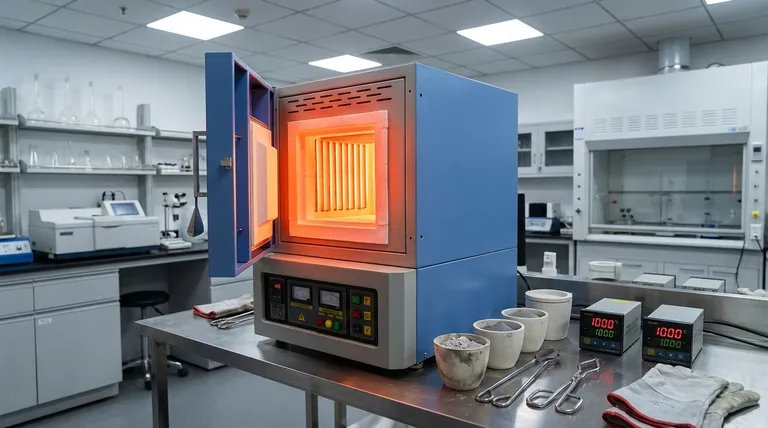
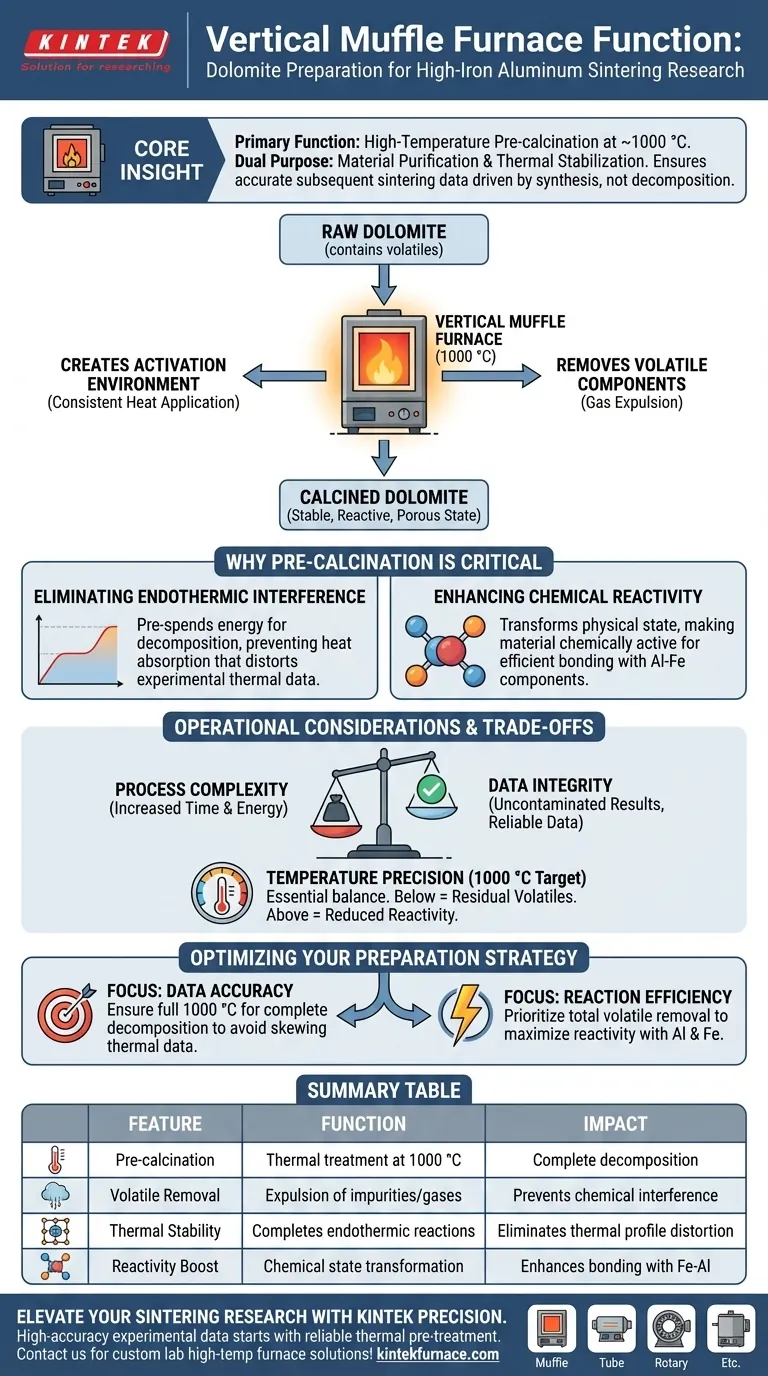
The primary function of a vertical muffle furnace in the preparation of dolomite is to facilitate high-temperature pre-calcination. Specifically, the furnace maintains a controlled environment at approximately 1000 °C to thermally treat raw dolomite before it is introduced to the high-iron aluminum sintering process.
Core Insight The furnace serves a dual purpose: material purification and thermal stabilization. By removing volatiles and completing necessary endothermic reactions early, it ensures that the subsequent sintering phase is driven purely by synthesis rather than decomposition, guaranteeing the accuracy of your experimental data.
The Mechanics of Thermal Pre-Treatment
Creating the Activation Environment
The vertical muffle furnace provides the specific thermal energy required to alter the chemical structure of dolomite.
At 1000 °C, the furnace ensures the material reaches the threshold necessary for complete thermal decomposition. This consistent heat application is the foundational step for preparing raw minerals for complex sintering tasks.
Removal of Volatile Components
Raw dolomite contains significant volatile matter that must be expelled prior to sintering.
The furnace drives off these impurities, primarily in the form of gas. Eliminating these volatiles prevents them from interfering with the delicate chemical balances required during the high-iron aluminum sintering phase.
Why Pre-Calcination is Critical
Eliminating Endothermic Interference
One of the most critical functions of the furnace is to "pre-spend" the energy required for decomposition.
If raw dolomite were used directly in sintering, it would undergo endothermic reactions (absorbing heat) inside the sintering vessel. This would distort the thermal profile of the experiment. Pre-calcination ensures these heat-absorbing reactions are completed beforehand.
Enhancing Chemical Reactivity
The heat treatment transforms the physical state of the dolomite to make it more chemically active.
By converting the raw mineral into a calcined state, the furnace significantly enhances the chemical reactivity of the material. This ensures that when the dolomite meets the high-iron aluminum components, the sintering reaction is efficient and robust.
Operational Considerations and Trade-offs
Process Complexity vs. Data Integrity
Using a vertical muffle furnace adds a significant step to the preparation workflow, increasing time and energy consumption.
However, skipping this step introduces variables that compromise data reliability. The trade-off is an investment of preparation time in exchange for uncontaminated experimental results.
Temperature Precision
The specific target of 1000 °C is not arbitrary; it balances complete decomposition with material integrity.
Operating below this temperature risks leaving residual volatiles that will outgas during sintering. Conversely, excessive temperatures could potentially alter the microstructure in ways that reduce reactivity, making precise furnace control essential.
Optimizing Your Preparation Strategy
To ensure your high-iron aluminum sintering research yields valid results, consider your specific objectives when utilizing the furnace:
- If your primary focus is Data Accuracy: Ensure the dolomite reaches the full 1000 °C to completely eliminate endothermic reactions that would skew your thermal data during sintering.
- If your primary focus is Reaction Efficiency: Prioritize the removal of all volatile components to maximize the chemical reactivity of the dolomite when it mixes with aluminum and iron sources.
By isolating the decomposition process in the muffle furnace, you transform a raw, unpredictable mineral into a stable, reactive ingredient ready for precise scientific synthesis.
Summary Table:
| Feature | Function in Dolomite Preparation | Impact on Research |
|---|---|---|
| Pre-calcination | Thermal treatment at 1000 °C | Ensures complete decomposition of raw minerals |
| Volatile Removal | Expulsion of impurities/gases | Prevents chemical interference during sintering |
| Thermal Stability | Completes endothermic reactions | Eliminates thermal profile distortion in experiments |
| Reactivity Boost | Chemical state transformation | Enhances bonding with iron-aluminum components |
Elevate Your Sintering Research with KINTEK Precision
High-accuracy experimental data starts with reliable thermal pre-treatment. KINTEK provides industry-leading Muffle, Tube, Rotary, Vacuum, and CVD systems designed to meet the rigorous demands of material science. Our vertical muffle furnaces offer the precise temperature control and uniform heating essential for calcining dolomite and other minerals without compromising microstructure.
Backed by expert R&D and manufacturing, we specialize in customizable lab high-temp furnaces tailored to your unique research needs. Ensure your sintering synthesis is driven by science, not decomposition variables.
Ready to optimize your lab's thermal processes? Contact us today to find your custom furnace solution!
Visual Guide
References
- Seong‐Jin Kim, Sung‐Mo Jung. Effect of Mill-Scale and Calcined Dolomite on High Al2O3 Sinter and Its Phase Development. DOI: 10.1007/s11663-025-03677-7
This article is also based on technical information from Kintek Furnace Knowledge Base .
Related Products
- High Temperature Muffle Oven Furnace for Laboratory Debinding and Pre Sintering
- 1800℃ High Temperature Muffle Oven Furnace for Laboratory
- Laboratory Muffle Oven Furnace with Bottom Lifting
- 1700℃ High Temperature Muffle Oven Furnace for Laboratory
- 1200℃ Muffle Oven Furnace for Laboratory
People Also Ask
- What thermal phenomena occur during polymer binder burnout in ceramic green bodies? Lab Furnace Guide
- What role does a high-temperature muffle furnace play in STFO synthesis? Achieve Pure Perovskite Results
- Why is controlled heat treatment in a muffle furnace necessary for calcined clay? Achieve Optimal Pozzolanic Activity
- How does a high-temperature muffle furnace facilitate the formation of LaNbxAl1−xO3+δ perovskite structures? Key Roles
- What role does a high-temperature muffle furnace play in the formation of biochar catalysts? Master Catalyst Synthesis



















