
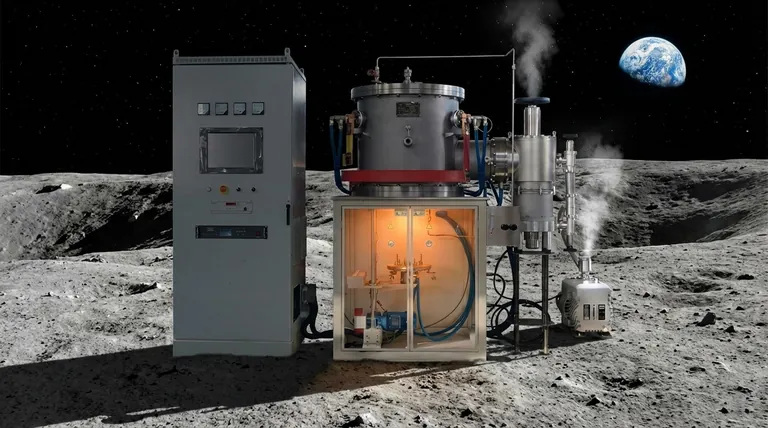
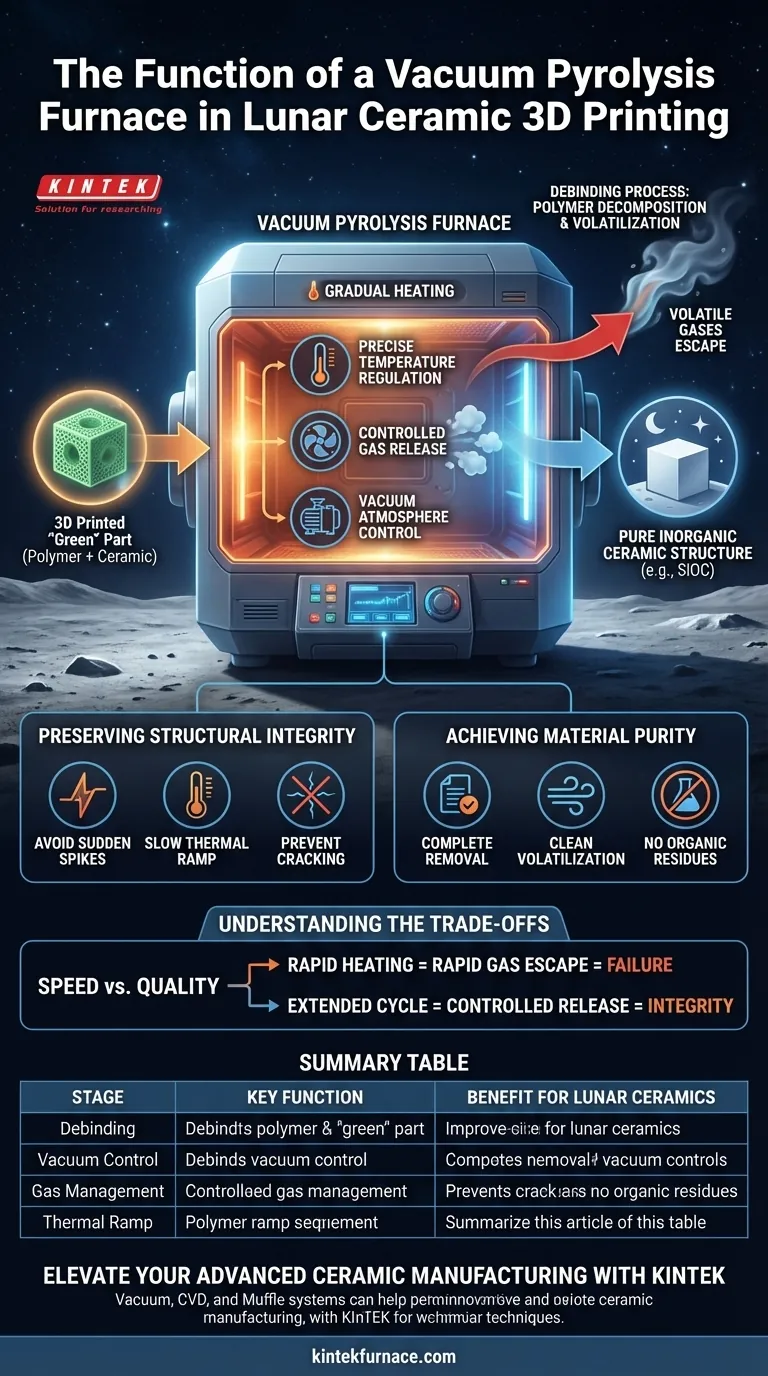
The vacuum pyrolysis furnace serves as the critical conversion stage in the lunar ceramic 3D printing workflow. Its primary function is to facilitate debinding, a process where temporary polymer binders used during printing are thermally decomposed and volatilized in a controlled vacuum environment to leave behind a pure ceramic structure.
The furnace transforms polymer-heavy "green" parts into inorganic ceramics through precise thermal decomposition. It is essential for managing the release of volatile gases, ensuring the material converts to a stable ceramic without suffering structural cracks.
Transforming Matter: The Debinding Process
Converting Polymers to Ceramics
In workflows utilizing precursor-derived ceramics or light-curing, the initial printed object relies on polymers to hold its shape. The vacuum pyrolysis furnace heats these parts to break down the organic polymer components. This chemical decomposition converts the material into stable, inorganic residues, such as SiOC (Silicon Oxycarbide) ceramics.
Achieving Material Purity
The process operates under a vacuum to strictly control the atmosphere around the printed part. This allows for the clean removal (volatilization) of the decomposed polymer binders. This step is vital to ensure the final component consists of pure ceramic material without organic contaminants.
Preserving Structural Integrity
Controlled Gas Release
As the polymers inside the printed part decompose, they turn into gas and expand. If this happens too quickly, the internal pressure can shatter the object. The furnace manages this environment to allow gases to escape at a safe, controlled rate.
Precise Temperature Regulation
The integrity of the final part is dictated by thermal precision. The furnace employs precise temperature control to avoid sudden spikes in heat. This gradual approach prevents the structural cracking that often occurs when gases escape violently during rapid decomposition.
Understanding the Trade-offs
The Risk of Thermal Speed
While the furnace is designed for conversion, it introduces a bottleneck regarding speed. You cannot rush the pyrolysis process; rapid heating triggers the rapid escape of gases. This leads to immediate structural failure or micro-cracking, rendering the printed component useless for high-stress applications.
Complexity of Atmosphere Control
Vacuum pyrolysis requires distinct atmospheric conditions compared to standard sintering. While sintering furnaces (mentioned in general ceramic production) fuse particles, this specific furnace must first strip away binders. Failing to maintain a sufficient vacuum during this stage can result in incomplete debinding and weak final parts.
Making the Right Choice for Your Workflow
To maximize the success rate of your ceramic prints, tailor your furnace settings to your specific requirements:
- If your primary focus is material purity: prioritize high vacuum levels to ensure complete volatilization of all polymer binders and residues.
- If your primary focus is structural survival: prioritize extended cycle times with slow temperature ramp rates to mitigate the stress of gas expansion.
The vacuum pyrolysis furnace is the bridge between a fragile printed shape and a durable, high-performance ceramic asset.
Summary Table:
| Stage | Key Function | Benefit for Lunar Ceramics |
|---|---|---|
| Debinding | Thermal decomposition of polymer binders | Converts "green" parts into pure inorganic structures |
| Vacuum Control | Precise atmospheric regulation | Ensures clean volatilization and high material purity |
| Gas Management | Regulated release of volatile gases | Prevents structural cracking and internal pressure buildup |
| Thermal Ramp | Gradual, precise heating profiles | Preserves structural integrity for high-stress applications |
Elevate Your Advanced Ceramic Manufacturing with KINTEK
Transitioning from complex 3D-printed shapes to high-performance ceramic assets requires absolute thermal precision. Backed by expert R&D and world-class manufacturing, KINTEK provides specialized Vacuum, CVD, and Muffle systems designed to master the critical debinding and pyrolysis stages. Whether you are developing lunar ceramic prototypes or industrial components, our customizable lab high-temperature furnaces ensure material purity and structural integrity.
Ready to optimize your ceramic workflow? Contact our experts today to discover how KINTEK’s tailored thermal solutions can drive your innovation forward.
Visual Guide
References
- Alex Ellery. Ceramics—The Forgotten but Essential Ingredients for a Circular Economy on the Moon. DOI: 10.3390/ceramics8030107
This article is also based on technical information from Kintek Furnace Knowledge Base .
Related Products
- Vacuum Heat Treat Sintering and Brazing Furnace
- Vacuum Induction Melting Furnace
- Electric Rotary Kiln Small Rotary Furnace Biomass Pyrolysis Plant Rotating Furnace
- Electric Rotary Kiln Pyrolysis Furnace Plant Machine Small Rotary Kiln Calciner
- Vacuum Heat Treat Sintering Furnace with Pressure for Vacuum Sintering
People Also Ask
- What is one of the most important uses of vacuum heat treating furnaces in aerospace? Achieve Superior Strength in Aircraft Alloys
- What are the benefits of using vacuum heat treating furnaces for metal alloys? Achieve Superior Metal Properties and Performance
- How does vacuum heat treating affect the grain structure of metal alloys? Achieve Precise Microstructure Control
- What is the temperature of a vacuum furnace brazing? Optimize Your Joint Strength and Cleanliness
- What are the steps involved in a typical vacuum brazing treatment? Master the Process for Strong, Clean Joints



















