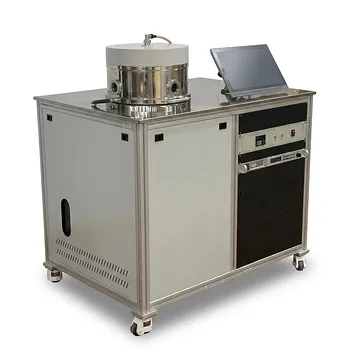
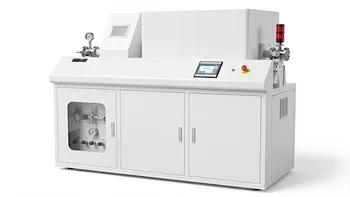
The tube furnace serves as the precision-controlled thermal engine for the rheometer. Its primary function is to create a stable, high-temperature environment—typically between 1100°C and 1465°C—around the sample crucible. This ensures that materials remain in the desired liquid or semi-solid state for accurate viscosity and crystallization kinetic measurements.
A tube furnace provides the extreme, uniform heat necessary to isolate a sample from ambient fluctuations, allowing a rheometer to measure mechanical properties without temperature-induced data drift.
Providing a Stable Thermal Environment
Precision Temperature Regulation
The furnace uses advanced control systems and thermocouples to maintain a specific temperature setpoint with minimal deviation. This high-precision regulation is a prerequisite for obtaining reliable high-temperature viscosity data, as even minor fluctuations can significantly alter a material's flow behavior.
Ensuring Thermal Uniformity
The cylindrical design of the furnace chamber, often lined with high-purity alumina refractory materials, creates a uniform thermal field. This uniformity ensures that the entire sample volume inside the crucible is at the same temperature, preventing gradients that would otherwise skew rheological results.
Facilitating Complex Testing Protocols
Managing Programmed Cooling Rates
For studying crystallization kinetics, the furnace must execute precise cooling stages, such as a steady 30°C per minute reduction. The integration with the rheometer allows the system to track how viscosity changes in real-time as the material transitions from a liquid to a solid state.
Supporting Isothermal Analysis
During isothermal testing, the tube furnace holds the sample at a constant temperature for extended periods. This stability allows researchers to observe how a material’s internal structure or chemical composition might evolve over time without the interference of temperature shifts.
Atmospheric and Material Integrity
Controlled Gas Environments
Using auxiliary tools like rotameters, the furnace can maintain a constant flow of reactive or inert gases like oxygen or nitrogen. This control over the experimental atmosphere is critical for preventing unwanted oxidation or for simulating specific industrial combustion environments.
Protection of Sensitive Components
The furnace chamber protects the rheometer’s delicate measuring geometry from direct exposure to the heating elements. By using a vacuum-formed chamber and specialized tubes, the system isolates the sample and the measurement sensors from electrical interference and physical debris.
Understanding the Trade-offs
Thermal Inertia and Response Times
High-temperature furnaces possess significant thermal mass, meaning they do not change temperature instantaneously. Researchers must account for this lag when designing fast-cooling experiments, as the furnace may struggle to match rapid theoretical cooling curves.
Material Degradation at Extreme Heat
Operating consistently at the upper limits (near 1465°C) accelerates the wear and tear on both the heating elements and the crucible materials. Frequent calibration and component replacement are necessary to maintain the "stable environment" required for high-fidelity data.
Maximizing Data Integrity in High-Temperature Rheology
To achieve the best results when pairing a tube furnace with a rheometer, you must align your hardware configuration with your specific research objectives.
- If your primary focus is crystallization kinetics: Prioritize a furnace with high-precision programmed cooling capabilities to ensure repeatable transition data.
- If your primary focus is atmospheric sensitivity: Ensure your setup includes a rotameter to strictly regulate gas flow and maintain a constant chemical environment.
- If your primary focus is long-term stability: Select high-purity alumina refractory tubes to minimize contamination and withstand prolonged isothermal holds.
The integration of a tube furnace transforms a standard rheometer into a powerful tool for characterizing the extreme-temperature behavior of ceramics, glass, and molten metals.
Summary Table:
| Key Function | Benefit to Rheological Testing | Ideal Application |
|---|---|---|
| Precision Regulation | Eliminates data drift from temp fluctuations | Reliable viscosity data (1100°C-1465°C) |
| Thermal Uniformity | Ensures the entire sample is at a consistent state | Accurate crystallization kinetics |
| Atmospheric Control | Prevents oxidation via inert or reactive gas flow | Industrial combustion simulation |
| Programmed Cooling | Tracks real-time liquid-to-solid transitions | Phase change and structural analysis |
| Sensor Protection | Shields delicate measuring geometry from heat | Long-term isothermal stability |
Elevate Your Research Precision with KINTEK
Unlock the full potential of your material analysis with KINTEK’s specialized thermal solutions. We understand that accurate high-temperature rheology requires more than just heat—it requires absolute control.
KINTEK specializes in laboratory equipment and consumables, offering a comprehensive range of high-temperature furnaces—including muffle, tube, rotary, vacuum, CVD, atmosphere, dental, and induction melting furnaces—all of which are fully customizable to meet your unique experimental needs.
Whether you are characterizing molten metals, glass, or advanced ceramics, our expert-grade equipment ensures the stable, uniform environment your data depends on.
Contact KINTEK today to discuss your custom furnace requirements and see how our precision engineering can drive your next breakthrough.
References
- Damien Perret, Isabelle Hugon. Crystallization and rheology of Na <sub>2</sub> O–CaO–Al <sub>2</sub> O <sub>3</sub> –SiO <sub>2</sub> melt in the vitrification of technological waste. DOI: 10.1111/ijag.16660
This article is also based on technical information from Kintek Furnace Knowledge Base .
Related Products
- Vacuum Sealed Continuous Working Rotary Tube Furnace Rotating Tube Furnace
- 1400℃ High Temperature Laboratory Tube Furnace with Alumina Tube
- 1700℃ High Temperature Laboratory Tube Furnace with Alumina Tube
- Magnesium Extraction and Purification Condensing Tube Furnace
- High Pressure Laboratory Vacuum Tube Furnace
People Also Ask
- What is the purpose of rotary tube furnaces? Achieve Uniform Heat Treatment for Powders and Granules
- What are the key advantages of using a rotary tube furnace? Achieve Dynamic, Uniform Heating for Powders
- What are the advantages of rotary tube furnaces in fuel compatibility? Boost Efficiency and Cut Costs
- How does the amount of material processed vary between batch and continuous rotary tube furnaces? Scale Your Production Efficiently
- What is the temperature range of some rotary tube furnaces? Achieve Uniform Heating Up to 1200°C