
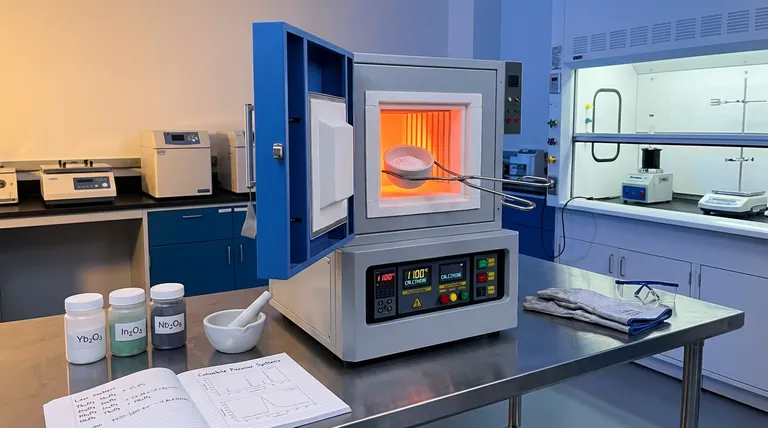
The primary function of a high-temperature muffle furnace in the columbite precursor method is to drive the solid-state reaction required to form specific intermediate compounds. It provides a stable environment, typically around 1100 °C, to calcine raw materials such as Yb2O3, In2O3, and Nb2O5. This thermal treatment synthesizes precursors like YbNbO4 and InNbO4, which are essential for the subsequent success of the ceramic processing.
Core Takeaway The muffle furnace does not simply heat the material; it acts as a phase-selection tool. By pre-reacting specific oxides into a "columbite" structure first, the furnace effectively suppresses the formation of the unwanted pyrochlore phase, guaranteeing that the final ceramic product achieves a pure perovskite structure.
The Critical Role of Thermal Treatment
Enabling Solid-State Reactions
The columbite precursor method relies on a solid-state reaction, where solid particles react chemically without melting.
The high-temperature muffle furnace creates the necessary energy barrier for this to occur. By maintaining a temperature of approximately 1100 °C, the furnace allows ions to diffuse across particle boundaries, transforming the raw oxide mixture into a new crystalline structure.
Synthesis of Intermediate Precursors
The specific goal of this furnace cycle is not to create the final ceramic immediately, but to create "columbite" precursors.
Using the raw materials Yb2O3, In2O3, and Nb2O5, the furnace synthesizes YbNbO4 and InNbO4. Generating these intermediate compounds is the defining step of this methodology.
Controlling Phase Purity
The ultimate measure of success in this process is the suppression of impurities.
In direct synthesis methods, a stable pyrochlore phase often forms, which degrades the electrical properties of the final ceramic. The muffle furnace's calcination step ensures the precursors are fully formed, which directs the reaction toward a pure perovskite phase during the final sintering stage.
Understanding the Trade-offs
Process Complexity vs. Material Quality
Using a muffle furnace for this precursor step adds time and energy costs compared to direct mixing methods ("one-pot" synthesis).
You are essentially doubling the heating steps: one cycle to make the precursor, and a second cycle to sinter the final ceramic. However, this trade-off is necessary when high-performance electrical properties are required, as direct methods often fail to eliminate the parasitic pyrochlore phase.
Uniformity Challenges
While the muffle furnace provides a high average temperature, thermal gradients can exist within the chamber.
If the powder bed is too deep or the dwell time is insufficient, the reaction may be incomplete. This results in residual unreacted oxides (Yb2O3 or Nb2O5) rather than the desired YbNbO4, defeating the purpose of the precursor step.
Making the Right Choice for Your Goal
To maximize the effectiveness of the columbite precursor method, align your furnace operations with your specific outcomes:
- If your primary focus is Phase Purity: Verify that your furnace maintains a strict 1100 °C for the full duration to ensure complete conversion to YbNbO4/InNbO4 before proceeding.
- If your primary focus is Process Efficiency: Optimize the powder loading and tray geometry to ensure uniform heat distribution, minimizing the dwell time required for full calcination.
The muffle furnace is the gatekeeper of quality, ensuring that only the correct crystal structures advance to the final processing stage.
Summary Table:
| Feature | Function in Columbite Precursor Method |
|---|---|
| Core Temperature | Approximately 1100 °C |
| Primary Mechanism | Drives solid-state ion diffusion without melting |
| Key Precursors | Synthesizes YbNbO4 and InNbO4 from raw oxides |
| Structural Goal | Suppresses parasitic pyrochlore; ensures pure perovskite |
| Primary Raw Materials | Yb2O3, In2O3, and Nb2O5 |
Elevate Your Ceramic Synthesis with KINTEK Precision
Achieving the perfect perovskite structure requires more than just heat; it requires the absolute thermal stability and phase-selection control found in KINTEK’s high-temperature systems.
Backed by expert R&D and world-class manufacturing, KINTEK offers a comprehensive range of Muffle, Tube, Rotary, Vacuum, and CVD systems. Whether you are synthesizing columbite precursors or performing final sintering, our lab furnaces are fully customizable to meet your unique materials science needs.
Ready to eliminate unwanted phases and guarantee material quality? Contact our specialists today to find the ideal thermal solution for your lab.
References
- Novel high-<i>T</i>C piezo-/ferroelectric ceramics based on a medium-entropy morphotropic phase boundary design strategy. DOI: 10.1063/5.0244768
This article is also based on technical information from Kintek Furnace Knowledge Base .
Related Products
- High Temperature Muffle Oven Furnace for Laboratory Debinding and Pre Sintering
- 1700℃ High Temperature Muffle Oven Furnace for Laboratory
- 1800℃ High Temperature Muffle Oven Furnace for Laboratory
- 1200℃ Muffle Oven Furnace for Laboratory
- 1400℃ Muffle Oven Furnace for Laboratory
People Also Ask
- What thermal phenomena occur during polymer binder burnout in ceramic green bodies? Lab Furnace Guide
- What role does a high-temperature muffle furnace play in STFO synthesis? Achieve Pure Perovskite Results
- Why is controlled heat treatment in a muffle furnace necessary for calcined clay? Achieve Optimal Pozzolanic Activity
- How does a high-temperature muffle furnace facilitate the formation of LaNbxAl1−xO3+δ perovskite structures? Key Roles
- What role does a high-temperature muffle furnace play in the multi-stage synthesis of Li0.5MnFe1.5O4? Key to Pure Spinel



















