
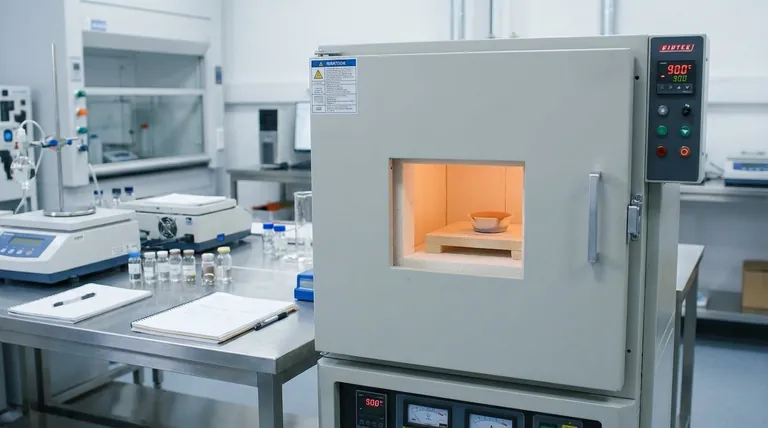
The primary function of a high-temperature muffle furnace is to facilitate solid-phase sintering, a process that fundamentally alters the microstructure of the coating materials. By subjecting spray-dried supraparticles to a uniform thermal environment between 500°C and 900°C, the furnace promotes the formation of robust silicon-oxygen-silicon (Si-O-Si) covalent bond bridges. This chemical bonding transforms loose particle aggregates into a cohesive, mechanically integrated structure capable of withstanding significant physical wear.
Core Takeaway: The muffle furnace acts as a structural hardener, moving the coating from a state of loose physical accumulation to one of chemical integration. Its ability to generate precise, uniform heat drives the formation of covalent bonds, which are the primary source of the coating's mechanical durability.
The Mechanism of Structural Reinforcement
Solid-Phase Sintering
The core process occurring within the furnace is solid-phase sintering. This goes beyond simple drying; it fuses primary particles together without melting them completely.
Formation of Covalent Bridges
During this high-temperature treatment, chemical reactions occur between the particles. Specifically, Si-O-Si covalent bond bridges are formed.
These bonds act as internal "welds" between particles. They provide the tensile and cohesive strength necessary for the coating to resist abrasion and impact.
Uniform Thermal Field
The muffle furnace provides a highly consistent thermal environment, typically ranging from 500°C to 900°C.
This uniformity ensures that sintering occurs evenly across the entire sample. It prevents weak spots that could lead to localized structural failure.
The Role of Precision and Control
Strict Adherence to Time-Temperature Curves
An automated, program-controlled muffle furnace allows for exact replication of thermal cycles.
For example, a specific cycle might involve maintaining a constant high temperature for 55 minutes followed by 5 minutes of rapid cooling.
Eliminating Human Error
Manual control of high-temperature processes introduces variables that can skew results. Automated furnaces eliminate this error margin.
This ensures that every sample undergoes the exact same thermal stress, allowing for a valid scientific comparison of the coating's durability and failure limits.
Understanding the Trade-offs
Balancing Temperature and Texture
While high heat increases density and strength, there is a critical balance to maintain.
Superhydrophobic coatings rely on microscopic roughness (texture) to repel water. Excessive heat or prolonged exposure could overly densify the material, smoothing out the necessary roughness and reducing water repellency.
Thermal Stress on Substrates
The high temperatures required for sintering (up to 900°C) impose significant stress on the underlying substrate.
The process must be carefully managed to ensure the substrate does not degrade or warp while the coating is being strengthened.
Making the Right Choice for Your Goal
To maximize the effectiveness of your thermal treatment, consider your specific objective:
- If your primary focus is mechanical wear resistance: Prioritize the 500°C to 900°C range to ensure the complete formation of Si-O-Si covalent bonds for maximum internal cohesion.
- If your primary focus is scientific validation and reproducibility: Utilize an automated program-controlled furnace to strictly adhere to time-temperature curves, ensuring identical thermal history for all test samples.
By controlling the thermal history, you transform a fragile surface into a durable, engineering-grade interface.
Summary Table:
| Feature | Function in Coating Reinforcement |
|---|---|
| Sintering Process | Facilitates solid-phase sintering to fuse particle aggregates. |
| Bond Formation | Promotes Si-O-Si covalent bridges for superior cohesive strength. |
| Thermal Range | Provides uniform heat between 500°C and 900°C for consistent hardening. |
| Process Control | Automated time-temperature curves ensure scientific reproducibility. |
| Structural Result | Transforms loose particles into a wear-resistant, integrated structure. |
Elevate Your Material Durability with KINTEK
Transform fragile surfaces into high-performance, engineering-grade interfaces with KINTEK’s precision thermal solutions. Backed by expert R&D and world-class manufacturing, KINTEK offers a comprehensive range of Muffle, Tube, Rotary, Vacuum, and CVD systems—all fully customizable to meet your specific research or industrial requirements.
Whether you are perfecting superhydrophobic coatings or advancing solid-phase sintering techniques, our furnaces provide the uniform thermal fields and automated controls necessary for maximum mechanical strength.
Ready to optimize your thermal processing? Contact us today to find your custom furnace solution.
References
- A Supraparticle‐Based Approach to Robust Biomimetic Superhydrophobic Coatings. DOI: 10.1002/smll.202505850
This article is also based on technical information from Kintek Furnace Knowledge Base .
Related Products
- 1700℃ High Temperature Muffle Oven Furnace for Laboratory
- 1800℃ High Temperature Muffle Oven Furnace for Laboratory
- 1200℃ Muffle Oven Furnace for Laboratory
- 1400℃ Muffle Oven Furnace for Laboratory
- High Temperature Muffle Oven Furnace for Laboratory Debinding and Pre Sintering
People Also Ask
- What is the primary function of a high-temperature laboratory muffle furnace in chemical synthesis? Achieve Precision.
- How does a high-temperature laboratory muffle furnace affect material properties? Transform Anodic Oxide Films Fast
- What role does a muffle furnace play in BCZY712 electrolyte powder production? Achieve Perfect Phase Purity
- How does the two-stage sintering process contribute to the synthesis of MeCuFeO3 perovskite? Optimize crystal purity.
- How does a muffle furnace impact Ni/MgAl2O4 catalysts? Optimize Stability and Catalytic Performance



















