
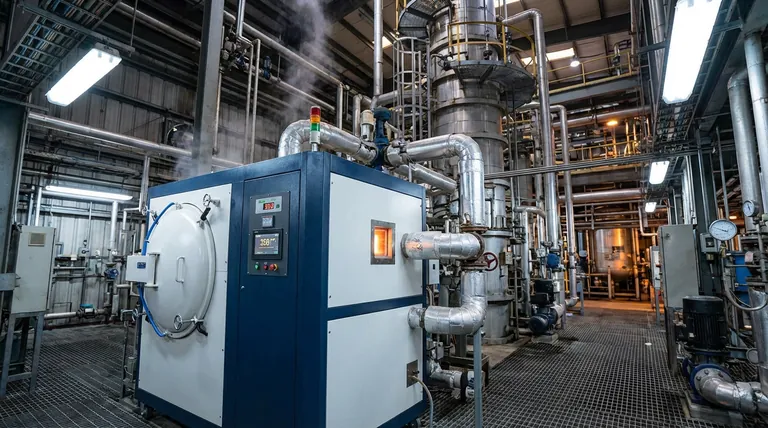
The heating furnace acts as the primary thermal driver in the distillation separation process of a High Vacuum Unit (HVU). Its specific function is to subject heavy vacuum residue—comprised of dense, long-chain hydrocarbons—to high-intensity thermal energy, raising the feedstock temperature to a precise range of 340-360°C. This thermal input is the prerequisite for reducing the material's viscosity and generating the enthalpy required for evaporation in the subsequent separation phase.
By precisely controlling the thermal state of heavy residue, the furnace ensures the material is fluid enough to flow and energetic enough to flash, enabling the separation of valuable gas oils from heavy bottoms.
The Physics of Thermal Separation
The heating furnace is not merely increasing temperature; it is altering the physical properties of the feedstock to make separation mechanically and chemically possible.
Overcoming High Viscosity
The heavy vacuum residue entering the unit contains long-chain hydrocarbons. In their natural state, these chains create a highly viscous, thick fluid that is difficult to pump or fractionate.
The furnace applies heat to physically loosen these molecular chains. By significantly reducing viscosity, the furnace ensures the feed can move efficiently into the vacuum fractionation column.
Providing Enthalpy for Evaporation
Separation in a distillation column relies on boiling point differences. The furnace provides the necessary enthalpy (internal heat energy) to trigger this phase change.
Without this high-intensity energy input, the heavier components would never reach the vapor pressure required to separate from the residue.
Operational Targets and Output
The effectiveness of the HVU is directly tied to the furnace hitting specific operational targets derived from the feedstock's chemistry.
The 340-360°C Temperature Window
The primary reference indicates a critical operating window of 340-360°C.
Maintaining this specific range is essential. It provides enough energy to liberate the desired products without reaching temperatures that might cause unwanted thermal cracking in the heater tubes.
Enabling Product Fractionation
The ultimate goal of this heating process is to prepare the feed for the vacuum fractionation column.
Once the heated feed enters the column, the energy provided by the furnace allows for the extraction of distinct product streams. These include Light Vacuum Gas Oil (LVGO), Medium Vacuum Gas Oil (MVGO), and Heavy Vacuum Gas Oil (HVGO).
Understanding the Trade-offs
While the furnace is essential, its operation requires a delicate balance between energy input and material integrity.
Precision vs. Degradation
The furnace must provide high-intensity energy, but it cannot simply blast heat indiscriminately.
If the temperature drops below 340°C, the viscosity remains too high, and separation efficiency plummets. Conversely, exceeding 360°C risks thermally degrading the long-chain hydrocarbons, potentially fouling the equipment or ruining product quality.
Energy Conversion Efficiency
As noted in supplementary contexts, industrial furnaces utilize heating elements or burners to convert energy (such as electricity or fuel) into heat.
The trade-off here is operational cost versus thermal control. The system must be efficient enough to reach high temperatures economically while remaining responsive enough to hold the narrow 20-degree window required for the HVU.
Optimizing for Yield and Efficiency
To maximize the performance of a High Vacuum Unit, you must view the furnace as a precision instrument rather than a simple heater.
- If your primary focus is Separation Efficiency: Ensure the furnace consistently maintains the 340-360°C range to provide the exact enthalpy needed for maximum evaporation of gas oils.
- If your primary focus is Hydraulic Stability: Prioritize the furnace's ability to reduce viscosity, ensuring smooth flow of heavy long-chain hydrocarbons into the column.
The heating furnace is the critical gateway that transforms heavy, unworkable residue into high-value distillates.
Summary Table:
| Feature | HVU Furnace Function & Target |
|---|---|
| Primary Role | Thermal driver for heavy residue separation |
| Temperature Range | 340°C - 360°C |
| Physical Impact | Reduces viscosity of long-chain hydrocarbons |
| Thermal Output | Provides enthalpy for phase change/evaporation |
| Key Distillates | LVGO, MVGO, and HVGO |
| Operational Risk | Thermal cracking or fouling above 360°C |
Optimize Your Distillation with Precision Thermal Solutions
Maximize your yields and maintain critical temperature windows with high-performance heating technology. KINTEK provides industry-leading thermal solutions backed by expert R&D and manufacturing. Our extensive range, including Muffle, Tube, Rotary, Vacuum, and CVD systems, is fully customizable to meet the unique demands of your laboratory or industrial high-temperature processes.
Don't let thermal instability compromise your separation efficiency. Contact KINTEK today to discover how our precision systems can enhance your operational performance.
References
- Budi Nugroho, Al Misqi. Optimization Of Furnace Efficiency In High Vacuum Units: Analyzing Heat Absorption And Loss Methods For Enhanced Fuel Utilization. DOI: 10.61978/catalyx.v1i2.360
This article is also based on technical information from Kintek Furnace Knowledge Base .
Related Products
- 2200 ℃ Tungsten Vacuum Heat Treat and Sintering Furnace
- 2200 ℃ Graphite Vacuum Heat Treat Furnace
- Molybdenum Vacuum Heat Treat Furnace
- 9MPa Air Pressure Vacuum Heat Treat and Sintering Furnace
- Vacuum Heat Treat Sintering Furnace Molybdenum Wire Vacuum Sintering Furnace
People Also Ask
- How does a tungsten-heated vacuum sintering furnace prepare (TbxY1-x)2O3 ceramics? Achieve 99%+ Density & Purity
- How do compaction pressure and vacuum sintering optimize porous ceramics? Maximize Density & Toughness
- What wear-resistance enhancements are achieved by powder coating? The Role of Vacuum Sintering Furnaces
- What role does a high-temperature vacuum sintering furnace play in the densification of WC-10(Ni, Ni/Co) alloys?
- What core role does a high-temperature vacuum sintering furnace play in Sm:YAG ceramics? Mastering Optical Clarity



















