
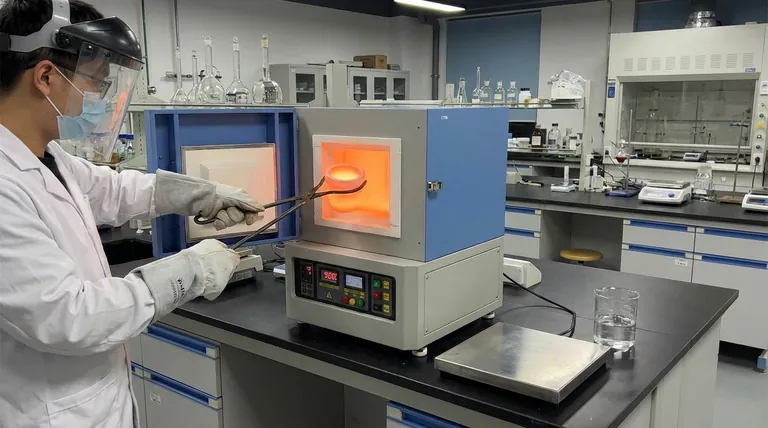
To prepare phosphate glass precursors effectively, specifically for compositions like 20Na2O–10NaCl–70P2O5, the high-temperature melting furnace requires a precise thermal protocol. The raw material mixture must be maintained at 900 °C for a duration of one hour.
Consistency in inorganic phosphate glass production relies on achieving a uniform melt prior to solidification. Holding the mixture at 900 °C for one hour ensures the raw materials are thoroughly melted and chemically homogenized before the structure is frozen.
Achieving Chemical Homogeneity
The Necessity of Dwell Time
Simply reaching the melting point is insufficient for high-quality glass production. The furnace must hold the temperature at 900 °C to allow the raw materials to fully interact.
Ensuring Uniform Distribution
During this one-hour window, the mixture undergoes chemical homogenization. This process ensures that the oxide and chloride components diffuse evenly throughout the liquid melt, eliminating local variations in composition.
The Role of Quenching
Freezing the Structure
Once the one-hour heating phase is complete, the process shifts immediately to cooling. The homogenized melt must undergo rapid quenching.
Locking in the Amorphous State
This rapid cooling acts to "freeze" the liquid structure in place. By doing so, it creates the desired amorphous glass structure rather than allowing the material to organize into a crystalline form.
Understanding the Risks and Trade-offs
The Risk of Insufficient Heating
Cutting the duration short of one hour or failing to maintain 900 °C compromises the melt. Insufficient heat exposure can lead to undissolved raw materials or chemically distinct regions within the final glass.
The Balance of Processing
While higher temperatures or longer times might seem beneficial, the specific protocol of 900 °C for one hour is targeted to ensure quality without unnecessary energy expenditure. Deviating from this standard introduces variables that may affect the physical properties of the resulting phosphate glass.
Making the Right Choice for Your Goal
To ensure the successful synthesis of your phosphate glass precursors, adhere to the following parameters:
- If your primary focus is structural integrity: Ensure the furnace maintains a steady 900 °C without fluctuation to guarantee a complete melt.
- If your primary focus is material uniformity: Do not shorten the one-hour dwell time, as this period is critical for achieving chemical homogeneity.
Precision in the melting phase is the defining factor in the quality of the final amorphous glass product.
Summary Table:
| Parameter | Specification | Purpose |
|---|---|---|
| Melting Temperature | 900 °C | Ensures complete raw material liquefaction |
| Dwell Time | 1 Hour | Facilitates chemical homogenization and diffusion |
| Cooling Method | Rapid Quenching | Freezes amorphous structure and prevents crystallization |
| Target Composition | 20Na2O–10NaCl–70P2O5 | Optimization of oxide and chloride glass precursors |
Elevate Your Glass Synthesis with KINTEK
Achieving the perfect amorphous structure requires uncompromising thermal precision. KINTEK provides state-of-the-art Muffle, Tube, and Vacuum furnace systems specifically engineered to maintain steady temperatures for critical dwell times.
Whether you are developing 20Na2O–10NaCl–70P2O5 or custom glass compositions, our expert R&D and customizable lab high-temp furnaces ensure uniform heating and chemical homogeneity for your research.
Ready to optimize your material processing? Contact KINTEK today to find your custom furnace solution!
References
- Ashleigh M. Chester, Thomas D. Bennett. Loading and thermal behaviour of ZIF-8 metal–organic framework-inorganic glass composites. DOI: 10.1039/d4dt00894d
This article is also based on technical information from Kintek Furnace Knowledge Base .
Related Products
- 1800℃ High Temperature Muffle Oven Furnace for Laboratory
- 1400℃ High Temperature Laboratory Tube Furnace with Alumina Tube
- 1700℃ High Temperature Muffle Oven Furnace for Laboratory
- 1700℃ High Temperature Laboratory Tube Furnace with Alumina Tube
- High Temperature Muffle Oven Furnace for Laboratory Debinding and Pre Sintering
People Also Ask
- How does a high-temperature laboratory muffle furnace affect material properties? Transform Anodic Oxide Films Fast
- What is the primary function of a high-temperature laboratory muffle furnace in chemical synthesis? Achieve Precision.
- Why is a laboratory high-temperature muffle furnace used for BaTiO3? Achieve Optimal Tetragonal Crystalline Phases
- What role does a muffle furnace play in plant bark mineral analysis? Essential for Precise Dry Ashing & Trace Extraction
- What is the critical role of a laboratory high-temperature muffle furnace in TiO2/LDH? Unlock Superior Crystallization



















