
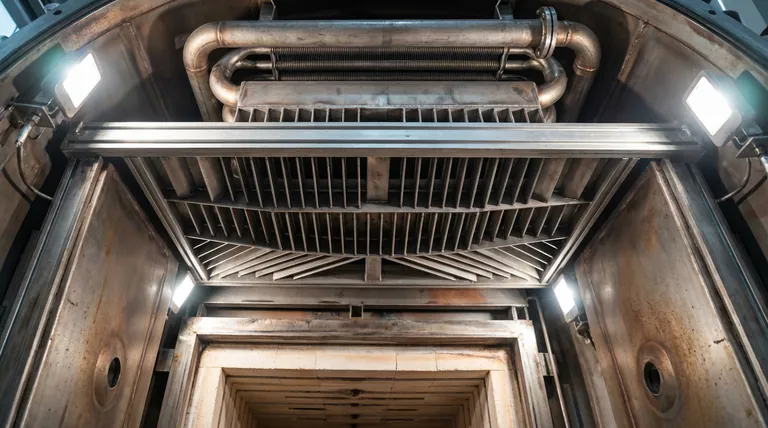
The flow-guiding grille acts as a critical aerodynamic corrective device within a vacuum high-pressure gas quenching furnace. Installed between the upper furnace chamber and the heat exchanger, its primary function is to physically redistribute circulating gas to ensure uniform airflow velocity across the entire workload.
Core Takeaway In vacuum quenching, raw gas power is insufficient without direction. The flow-guiding grille converts chaotic, uneven airflow into a consistent, high-velocity stream, eliminating "dead zones" to guarantee that every part of the workpiece cools at the same rate.
The Mechanics of Airflow Optimization
Strategic Placement
The grille is strategically positioned in the transition zone between the upper part of the furnace chamber and the heat exchanger.
This location allows it to intercept the gas immediately before or after it interacts with the cooling elements, acting as the "gatekeeper" for airflow quality.
Physical Flow Redistribution
Left to its own devices, gas flow in a vacuum furnace is naturally uneven.
The flow-guiding grille physically intervenes in this path. It forces the gas to spread out, correcting natural tendencies for the gas to channel into specific areas while ignoring others.
Eliminating Dead Zones
The most critical technical function of the grille is the elimination of low-speed dead zones.
Without this component, pockets of stagnant air can form around the workpiece. The grille breaks these pockets up, ensuring active gas circulation reaches every surface of the load.
drastic Velocity Increases
The impact on gas velocity is measurable and significant.
According to performance data, the grille can increase gas velocity near the furnace walls from 1.5 m/s to 4.3 m/s. This velocity boost is uniform, occurring at both the walls and the center of the furnace.
The Role in Thermal Dynamics
Ensuring Uniform Heat Exchange
Quenching relies on the gas absorbing heat from the workpiece and transferring it to the heat exchanger.
The grille ensures this heat exchange condition is uniform for all workpieces. By standardizing the flow, it prevents scenarios where one part of the load cools rapidly while another retains heat.
Supporting the Closed-Loop Cycle
The vacuum furnace operates on a closed loop where gas is heated by the load, cooled by the exchanger, and recirculated.
The grille acts as a stabilizing element within this loop. It optimizes the aerodynamic link between the hot load and the cooling piping, allowing the system to maintain stable cooling intensity.
The Consequence of Poor Flow Control
The Risk of Non-Uniformity
If a furnace lacks an effective flow-guiding grille, the airflow remains chaotic.
This results in significant velocity disparities between the center of the load and the walls. The consequence is unpredictable metallurgical results, where parts in "dead zones" fail to meet hardness specifications due to insufficient cooling rates.
Dependency on Physical Intervention
It is important to note that high pressure alone does not guarantee uniformity.
Simply increasing the pressure or fan speed without a flow-guiding grille often fails to solve the problem of stagnant air pockets. Physical intervention via the grille is the only reliable method to direct the high-pressure gas exactly where it is needed.
Maximizing Quenching Efficiency
If your primary focus is Hardness Consistency:
- Rely on the grille's ability to eliminate low-speed dead zones, ensuring every millimeter of the workpiece receives the same cooling impact.
If your primary focus is System Stability:
- Focus on how the grille optimizes the link to the heat exchanger, preventing hot spots that could disrupt the continuous cooling cycle.
The flow-guiding grille transforms raw gas pressure into precision cooling, bridging the gap between mechanical capacity and metallurgical quality.
Summary Table:
| Feature | Function | Impact on Performance |
|---|---|---|
| Placement | Between chamber and heat exchanger | Strategic aerodynamic control |
| Airflow Velocity | Increases from 1.5 m/s to 4.3 m/s | Faster, more consistent heat extraction |
| Dead Zone Removal | Eliminates stagnant air pockets | Uniform cooling across the entire load |
| Heat Exchange | Standardizes gas circulation | Stabilizes the closed-loop cooling cycle |
Achieve perfect metallurgical results with KINTEK’s advanced vacuum systems. Backed by expert R&D and manufacturing, KINTEK offers customizable Muffle, Tube, Rotary, Vacuum, and CVD systems designed to eliminate cooling inconsistencies and maximize lab efficiency. Contact our thermal processing experts today to optimize your quenching process.
References
- Zaiyong Ma, Jingbo Ma. Research on the uniformity of cooling of gear ring parts under vacuum high-pressure gas quenching. DOI: 10.1088/1742-6596/3080/1/012130
This article is also based on technical information from Kintek Furnace Knowledge Base .
Related Products
- 9MPa Air Pressure Vacuum Heat Treat and Sintering Furnace
- High Pressure Laboratory Vacuum Tube Furnace
- Vacuum Heat Treat Sintering Furnace with Pressure for Vacuum Sintering
- 600T Vacuum Induction Hot Press Vacuum Heat Treat and Sintering Furnace
- Vacuum Hot Press Furnace Machine Heated Vacuum Press Tube Furnace
People Also Ask
- What are the key features of vacuum pressure sintering furnaces? Unlock High-Purity, Dense Materials
- What are the key components of a vacuum pressure sintering furnace? Essential Systems for High-Performance Materials
- What safety features are integrated into vacuum pressure sintering furnaces? Ensure Operator and Equipment Protection
- What materials can be processed using vacuum pressure sintering furnaces? Unlock High-Performance Material Densification
- What are the main technical parameters of vacuum pressure sintering furnaces? Key Specs for Advanced Materials



















