
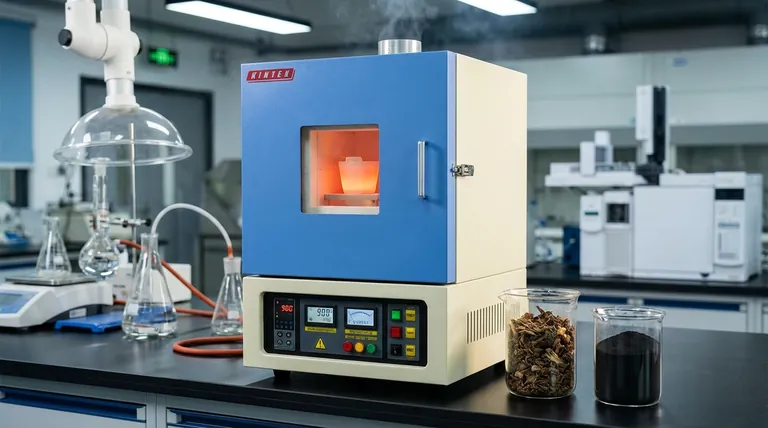
The high-temperature muffle furnace acts as the critical vessel for controlled pyrolysis, creating the precise, oxygen-limited environment required to transform raw biomass into functionalized carbon. It facilitates the carbonization process while simultaneously driving the chemical integration of iron (Fe) and nitrogen (N) into the carbon lattice. This thermal treatment is the deciding factor in determining the final material's structural integrity and catalytic capability.
By maintaining strict thermal control between 300°C and 900°C, the muffle furnace governs the transition from biomass to graphitic carbon. It is the primary tool for generating the specific pore structures and active sites that define the material's final adsorption capacity and catalytic power.
The Mechanics of Synthesis
Establishing the Pyrolysis Environment
The fundamental role of the muffle furnace is to provide a controlled anaerobic or oxygen-limited atmosphere.
Without this isolation from ambient air, the biomass would simply combust rather than carbonize. This controlled environment allows for the precise thermal decomposition of organic material necessary for synthesis.
Precision Thermal Regulation
The furnace must maintain exact temperatures within the 300°C to 900°C range.
This specific thermal window is non-negotiable for driving the chemical reactions required for Fe-N-BC. It allows operators to manipulate reaction rates and selectivity, ensuring the yield and purity of the final carbon composite.
Driving Structural and Chemical Evolution
Embedding Active Elements
High temperatures induce the embedding of iron and nitrogen elements directly into the forming carbon skeleton.
This process transforms inert biomass into a chemically active material. The heat ensures that these dopants are not just surface coatings but are integrated into the lattice structure.
Formation of Graphitic Structures
The thermal energy supplied by the furnace promotes the arrangement of carbon atoms into ordered graphitic structures.
This structural evolution provides the electrical conductivity and mechanical stability required for advanced applications.
Creation of Pore Structure
The furnace conditions cause volatile components, specifically agents like urea, to gasify and escape.
This volatilization leaves behind a rich, complex pore structure. These pores are critical, as they directly determine the material's specific surface area and its subsequent adsorption performance.
Understanding the Trade-offs
The Risk of Thermal Imprecision
While high temperatures are necessary, the specific set point directly dictates the material's properties.
If the temperature is too low, carbonization may be incomplete, leading to poor conductivity. If the temperature is uncontrolled, it may alter the pore structure unpredictably, reducing the available surface area for catalysis.
Balancing Activity and Structure
There is often a trade-off between maximizing surface area (porosity) and maximizing graphitic order (conductivity).
The muffle furnace must be programmed to find the exact thermal "sweet spot" that balances these competing needs to optimize the catalytic activity of the Fe-N-BC.
Optimizing Your Synthesis Strategy
To achieve the best results when converting biomass to Fe-N-BC, align your thermal profile with your specific performance metrics.
- If your primary focus is adsorption capacity: Prioritize temperature ranges that maximize urea volatilization to develop the richest possible pore structure.
- If your primary focus is catalytic stability: Target the higher end of the temperature spectrum (closer to 900°C) to promote robust graphitic structure formation.
Ultimately, the muffle furnace is not just a heat source; it is the precision instrument that defines the chemical identity and performance of your final catalyst.
Summary Table:
| Process Step | Temperature Range | Functional Outcome |
|---|---|---|
| Carbonization | 300°C - 900°C | Transformation of biomass into stable graphitic carbon structure. |
| Doping & Integration | High Heat | Chemical embedding of Fe and N into the carbon lattice for activity. |
| Pore Formation | High Heat | Volatilization of urea to create high surface area for adsorption. |
| Atmosphere Control | N/A | Anaerobic environment prevents combustion and ensures pyrolysis. |
Elevate Your Material Synthesis with KINTEK
Achieve the precise thermal environment required for advanced Fe-N-BC production. Backed by expert R&D and world-class manufacturing, KINTEK provides high-performance Muffle, Tube, Rotary, Vacuum, and CVD systems tailored for researchers and industrial labs. Our furnaces offer the exact temperature regulation and atmosphere control needed to optimize pore structure and catalytic activity.
Ready to customize a high-temperature solution for your unique biomass conversion needs?
References
- Tetracycline Degradation by Persulfate Assisted by Fe and N Co-Doped Biochar Derived from Spent Mushroom Substrate for Sustainability: Effect of Pyrolysis Temperature. DOI: 10.3390/su17020395
This article is also based on technical information from Kintek Furnace Knowledge Base .
Related Products
- 1700℃ High Temperature Muffle Oven Furnace for Laboratory
- 1800℃ High Temperature Muffle Oven Furnace for Laboratory
- 1200℃ Muffle Oven Furnace for Laboratory
- 1400℃ Muffle Oven Furnace for Laboratory
- Laboratory Muffle Oven Furnace with Bottom Lifting
People Also Ask
- What is the primary function of a high-temperature laboratory muffle furnace in chemical synthesis? Achieve Precision.
- How does a high-temperature laboratory muffle furnace affect material properties? Transform Anodic Oxide Films Fast
- What role does a muffle furnace play in BCZY712 electrolyte powder production? Achieve Perfect Phase Purity
- How does a muffle furnace impact Ni/MgAl2O4 catalysts? Optimize Stability and Catalytic Performance
- How does the two-stage sintering process contribute to the synthesis of MeCuFeO3 perovskite? Optimize crystal purity.



















