
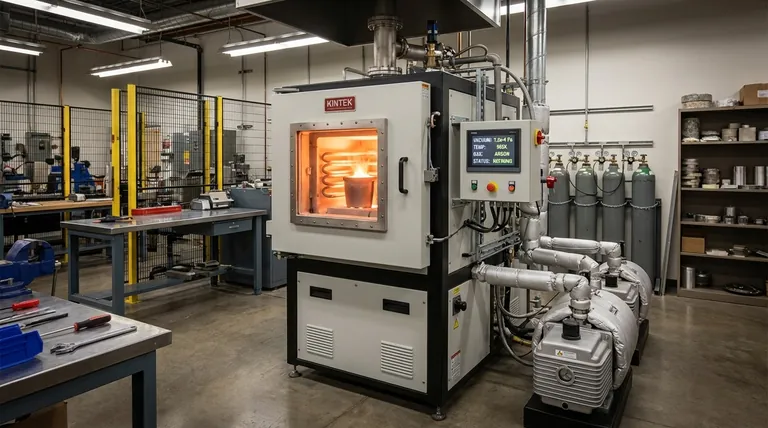
The core role of a vacuum resistance melting furnace in refining AM60 magnesium alloy is to create a highly controlled, oxygen-free environment. This specialized atmosphere is essential to prevent the severe oxidation and manage the evaporation of the highly reactive molten magnesium, enabling a successful and repeatable refining process.
The furnace's function is not merely to melt the metal, but to actively master the volatile chemistry of magnesium. By first removing reactive oxygen via vacuum and then suppressing evaporation with a protective argon atmosphere, it makes high-purity refining possible.
The Fundamental Challenge: Magnesium's Volatile Nature
To understand the furnace's role, we must first appreciate the inherent difficulties of working with magnesium at high temperatures. The entire process is designed to counteract two key chemical behaviors.
Extreme Reactivity with Oxygen
Magnesium is an extremely reactive metal. When heated to its melting point, it will react violently with any oxygen present in the air, causing severe oxidation and significant loss of material.
High Vapor Pressure and Evaporation
Even without oxygen, molten magnesium has a high tendency to evaporate, turning directly from a liquid into a gas. Under a pure vacuum, this evaporation can be rapid and uncontrolled, leading to material loss and altering the final composition of the alloy.
How the Furnace Creates the Refining Environment
The vacuum furnace executes a precise, two-stage atmospheric control process to overcome these challenges, providing a stable platform for melting and refining.
Step 1: High-Vacuum Evacuation
The first critical step is to evacuate the furnace chamber to a high vacuum state. This removes residual air, specifically the oxygen and water vapor that would otherwise react with the magnesium. This creates the clean, inert environment necessary for the next stage.
Step 2: Inert Gas Backfilling
Once the reactive gases are removed, the furnace is backfilled with high-purity argon gas to a specific low pressure, typically around 150 Pa. This low-pressure inert atmosphere serves two distinct and vital purposes.
The Dual Purpose of the Argon Atmosphere
The argon gas acts as a protective blanket over the molten alloy. It is not just a placeholder but an active control mechanism.
First, the pressure from the argon gas suppresses the evaporation of magnesium from the melt. It physically obstructs the magnesium vapor from escaping the surface, allowing for stable melting without significant material loss.
Second, it prevents oxidation by creating positive pressure within the furnace. This ensures that if any microscopic leaks were to occur, the argon would leak out rather than air leaking in, completely isolating the molten magnesium from contamination.
Precise Temperature Control
Throughout this process, the furnace must maintain a stable and uniform temperature, typically between 973-993K. This precision ensures that the alloy melts correctly and that the evaporation rate remains predictable and under control.
Understanding the Key Considerations
The success of this process hinges on understanding the interplay between vacuum, pressure, and material purity.
The Necessity of the Two-Stage Process
Neither a high vacuum alone nor an argon atmosphere alone is sufficient. Melting under a high vacuum would lead to excessive evaporation. Melting under argon without a prior vacuum would trap the initial reactive gases, causing contamination. The sequence is critical.
Furnace Integrity is Paramount
The entire process relies on the furnace's ability to achieve and hold a high vacuum and prevent leaks. Any failure in the system's integrity compromises the protective atmosphere and can lead to a failed batch.
An Environmentally Friendly Method
This controlled argon atmosphere provides an effective and environmentally sound alternative to using potent greenhouse gases like SF₆, which have historically been used to protect magnesium melts.
Making the Right Choice for Your Goal
The furnace's capabilities allow you to tailor the process to achieve specific outcomes for the AM60 alloy.
- If your primary focus is preventing material loss: The controlled low-pressure argon atmosphere is your most critical parameter, as it directly suppresses magnesium evaporation.
- If your primary focus is achieving maximum purity: The initial high-vacuum evacuation is non-negotiable to remove the primary contaminants—oxygen and water—before they can react with the melt.
- If your primary focus is process repeatability: Meticulous control over the vacuum level, argon pressure, and temperature profile is essential for producing consistent batches of high-quality alloy.
Ultimately, the vacuum resistance furnace transforms the challenge of magnesium's inherent reactivity into a precisely controlled and repeatable manufacturing advantage.
Summary Table:
| Process Stage | Key Function | Outcome for AM60 Alloy |
|---|---|---|
| High-Vacuum Evacuation | Removes oxygen and water vapor | Prevents severe oxidation and contamination |
| Inert Gas Backfilling | Backfills with low-pressure Argon | Suppresses magnesium evaporation, ensures stability |
| Precise Temperature Control | Maintains stable heat (973-993K) | Enables uniform melting and predictable evaporation |
Ready to achieve high-purity, repeatable results with your magnesium alloys?
The precise atmospheric control described here is key to mastering reactive metals like magnesium. Backed by expert R&D and manufacturing, KINTEK offers Vacuum, Muffle, Tube, Rotary, CVD systems, and other lab high-temp furnaces, all customizable for your unique needs.
Contact our experts today to discuss how a KINTEK vacuum furnace can transform your refining process!
Visual Guide

Related Products
- Vacuum Induction Melting Furnace
- Vacuum Heat Treat Sintering Furnace with Pressure for Vacuum Sintering
- Vacuum Heat Treat Sintering and Brazing Furnace
- Vacuum Heat Treat Sintering Furnace Molybdenum Wire Vacuum Sintering Furnace
- Small Vacuum Heat Treat and Tungsten Wire Sintering Furnace
People Also Ask
- What are the core functions of the High Vacuum Induction Melting (VIM) furnace? Optimize DD5 Superalloy Purification
- What is the role of VIM and directional solidification in aero-engine blade substrates? Engineering Extreme Durability
- What are the technical advantages of using a Vacuum Induction Melting furnace in the development of advanced packaging steel?
- Why is a Vacuum Induction Melting furnace (VIM) used for Cu-Zn-Al-Sn alloys? Achieve Precision Composition Control
- What role does a Vacuum Induction Melting furnace play in the production of high-aluminum nickel-based superalloys?



















