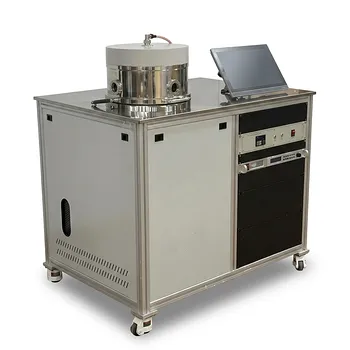
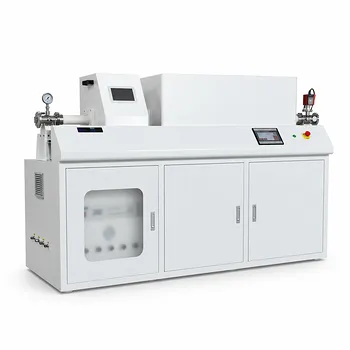
In Temperature Programmed Oxidation (TPO) experiments, the tube furnace and quartz tube function as a integrated micro-reactor system designed to characterize catalyst activity. The tube furnace provides a highly controlled, programmable thermal environment that enables precise heating ramps essential for kinetic analysis. The quartz tube acts as the reaction chamber and sample holder, maintaining high purity and chemical inertness while allowing simulated exhaust gases to flow over the catalyst bed.
The core function of this setup is to create a repeatable, stable thermal and chemical environment that allows researchers to correlate specific temperatures with oxidation events. By isolating the catalytic reaction within a pure quartz environment, the system ensures that measured carbon conversion and selectivity data are a direct result of the catalyst's performance.
The Role of the Tube Furnace in Thermal Control
Precision Heating and Ramp Control
The tube furnace is responsible for executing the programmed temperature ramp, which is the "T" in TPO. It must increase the heat at a linear, predictable rate—often as low as 2 °C/min—to ensure that oxidation peaks are clearly separated and quantifiable.
Establishing a Stable Temperature Field
A high-quality furnace creates a uniform heating zone that eliminates cold spots within the catalyst bed. This stability is critical for gathering accurate reaction kinetic data, as even minor temperature fluctuations can lead to significant errors in calculating catalyst conversion rates.
Simulating Industrial Conditions
The furnace allows the setup to reach temperatures typically ranging from ambient to 900 °C. This range is necessary to simulate various industrial exhaust environments and to determine key activity markers like T50 and T90 (the temperatures at which 50% and 90% conversion occur).
The Quartz Tube as a High-Purity Reaction Environment
The Micro-Bed and Gas Dynamics
The quartz tube serves as the physical housing for the catalyst mixture, often containing a loose blend of soot and catalyst. Its cylindrical design ensures that simulated exhaust gases flow evenly through the reactants, providing consistent contact between the gas phase and the active sites.
Chemical Inertness and Thermal Stability
Quartz is selected for its exceptional purity and resistance to thermal shock. Because it is chemically inert, it does not participate in the oxidation reaction or contaminate the sample, ensuring that the CO and CO2 detected by infrared analysis come solely from the catalytic reaction.
Support for Multiphase Characterization
Beyond simple oxidation, the quartz tube's stability allows for complex thermal processes like the Kirkendall effect or hydrogen reduction. This versatility enables researchers to prepare and characterize catalysts in the same environment, maintaining the integrity of the microstructure.
Understanding the Trade-offs
Thermal Lag and Internal Measurement
A common pitfall is the difference between the furnace setpoint and the actual bed temperature. While the furnace provides the heat, the catalyst bed may experience thermal lag, requiring internal thermocouples to ensure the kinetic data reflects the true reaction temperature.
Material Limitations of Quartz
While quartz is highly inert, it is subject to devitrification at sustained high temperatures, especially when exposed to certain alkali metals. Over time, the tube can become brittle or opaque, potentially affecting the uniformity of radiant heating.
Pressure and Flow Constraints
Quartz tubes are typically used in low-pressure laboratory settings. High-pressure TPO experiments may require specialized materials or thicker-walled tubes, as standard quartz can become a safety hazard under significant internal pressure at high temperatures.
Making the Right Choice for Your Goal
How to Apply This to Your Project
- If your primary focus is kinetic accuracy: Invest in a furnace with multi-zone heating to ensure the most uniform temperature field across the entire quartz tube length.
- If your primary focus is preventing contamination: Use high-purity, optical-grade quartz tubes and implement a rigorous cleaning protocol between TPO runs to remove residual soot or metal precursors.
- If your primary focus is high-throughput testing: Standardize the dimensions of your quartz tubes and sample placement to ensure repeatable gas hourly space velocity (GHSV) across different experiments.
By mastering the synergy between the furnace's thermal precision and the quartz tube's chemical purity, you can transform raw oxidation data into a definitive profile of catalytic performance.
Summary Table:
| Component | Core Function in TPO | Critical Advantages |
|---|---|---|
| Tube Furnace | Programmed Thermal Control | Linear heating ramps (e.g., 2°C/min) & uniform heating zones. |
| Quartz Tube | Inert Reaction Chamber | High chemical purity, thermal shock resistance, & gas flow stability. |
| Integrated System | Kinetic Activity Analysis | Accurate measurement of T50/T90 markers & carbon conversion rates. |
Elevate Your Catalyst Research with KINTEK Precision
Achieving repeatable TPO data requires the perfect synergy between thermal control and material purity. KINTEK specializes in high-performance laboratory equipment and consumables designed for demanding research environments.
We offer a comprehensive range of high-temperature furnaces, including tube, muffle, rotary, vacuum, CVD, and atmosphere models, all of which are fully customizable to meet your specific TPO or thermal processing needs. Whether you require precise multi-zone heating or high-purity quartz components, our solutions ensure your kinetic data is accurate and free from contamination.
Ready to optimize your lab’s efficiency? Contact KINTEK today to discuss your unique requirements!
References
- Diming Lou, Zhiyuan Hu. Study on the Catalytic Characteristics of Precious Metal Catalysts with Different Pt/Pd Ratios for Soot Combustion. DOI: 10.1021/acsomega.3c01543
This article is also based on technical information from Kintek Furnace Knowledge Base .
Related Products
- Vacuum Sealed Continuous Working Rotary Tube Furnace Rotating Tube Furnace
- 1400℃ High Temperature Laboratory Tube Furnace with Alumina Tube
- 1700℃ High Temperature Laboratory Tube Furnace with Alumina Tube
- Magnesium Extraction and Purification Condensing Tube Furnace
- High Pressure Laboratory Vacuum Tube Furnace
People Also Ask
- What is the purpose of rotary tube furnaces? Achieve Uniform Heat Treatment for Powders and Granules
- What are the key advantages of using a rotary tube furnace? Achieve Dynamic, Uniform Heating for Powders
- How does the amount of material processed vary between batch and continuous rotary tube furnaces? Scale Your Production Efficiently
- What are the advantages of rotary tube furnaces in fuel compatibility? Boost Efficiency and Cut Costs
- What is the temperature range of some rotary tube furnaces? Achieve Uniform Heating Up to 1200°C