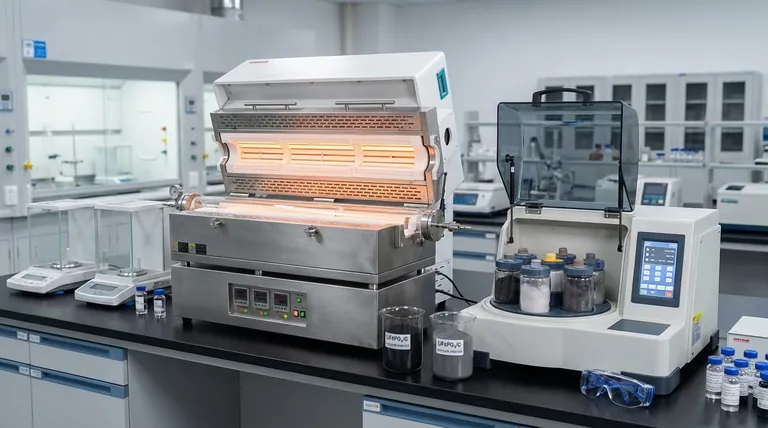
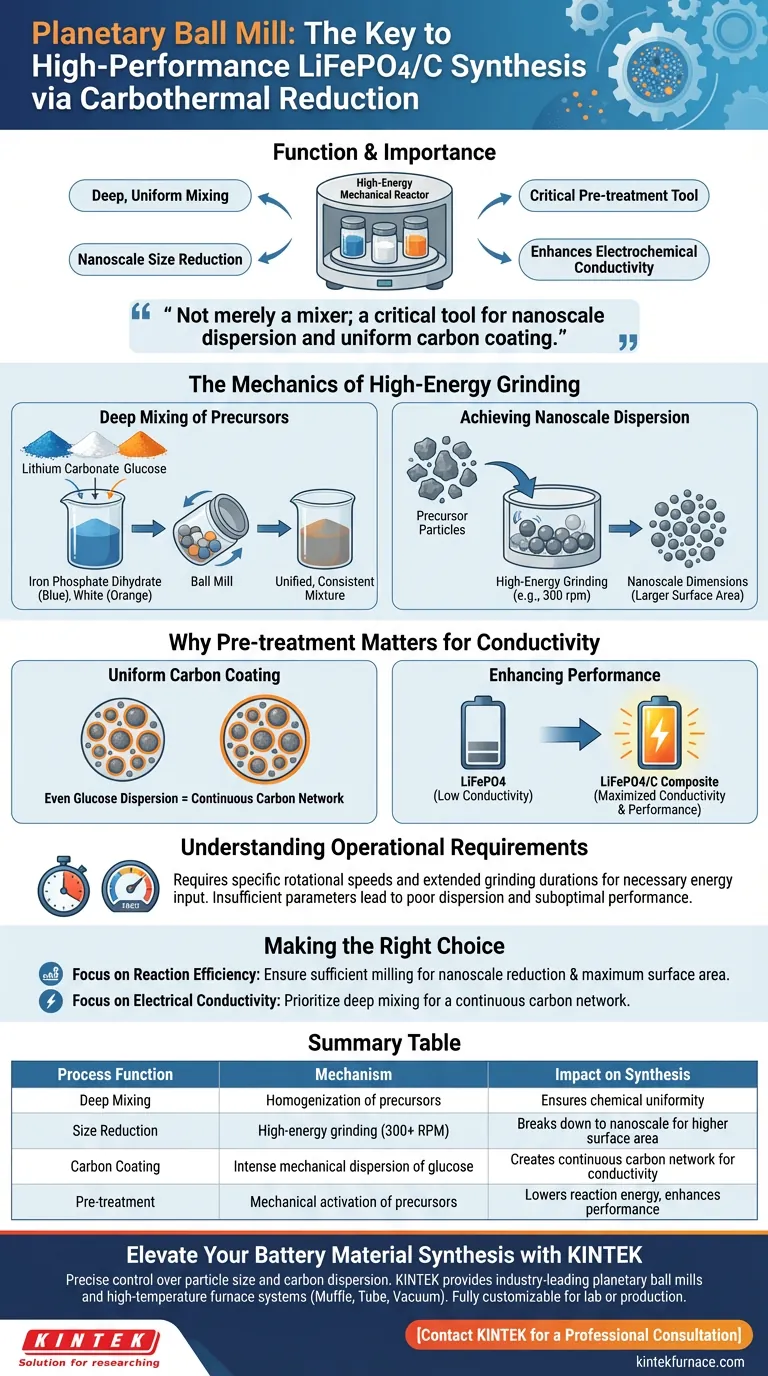
In the context of carbothermal reduction synthesis, the planetary ball mill functions as a high-energy mechanical reactor designed to achieve deep, uniform mixing of iron phosphate dihydrate, lithium carbonate, and glucose. By operating at specific high speeds, such as 300 rpm, the mill subjects these precursors to intense grinding forces. This process reduces particle size to the nanoscale, ensuring the carbon source is intimately mixed with the active materials before the thermal reaction occurs.
The planetary ball mill is not merely a mixer; it is a critical pre-treatment tool that facilitates nanoscale dispersion and uniform carbon coating, directly enabling the enhanced electrochemical conductivity required for high-performance batteries.
The Mechanics of High-Energy Grinding
Deep Mixing of Precursors
The primary function of the planetary ball mill is to homogenize the raw materials: iron phosphate dihydrate, lithium carbonate, and glucose.
Standard mixing methods often fail to achieve the intimacy required for efficient chemical reactions in solid-state synthesis.
The ball mill overcomes this by forcing these distinct compounds into a unified, consistent mixture.
Achieving Nanoscale Dispersion
The mill utilizes high-energy grinding to physically break down the precursor particles.
By operating at optimized speeds (e.g., 300 rpm) for extended periods, the mechanical force reduces the materials to nanoscale dimensions.
This reduction in particle size creates a significantly larger surface area, which is vital for the subsequent chemical reaction.
Why Pre-treatment Matters for Conductivity
Uniform Carbon Coating
In the carbothermal reduction method, glucose acts as the carbon source.
The planetary ball mill ensures that this glucose is dispersed evenly across the iron and lithium precursors.
This deep mixing results in a uniform carbon coating on the final particles, rather than isolated patches of carbon.
Enhancing Electrochemical Performance
LiFePO4 is known for having naturally low electrical conductivity.
The milling process acts as a crucial pre-treatment step to solve this intrinsic limitation.
By ensuring nanoscale dispersion and uniform coating, the mill maximizes the electrochemical conductivity of the final LiFePO4/C composite material.
Understanding the Operational Requirements
The Importance of Specific Parameters
The effectiveness of the ball mill is highly dependent on operational parameters.
The process requires specific rotational speeds and extended grinding durations to achieve the necessary energy input.
Insufficient speed or time will result in poor dispersion, leading to a battery material with suboptimal conductivity and performance.
Making the Right Choice for Your Goal
To maximize the quality of your LiFePO4/C synthesis, consider how you apply the milling process:
- If your primary focus is Reaction Efficiency: Ensure the milling duration is sufficient to reduce all precursors to the nanoscale, maximizing the surface area available for the carbothermal reaction.
- If your primary focus is Electrical Conductivity: Prioritize the deep mixing of glucose to guarantee a continuous, uniform carbon network throughout the composite.
The planetary ball mill is the bridge between raw chemical ingredients and a highly conductive, electrochemically active battery material.
Summary Table:
| Process Function | Mechanism | Impact on Synthesis |
|---|---|---|
| Deep Mixing | Homogenization of precursors (FePO4, Li2CO3, Glucose) | Ensures chemical uniformity and reaction efficiency |
| Size Reduction | High-energy grinding at 300+ RPM | Breaks particles down to the nanoscale for higher surface area |
| Carbon Coating | Intense mechanical dispersion of glucose | Creates a continuous carbon network for superior conductivity |
| Pre-treatment | Mechanical activation of precursors | Lowers reaction energy and enhances electrochemical performance |
Elevate Your Battery Material Synthesis with KINTEK
Precise control over particle size and carbon dispersion is the difference between a standard battery and a high-performance power cell. KINTEK provides industry-leading planetary ball mills and high-temperature furnace systems—including Muffle, Tube, and Vacuum furnaces—specifically designed for the rigorous demands of LiFePO4/C carbothermal reduction.
Backed by expert R&D and manufacturing, our systems are fully customizable to meet your unique lab or production requirements. Ensure uniform coating and nanoscale precision today.
Contact KINTEK for a Professional Consultation
Visual Guide
References
- Ziyang Xu, Jingkui Qu. Sustainable Utilization of Fe(Ⅲ) Isolated from Laterite Hydrochloric Acid Lixivium via Ultrasonic-Assisted Precipitation to Synthesize LiFePO4/C for Batteries. DOI: 10.3390/ma17020342
This article is also based on technical information from Kintek Furnace Knowledge Base .
Related Products
- Electric Rotary Kiln Small Rotary Furnace Biomass Pyrolysis Plant Rotating Furnace
- Electric Rotary Kiln Continuous Working Small Rotary Furnace Kiln for Pyrolysis Plant Heating
- Electric Rotary Kiln Pyrolysis Furnace Plant Machine Small Rotary Kiln Calciner
- High Temperature Muffle Oven Furnace for Laboratory Debinding and Pre Sintering
- Electric Rotary Kiln Small Rotary Furnace for Activated Carbon Regeneration
People Also Ask
- What are the main applications of a rotary kiln electric furnace? Achieve Uniform Heat Treatment for Powders
- What are the key components of a rotary kiln electric furnace? Unlock Efficient Thermal Processing
- What is the significance of the refractory lining in a rotary kiln electric furnace? Unlock Efficiency and Longevity
- What is the benefit of adjustable speed control in rotary kilns? Optimize Efficiency and Quality
- What are the main advantages of using rotary kilns for bulk solids processing? Achieve High-Volume, Uniform Thermal Processing