The high-temperature electric furnace is the critical catalyst for the synthesis and functional activation of amorphous self-healing geopolymer (ASH-G) composites. By providing a precise thermal environment—typically reaching 900 °C—the furnace drives the dehydration and densification of the geopolymer matrix while simultaneously softening internal glass micro-particles. This process enables the material to self-repair micro-cracks through capillary action and develop a protective surface glaze.
The furnace serves a dual role: it physically matures the geopolymer structure and chemically triggers the "healing" phase, transforming a static composite into a dynamic, self-repairing material.
The Synthesis and Densification Process
Matrix Dehydration and Consolidation
The primary function of the electric furnace during the synthesis phase is to facilitate thermal dehydration. As the temperature rises, chemically bound water is removed from the geopolymer structure.
This removal of moisture allows for the densification of the matrix. Without this controlled heating, the geopolymer would remain porous and lack the structural integrity required for high-performance applications.
Achieving Structural Stability
At temperatures around 900 °C, the furnace promotes densification reactions between particles. This sintering effect directly determines the final mineral phase composition and the stability of the material under extreme conditions.
The controlled heating rate—often maintained at approximately 5°C per minute—is vital. It ensures that the transition from a raw paste to a hardened refractory material occurs without internal stresses that could lead to structural failure.
Enabling the Self-Healing Mechanism
Softening the Glass Phase
The ASH-G composite relies on embedded glass micro-particles to achieve its self-healing properties. The furnace provides the exact thermal energy required to reach the softening point of these glass components.
Once softened, the glass phase becomes viscous. This allows it to flow into micro-cracks that naturally form during the dehydration process, effectively "plugging" defects at the microscopic level.
Capillary Action and Glazing
The movement of the softened glass is driven by capillary action. As the furnace maintains the high-temperature field, the glass fills voids and eventually forms a protective surface glaze.
This glaze acts as a secondary barrier. It enhances the composite’s resistance to environmental degradation and further stabilizes the internal structure against future mechanical stress.
Broader Roles in Geopolymer Preparation
Thermal Activation of Precursors
The electric furnace is also indispensable for preparing the raw materials used in ASH-G and related composites. It is used to transform inactive minerals, such as kaolin, into highly reactive metakaolin through dehydroxylation.
By applying temperatures between 750°C and 900°C, the furnace destroys the crystalline lattice of clay minerals. This creates an amorphous aluminosilicate structure, which is a prerequisite for the geopolymerization reaction.
Material Purity and Evaluation
In the evaluation phase, the furnace is used to determine the Loss on Ignition (LOI) of raw materials like fly ash. Heating samples to 1000°C ensures the complete removal of unburnt carbon and volatile substances.
This step is critical for assessing the purity and reactivity of the precursors. Accurate evaluation ensures that the subsequent synthesis of the ASH-G composite is consistent and high-quality.
Understanding the Trade-offs
Precision vs. Energy Consumption
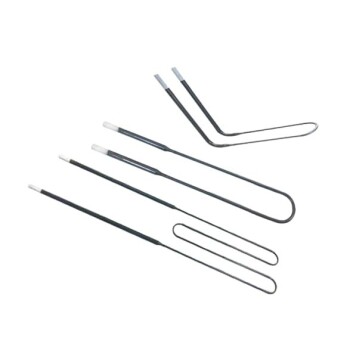
Achieving the precise 900 °C threshold requires significant energy and high-quality heating elements. If the temperature fluctuates or fails to reach the softening point of the glass phase, the self-healing mechanism will not activate, resulting in a standard, brittle geopolymer.
Heating Rates and Micro-cracking
While the furnace enables healing, the very process of high-temperature dehydration causes the micro-cracks that need to be healed. If the heating rate is too aggressive, the volume of cracks may exceed the capacity of the softened glass to fill them, compromising the final product's strength.
Making the Right Choice for Your Goal
How to Apply This to Your Project
- If your primary focus is Maximum Structural Density: Prioritize a slow, controlled heating rate (e.g., 5°C/min) to ensure uniform dehydration and sintering.
- If your primary focus is Self-Healing Efficiency: Ensure the furnace temperature is precisely calibrated to the specific softening point of your glass micro-particles, typically around 900 °C.
- If your primary focus is Precursor Reactivity: Utilize the furnace for a pre-synthesis calcination step at 750°C to 800°C to fully activate clay-based raw materials.
The high-temperature electric furnace is the fundamental tool that bridges the gap between raw aluminosilicate precursors and high-performance, self-repairing geopolymer systems.
Summary Table:
| Process Stage | Primary Furnace Function | Key Parameters |
|---|---|---|
| Synthesis & Densification | Matrix dehydration and sintering of particles | 900°C, 5°C/min heating rate |
| Self-Healing Activation | Softening glass micro-particles to fill micro-cracks | Softening point (~900°C) |
| Precursor Activation | Dehydroxylation of kaolin into metakaolin | 750°C - 900°C |
| Quality Evaluation | Loss on Ignition (LOI) and purity assessment | Up to 1000°C |
Elevate Your Advanced Material Synthesis with KINTEK
Precise thermal control is the difference between a standard geopolymer and a high-performance self-healing composite. At KINTEK, we specialize in high-performance laboratory equipment designed for rigorous research environments. Our comprehensive range of high-temperature furnaces—including muffle, tube, vacuum, CVD, and atmosphere furnaces—is engineered to provide the temperature uniformity and stability required for complex ASH-G synthesis.
Whether you need to activate precursors or trigger delicate self-healing phases, our systems are fully customizable to meet your unique laboratory specifications.
Ready to optimize your thermal processes? Contact KINTEK today for expert consultation and reliable laboratory solutions!
References
- Patrick F. Keane, Frank Bruno. Self-Healing Glass/Metakaolin-Based Geopolymer Composite Exposed to Molten Sodium Chloride and Potassium Chloride. DOI: 10.3390/app13042615
This article is also based on technical information from Kintek Furnace Knowledge Base .
Related Products
- 1700℃ High Temperature Muffle Oven Furnace for Laboratory
- 1800℃ High Temperature Muffle Oven Furnace for Laboratory
- 1700℃ High Temperature Laboratory Tube Furnace with Alumina Tube
- 1400℃ High Temperature Laboratory Tube Furnace with Alumina Tube
- 1200℃ Muffle Oven Furnace for Laboratory
People Also Ask
- What is the primary function of a high-temperature laboratory muffle furnace in chemical synthesis? Achieve Precision.
- How does a high-temperature laboratory muffle furnace affect material properties? Transform Anodic Oxide Films Fast
- What role does a muffle furnace play in BCZY712 electrolyte powder production? Achieve Perfect Phase Purity
- What role does a muffle furnace play in converting rice husk to ash? Achieve High-Purity Biogenic Silica Isolation
- Why must a high-temperature muffle furnace be used to evaluate the mineral density of tigernut composite flour?