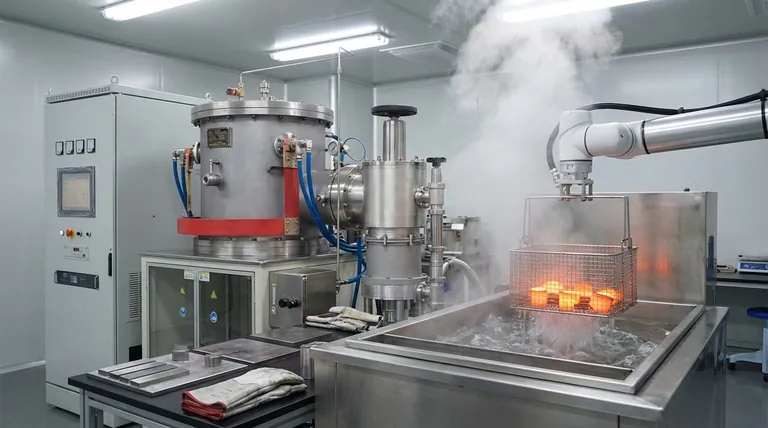
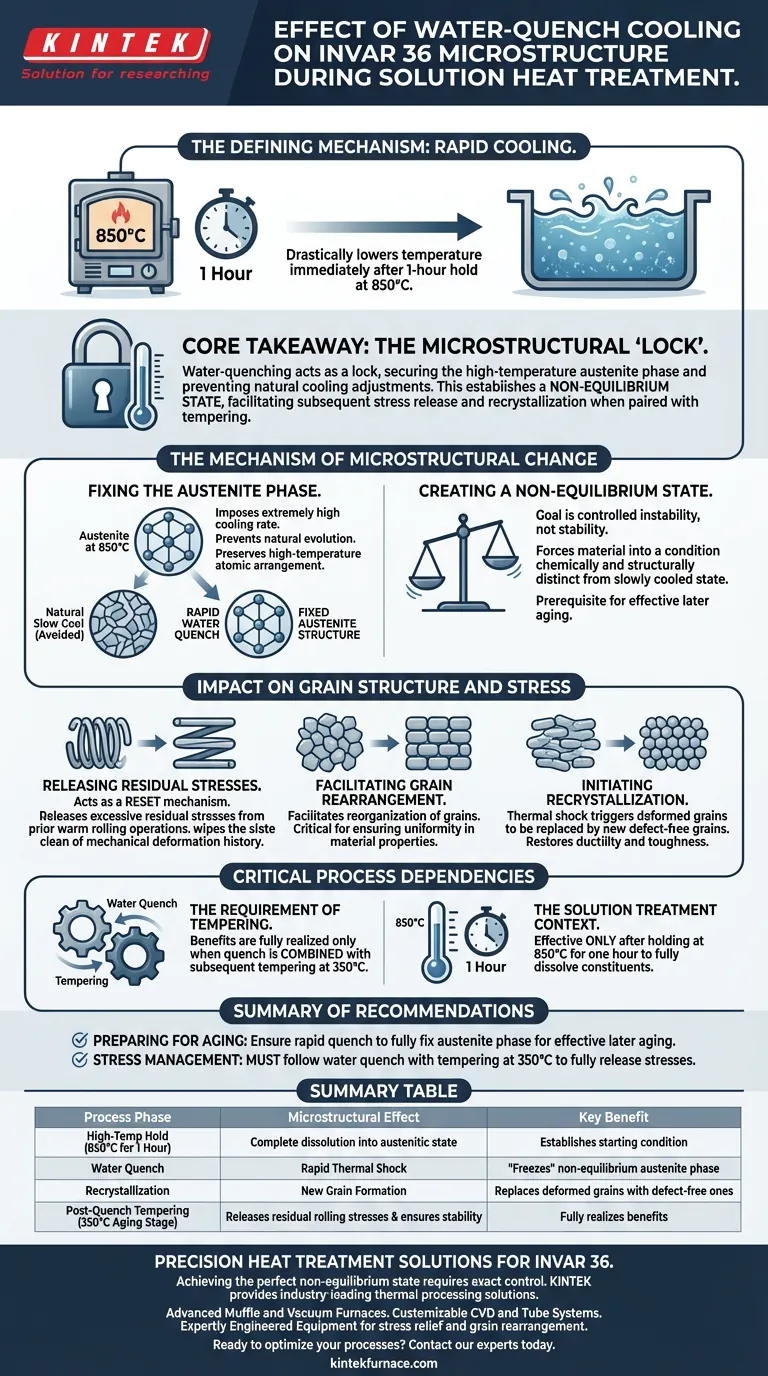
Rapid cooling is the defining mechanism. Water-quench cooling equipment is employed to drastically lower the temperature of Invar 36 immediately after it has been held at a solution temperature of 850 °C for one hour. The primary effect of this high cooling rate is to "freeze" or fix the austenite microstructure in its high-temperature state, creating a specific non-equilibrium condition required for subsequent processing.
Core Takeaway Water-quenching acts as a microstructural "lock," securing the high-temperature austenite phase to prevent natural cooling adjustments. By establishing a non-equilibrium state, this process—when paired with tempering—facilitates the release of rolling stresses and initiates the critical recrystallization of the alloy's grain structure.
The Mechanism of Microstructural Change
Fixing the Austenite Phase
The equipment’s function is to impose an extremely high cooling rate on the alloy. At 850 °C, Invar 36 exists in an austenitic state.
By cooling the material rapidly with water, you prevent the microstructure from evolving as it naturally would during a slow cool. This effectively fixes the austenite structure, preserving the atomic arrangement found at high temperatures.
Creating a Non-Equilibrium State
The goal of this process is not stability, but rather controlled instability.
Water quenching forces the material into a non-equilibrium condition. This state is chemically and structurally distinct from the state the material would achieve if allowed to cool slowly to room temperature. This specific condition is a prerequisite for the effectiveness of later aging stages.
Impact on Grain Structure and Stress
Releasing Residual Stresses
While quenching is often associated with inducing stress in other materials, its role here acts as a reset mechanism.
Invar 36 often contains excessive residual stresses from prior warm rolling operations. The solution heat treatment, capped by this water quench, helps release these residual stresses. It essentially wipes the slate clean of previous mechanical deformation history.
Facilitating Grain Rearrangement
Beyond stress relief, the quench plays a vital role in the evolution of the grains themselves.
The process facilitates grain rearrangement within the microstructure. This reorganization is critical for ensuring uniformity in the material's properties.
Initiating Recrystallization
The thermal shock and subsequent state of the material trigger the beginning of recrystallization.
This is the process where deformed grains are replaced by a new set of defect-free grains. This structural renewal is essential for restoring the ductility and toughness of the Invar 36.
Critical Process Dependencies
The Requirement of Tempering
It is critical to note that water quenching is part of a dual-step system.
The benefits described—specifically the release of stress and grain rearrangement—are fully realized when the quench is combined with subsequent tempering at 350 °C.
The Solution Treatment Context
The quench cannot be viewed in isolation from the heating cycle.
It is specifically effective only after the material has been held at 850 °C for one hour. If the material is not held at this temperature long enough to fully dissolve constituents into the austenite, the water quench will not produce the correct non-equilibrium structure.
Applying This to Your Process
Summary of Recommendations
- If your primary focus is Preparing for Aging: Ensure the quench is rapid enough to fully fix the austenite phase, as this non-equilibrium state is necessary for effective aging later.
- If your primary focus is Stress Management: Do not rely on quenching alone; you must follow the water quench with tempering at 350 °C to fully release excessive stresses from warm rolling.
Success in treating Invar 36 relies on using the water quench not as a final step, but as a precise method to lock in the microstructure required for effective tempering.
Summary Table:
| Process Phase | Microstructural Effect | Key Benefit |
|---|---|---|
| High-Temp Hold | 850 °C for 1 Hour | Complete dissolution into austenitic state |
| Water Quench | Rapid Thermal Shock | "Freezes" non-equilibrium austenite phase |
| Recrystallization | New Grain Formation | Replaces deformed grains with defect-free ones |
| Post-Quench Tempering | 350 °C Aging Stage | Releases residual rolling stresses & ensures stability |
Precision Heat Treatment Solutions for Invar 36
Achieving the perfect non-equilibrium state in Invar 36 requires exact temperature control and reliable quenching mechanisms. KINTEK provides industry-leading thermal processing solutions designed to meet the rigorous demands of material science.
Backed by expert R&D and manufacturing, we offer:
- Advanced Muffle and Vacuum Furnaces for precise solution treatment.
- Customizable CVD and Tube Systems tailored to your specific alloy requirements.
- Expertly Engineered Equipment to facilitate stress relief and grain rearrangement.
Ready to optimize your lab's high-temperature processes? Contact our experts today to discover how KINTEK’s customizable lab furnaces can enhance your material performance.
Visual Guide
References
- Mehmet Kul, Markus Merkel. Minimum and Stable Coefficient of Thermal Expansion by Three-Step Heat Treatment of Invar 36. DOI: 10.3390/cryst14121097
This article is also based on technical information from Kintek Furnace Knowledge Base .
Related Products
- Multi Heating Zones CVD Tube Furnace Machine for Chemical Vapor Deposition Equipment
- Stainless Steel Quick Release Vacuum Chain Three Section Clamp
- Vertical Laboratory Quartz Tube Furnace Tubular Furnace
- High Temperature Muffle Oven Furnace for Laboratory Debinding and Pre Sintering
- Multi Zone Laboratory Quartz Tube Furnace Tubular Furnace
People Also Ask
- What is the function of a multi-zone tube furnace in CVD synthesis? Master 2D In2Se3 Nanosheet Precision
- What environmental protection applications utilize multi zone tube furnaces? Unlock Precision in Waste Treatment and Green Tech
- What temperature-related capabilities make multi zone tube furnaces valuable for research? Unlock Precision Thermal Control
- What role do multi zone tube furnaces play in new energy research? Unlock Precise Thermal Control for Innovation
- Why are multi zone tube furnaces particularly useful for nanomaterial research? Unlock Precise Thermal Control for Advanced Synthesis