
Changing the diameter of staged combustion nozzles fundamentally alters the aerodynamics and thermal profile of the flame. specifically, reducing the nozzle diameter increases the velocity of the fuel-air jet, resulting in a more intense mixture and an elongated flame structure. This shift physically moves the primary reaction zone further down the radiant tube.
By manipulating the nozzle diameter, you are effectively controlling the flame's length and the location of its peak temperature. Smaller diameters create faster, longer flames that delay the high-temperature reaction, which is the primary mechanism for achieving ultra-low NOx emissions.
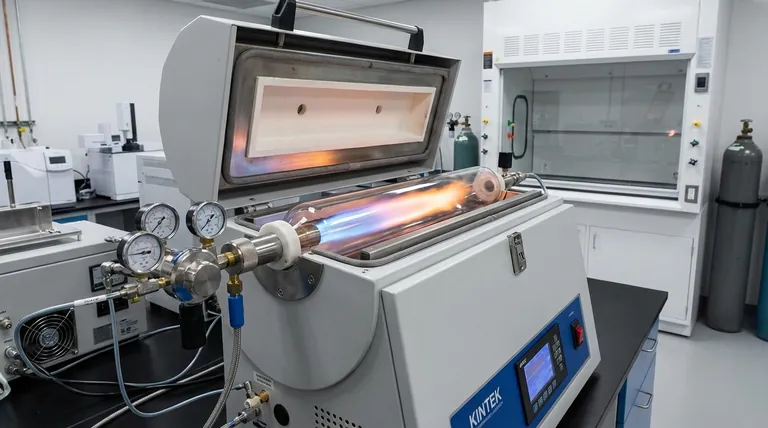
The Mechanics of Velocity and Mixing
Increasing Jet Velocity
The most immediate physical effect of reducing the nozzle diameter is a sharp increase in jet velocity.
Forcing the same volume of fuel and air through a smaller opening naturally accelerates the flow.
Intensifying the Mixture
This increased velocity leads to a higher intensity of the air-fuel mixture.
The kinetic energy introduced by the faster jet improves how thoroughly the fuel and oxidizer interact before combustion completes.
Impact on Flame Geometry
Elongating the Flame Shape
A smaller nozzle diameter results in a more elongated flame shape.
Rather than mushrooming out near the burner head, the high-velocity jet pushes the flame structure further into the radiant tube.
Shifting the Reaction Zone
Consequently, the zone of highest temperature does not occur immediately at the nozzle exit.
Instead, the high-temperature reaction zone shifts further downstream. This prevents localized overheating near the burner mounting face and distributes heat energy over a longer distance.
Thermal Profile and Emissions
Optimizing Temperature Gradients
Adjusting the diameter allows you to optimize the temperature gradient along the entire path of the flame.
By stretching the flame, you flatten the temperature spike, avoiding the intense hot spots that damage tubes and generate pollutants.
Achieving Ultra-Low NOx
This optimization is the critical factor in meeting ultra-low NOx emission standards.
By controlling the mixing intensity and delaying the peak temperature release, the system suppresses the thermal conditions required for NOx formation.
Understanding the Trade-offs
Altering Geometric Distribution
It is important to recognize that changing the nozzle diameter significantly alters the geometric distribution of the flame.
While a smaller diameter promotes elongation, it changes where the heat flux is applied to the process.
The Constraint of Tube Design
You are not tuning the burner in a vacuum; the flame geometry must match the physical constraints of the radiant tube.
An optimized gradient for emissions must still provide sufficient heat transfer in the correct zones for your specific process application.
Making the Right Choice for Your Goal
To apply these principles effectively, consider your primary operational objective:
- If your primary focus is Reducing NOx Emissions: Prioritize a smaller nozzle diameter to increase jet velocity, which shifts the high-temperature zone downstream and suppresses pollutant formation.
- If your primary focus is Tube Temperature Uniformity: Adjust the diameter to elongate the flame sufficiently so that the heat release is distributed along the tube length rather than concentrated at the burner head.
Correctly sizing the nozzle turns the physics of combustion into a precise tool for thermal uniformity.
Summary Table:
| Change in Nozzle Diameter | Jet Velocity | Flame Geometry | Peak Temperature Zone | NOx Emissions |
|---|---|---|---|---|
| Decrease (Smaller) | Increases | Elongated / Longer | Shifts further downstream | Significant Reduction |
| Increase (Larger) | Decreases | Wider / Shorter | Closer to burner head | Potential Increase |
Optimize Your Thermal Performance with KINTEK
Precise combustion control is essential for the longevity of your equipment and the quality of your output. Backed by expert R&D and manufacturing, KINTEK offers a wide range of specialized high-temperature solutions—including Muffle, Tube, Rotary, Vacuum, and CVD systems—all of which are fully customizable to your unique thermal profile requirements.
Whether you are looking to achieve ultra-low NOx emissions or require a custom-engineered furnace for your laboratory, our technical team is ready to assist. Contact us today to discover how our advanced heating technology can enhance your process efficiency.
Visual Guide

References
- Chien-Cheng Lin, Chien-Hsiung Tsai. Simulation of Staged Combustion Function in Double P-Type Radiant Tubes. DOI: 10.3390/engproc2025092094
This article is also based on technical information from Kintek Furnace Knowledge Base .
Related Products
- Multi Heating Zones CVD Tube Furnace Machine for Chemical Vapor Deposition Equipment
- Split Multi Heating Zone Rotary Tube Furnace Rotating Tube Furnace
- Multi Zone Laboratory Quartz Tube Furnace Tubular Furnace
- Electric Rotary Kiln Small Rotary Furnace Biomass Pyrolysis Plant Rotating Furnace
- 1200℃ Controlled Inert Nitrogen Atmosphere Furnace
People Also Ask
- What is the function of a multi-zone tube furnace in CVD synthesis? Master 2D In2Se3 Nanosheet Precision
- What temperature-related capabilities make multi zone tube furnaces valuable for research? Unlock Precision Thermal Control
- What environmental protection applications utilize multi zone tube furnaces? Unlock Precision in Waste Treatment and Green Tech
- Why are multi zone tube furnaces particularly useful for nanomaterial research? Unlock Precise Thermal Control for Advanced Synthesis
- What role do multi zone tube furnaces play in new energy research? Unlock Precise Thermal Control for Innovation



















