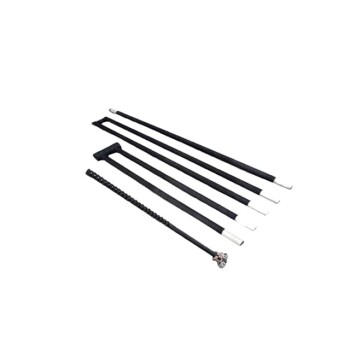
Designing h-BN thermocouple protection assemblies for sintering furnaces above 1800°C is a balancing act between thermal performance, chemical reactivity, and electrical integrity. The primary design consideration is to use segmented, high-density hexagonal boron nitride (h-BN) sleeves to electrically isolate the B₄C temperature-sensing rod from the outer graphite tube. The absolute atmospheric restriction is to operate these assemblies exclusively under high vacuum or pure rare‑gas (inert) atmospheres; the presence of nitrogen or oxidizing gases will chemically attack the graphite and B₄C elements, rapidly destroying the thermocouple.
The reliability of an h‑BN-protected thermocouple above 2000 °C depends on two non‑negotiable factors: a segmented, high‑purity sleeve design that prevents electrical shorts, and a furnace atmosphere that is strictly oxygen‑ and nitrogen‑free to avoid chemical degradation of the sensor electrodes.
Understanding the Design of h‑BN Protection Tubes
The architecture of the thermocouple assembly solves two simultaneous challenges: providing electrical insulation at extreme temperatures while managing mechanical stress from thermal expansion.
The Segmented Sleeve Architecture
A monolithic ceramic tube would crack from differential expansion between the inner B₄C rod, the h‑BN insulator, and the outer graphite sheath. Therefore, the h‑BN insulator is manufactured as multiple separate segments stacked along the thermocouple length.
This segmentation allows each piece to expand independently, preventing the build‑up of destructive tensile stresses. High‑density h‑BN is chosen because its high thermal conductivity shuttles heat effectively to the measurement junction, while its extremely high electrical resistivity keeps the B₄C rod galvanically isolated from the graphite tube.
Material Purity: The B₂O₃ Content Trap
A frequently overlooked design parameter is the residual boric oxide (B₂O₃) content in the sintered h‑BN ceramic. During high‑temperature operation, excess B₂O₃ can exude to the surface of the sleeve.
This creates a thin, electrically conductive glassy layer that shorts the B₄C rod to the outer graphite tube, instantly destroying the thermocouple’s insulation properties. Sintering additives like B₂O₃ are necessary for liquid‑phase sintering, but furnace‑grade h‑BN for thermocouple applications must be processed to retain only a minimal, non‑exuding quantity.
The Atmospheric Restriction: Why Gas Choice Matters
Furnace operators often focus on the h‑BN’s own temperature limits, but the true restriction for the assembly is far stricter and driven by the electrode materials.
The Vacuum and Inert Gas Mandate
The B₄C/C thermocouple assembly must be operated under high vacuum or pure rare‑gas atmospheres (argon, helium). Any trace of oxygen will oxidize the graphite tube and the B₄C rod at high temperature, while nitrogen reacts with both to form volatile or structurally degrading compounds. Even a partial pressure of these gases will drastically shorten the sensor’s operational life and lead to drift or abrupt signal loss.
Why h‑BN’s Own Stability is Not the Whole Story
It is true that h‑BN itself can remain stable up to 2400 °C in nitrogen and only begins to oxidize around 1000 °C in air. However, designing an assembly solely around h‑BN’s intrinsic limits misses the critical failure mode: the graphite and B₄C electrodes are far more reactive than the ceramic sleeve. The h‑BN sleeve acts as a chemically inert shield, but it is not a hermetic barrier; any process gas that reaches the internal electrodes will degrade them. Thus, the atmosphere specification for the whole assembly is the intersection of the least‑chemically‑stable component—in this case, the electrodes—making vacuum or noble gas the only viable choice.
Understanding the Trade‑offs
Operating an h‑BN-insulated thermocouple at the extreme edge of its capability forces several compromises that must be actively managed.
The Misleading Stability of h‑BN in Nitrogen
A common pitfall is to assume that because h‑BN can survive 2400 °C in nitrogen, a thermocouple protected by h‑BN can also survive. In practice, nitrogen permeates the small gaps between the segmented sleeves and attacks the B₄C and graphite. The result is a perfectly intact sleeve wrapped around a chemically consumed thermocouple junction. Accepting that the assembly’s temperature ceiling is defined by electrode‑gas compatibility, not just the ceramic’s melting point, is essential for reliable operation.
Thermal Gradients and Mechanical Stress
Even with segmentation, the assembly faces steep thermal gradients during furnace ramp‑up. The high thermal conductivity of h‑BN helps, but the low coefficient of thermal expansion (CTE) mismatch between the ceramic, the graphite outer tube, and the B₄C rod still generates localized stresses. Over multiple cycles, micro‑cracks can form if the sleeve segments are not designed with sufficient clearance. These cracks become pathways for gas ingress, accelerating electrode attack.
Making the Right Choice for Your Sintering Furnace
The optimal design and operating protocol depend on which failure mode you most need to guard against.
- If your primary focus is maximizing thermocouple lifespan: Use only segmented, low‑B₂O₃ h‑BN sleeves, and operate exclusively under high vacuum or high‑purity argon. Purge all nitrogen and confirm oxygen partial pressure is negligible before heating above 1000 °C.
- If your primary focus is pushing the operating temperature to the 2200 °C limit: Validate that the entire thermocouple assembly—not just the h‑BN—is rated for that atmosphere. Be prepared to sacrifice sensor life if any reactive gas is present, and schedule frequent replacement cycles.
- If your primary focus is avoiding electrical noise and signal drift: Specify h‑BN with a demonstrably low and stable B₂O₃ content, and perform a burn‑out heat treatment before installation to volatilize any surface residues that could create a conductive path.
A well‑designed h‑BN thermocouple protection assembly is an elegant solution to an extreme sensing problem—but it demands that you respect the chemical boundaries of every component, not just the ceramic that gives it its name.
Summary Table:
| Aspect | Key Design / Atmospheric Requirement | Impact on Assembly Performance |
|---|---|---|
| Sleeve Architecture | Segmented, high-density h-BN sleeves | Prevents thermal stress cracking and ensures electrical isolation |
| Material Purity | Low residual B₂O₃ content | Avoids conductive glassy surface layers that cause electrical shorts |
| Atmosphere Limit | Strictly high vacuum or pure noble gases (Ar, He) | Prevents chemical destruction of internal B₄C and graphite electrodes |
| Thermal Gradients | Engineered clearance gaps & matched CTE | Minimizes micro-cracking and delays harmful process gas ingress |
Maximize Sensor Life and Thermal Precision with KINTEK
Operating high-temperature processes above 1800°C demands specialized expertise and reliable hardware. KINTEK specializes in high-performance laboratory equipment and consumables, offering a comprehensive range of high-temperature furnaces—including vacuum, atmosphere, tube, muffle, and custom sintering solutions—tailored precisely to your thermal management needs.
Whether you need customized h-BN components or complete ultra-high-temperature furnace systems, our technical team is here to protect your process integrity. Contact KINTEK Experts Today to explore our custom solutions!
Related Products
- Multi Zone Laboratory Quartz Tube Furnace Tubular Furnace
- High Purity Quartz Tube and Quartz Boat for Laboratory Furnaces
- Multi Heating Zones CVD Tube Furnace Machine for Chemical Vapor Deposition Equipment
- 1200℃ Controlled Inert Nitrogen Atmosphere Furnace
- High Temperature Muffle Oven Furnace for Laboratory Debinding and Pre Sintering
People Also Ask
- What temperature-related capabilities make multi zone tube furnaces valuable for research? Unlock Precision Thermal Control
- What role do multi zone tube furnaces play in new energy research? Unlock Precise Thermal Control for Innovation
- Why are multi zone tube furnaces particularly useful for nanomaterial research? Unlock Precise Thermal Control for Advanced Synthesis
- What environmental protection applications utilize multi zone tube furnaces? Unlock Precision in Waste Treatment and Green Tech
- What are the main applications of multi zone tube furnaces in university laboratories? Unlock Precision in Material Science and Energy Research