
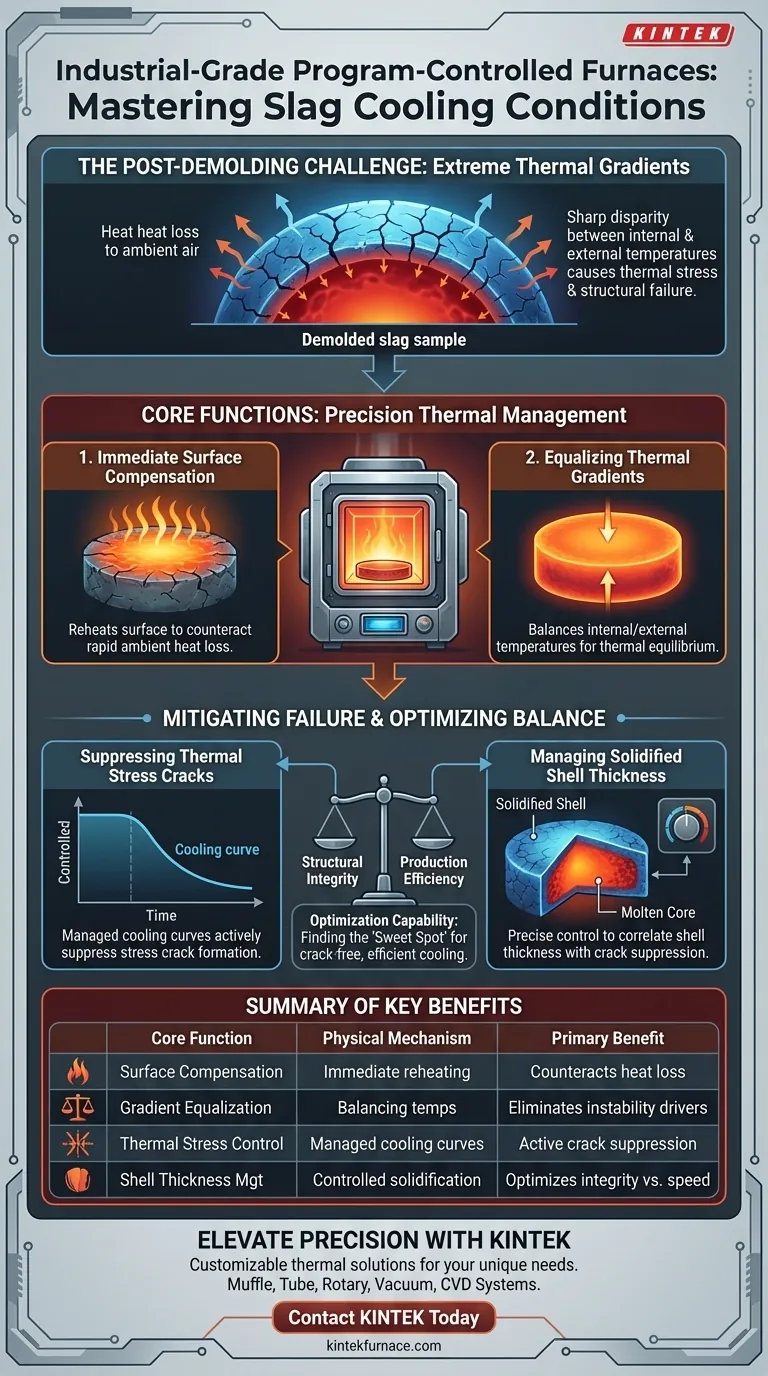
Industrial-grade program-controlled furnaces function primarily as high-precision thermal management systems designed to stabilize slag immediately after the demolding process. Their core capabilities center on precise temperature compensation and controlled slow cooling, specifically reheating the material's surface to neutralize the sharp disparity between internal and external temperatures.
By intervening effectively post-demolding, these furnaces eliminate extreme temperature gradients that cause structural failure. They allow operators to isolate the relationship between solidified shell thickness and thermal stress, ensuring that crack suppression does not come at the cost of production efficiency.
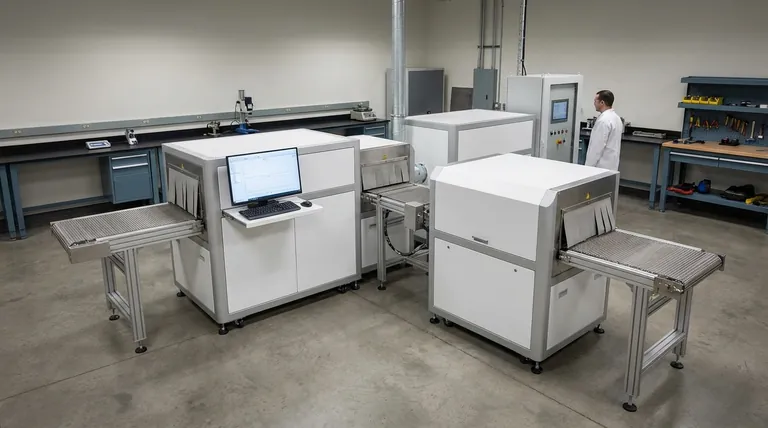
Precision Thermal Management
Immediate Surface Compensation
Once slag is removed from a mold, its surface is exposed to cooler ambient air while the core remains molten or extremely hot.
The program-controlled furnace intervenes immediately to reheat the surface of the sample. This action counteracts the rapid heat loss that typically occurs the moment the material is demolded.
Equalizing Thermal Gradients
The fundamental physical goal of this equipment is thermal equilibrium.
By applying targeted heat to the exterior, the system helps equalize the internal and external temperatures. This prevents the formation of steep temperature gradients that are the primary drivers of material instability.
Mitigating Structural Failure
Suppressing Thermal Stress Cracks
When the outside of a material cools much faster than the inside, tension builds up, resulting in thermal stress.
These furnaces provide a controlled thermal environment designed to eliminate these stresses. By managing the cooling curve, the system actively suppresses the formation of thermal stress cracks that would otherwise ruin the sample.
Managing Solidified Shell Thickness
A critical aspect of slag management is controlling the thickness of the solidified shell—the outer crust of the material.
This technology allows researchers and engineers to study exactly how shell thickness correlates with crack formation. It provides the control necessary to manipulate this variable precisely.
Understanding the Operational Balance
The Efficiency Trade-off
In traditional cooling scenarios, preventing cracks often requires significantly slowing down the process, which hurts production throughput.
The critical trade-off here is balancing structural integrity against production efficiency.
Optimization Capability
This furnace technology is designed to solve that trade-off.
It enables the study of cooling conditions that suppress cracks without sacrificing efficiency. The goal is to find the "sweet spot" where the cooling is slow enough to prevent defects but fast enough to maintain industrial viability.
Making the Right Choice for Your Goal
To maximize the utility of an industrial-grade program-controlled furnace, align its functions with your specific operational targets:
- If your primary focus is Quality Assurance: Leverage the precise temperature compensation to minimize the delta between surface and core temperatures immediately post-demolding to prevent thermal shock.
- If your primary focus is Process Efficiency: Use the controlled slow cooling features to determine the minimum solidified shell thickness required to suppress cracks, allowing for the fastest possible safe cooling rate.
These systems transform cooling from a passive waiting period into an active, value-adding process.
Summary Table:
| Core Function | Physical Mechanism | Primary Benefit |
|---|---|---|
| Surface Compensation | Immediate reheating post-demolding | Counteracts rapid ambient heat loss |
| Gradient Equalization | Balancing internal/external temps | Eliminates drivers of material instability |
| Thermal Stress Control | Managed cooling curves | Active suppression of stress cracks |
| Shell Thickness Mgt | Controlled shell solidification | Optimizes the balance of integrity vs. speed |
Elevate Your Slag Management Precision with KINTEK
Don't let thermal stress compromise your material integrity or production throughput. KINTEK provides industry-leading thermal solutions, including Muffle, Tube, Rotary, Vacuum, and CVD systems, all designed to meet the rigorous demands of industrial slag research and production.
Backed by expert R&D and precision manufacturing, our lab high-temp furnaces are fully customizable to help you achieve the perfect cooling curve for your unique needs.
Ready to optimize your thermal management? Contact KINTEK today to discover how our expert systems can enhance your lab's efficiency and product quality.
Visual Guide
Related Products
- Controlled Inert Nitrogen Hydrogen Atmosphere Furnace
- 1200℃ Controlled Inert Nitrogen Atmosphere Furnace
- 1700℃ Controlled Inert Nitrogen Atmosphere Furnace
- Mesh Belt Controlled Atmosphere Furnace Inert Nitrogen Atmosphere Furnace
- Spark Plasma Sintering SPS Furnace
People Also Ask
- What are the characteristics and uses of hydrogen atmospheres in furnaces? Unlock Clean Metal Processing
- What are the characteristics and uses of hydrogen atmosphere in furnaces? Achieve Superior Surface Purity and Bonding
- Mechanism of Fe81Ga19 Secondary Recrystallization? High-Precision Furnace Control for Goss Grain Growth
- How does a controlled atmosphere furnace contribute to energy efficiency? Lower Costs with Advanced Thermal Management
- Why is controlled atmosphere capability important in an atmosphere furnace? Unlock Precise Material Processing



















