
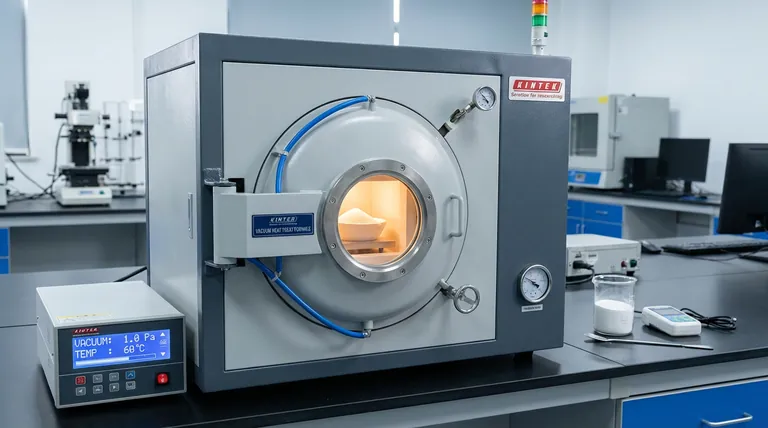
The definitive technical advantage of using a laboratory vacuum oven over a conventional blast oven lies in its ability to lower solvent boiling points through negative pressure. By creating a vacuum environment, these ovens allow moisture and solvents like ethanol to evaporate rapidly at significantly reduced temperatures.
This process eliminates the need for high heat, effectively preventing the oxidation of sensitive ceramic powders and avoiding the thermal degradation that frequently compromises material integrity in standard convection heating.
Core Takeaway Vacuum drying decouples temperature from evaporation efficiency. By reducing ambient pressure, you can aggressively remove solvents and trapped moisture without subjecting ceramic powders to the thermal stress or oxidative atmosphere inherent in conventional blast ovens, ensuring superior chemical purity and optimal microstructure for sintering.
Preserving Chemical Purity via Thermodynamics
Lowering the Activation Energy for Drying
In a conventional blast oven, drying relies on raising the temperature of the solvent (usually water or ethanol) to its boiling point at atmospheric pressure. This often requires temperatures that exceed the stability limits of reactive ceramic precursors.
A vacuum oven alters the thermodynamic environment by reducing the system pressure. This depression lowers the solvent's boiling point, allowing vaporization to occur at much cooler temperatures (e.g., removing moisture at 60°C instead of 100°C+).
Preventing Oxidation and Degradation
High-temperature air drying inevitably exposes powders to oxygen, leading to surface oxidation. For materials like ultra-fine titanium carbide or delithiated NCM powders, this exposure alters surface chemistry and degrades performance.
The vacuum environment is inherently anaerobic. By excluding oxygen during the heating process, the oven maintains the chemical purity of the active material surface and prevents unwanted side reactions.
Optimizing Physical Microstructure
Eliminating Hard Agglomerates
One of the most persistent issues in ceramic processing is "hard agglomeration." In blast ovens, as solvents evaporate slowly under heat, liquid bridge forces can pull particles together, forming dense clumps that are difficult to break down.
Vacuum drying accelerates solvent removal from within the powder clusters. This minimizes the duration and intensity of these liquid bridge forces, preventing the formation of hard agglomerates. The result is a powder that retains high surface activity, which facilitates better densification during the subsequent sintering steps.
Enhancing Porosity for Molding
Achieving a defect-free ceramic part requires a uniform internal structure before firing. Conventional ovens often leave trace moisture or air pockets trapped deep within powder clusters.
The negative pressure of a vacuum oven actively pulls trapped air bubbles and residual solvents out of the powder's pores. This ensures the dried powder maintains excellent porosity and flowability, which are critical prerequisites for uniform filling during compression molding.
Operational Control and Contamination Risks
Eliminating Cross-Contamination
Blast ovens rely on forced air convection—fans blowing hot air over the sample. This turbulence can lift fine powders, leading to material loss or cross-contamination between different samples in the same oven.
Vacuum ovens operate statically. Because there is no turbulent airflow, the risk of airborne cross-contamination is virtually eliminated, preserving the integrity of distinct sample batches.
Understanding the Trade-offs
While vacuum ovens offer superior quality control, they introduce specific operational constraints compared to blast ovens.
Throughput vs. Precision
Blast ovens are typically better suited for high-volume, continuous drying of robust materials where minor surface oxidation is acceptable. Vacuum ovens operate as batch processes and generally have smaller chamber capacities.
Thermal Transfer Efficiency
In a vacuum, there is no air to convect heat. Heat transfer relies on conduction through the shelves and radiation. This means that while solvent evaporation is faster due to pressure changes, the actual heating of the sample mass can be less uniform if the powder bed is too deep or not in good contact with the heated surface.
Making the Right Choice for Your Goal
To determine if a vacuum oven is necessary for your specific application, evaluate your material sensitivity and downstream processing needs.
- If your primary focus is Chemical Purity: Choose the vacuum oven to prevent oxidation and side reactions, particularly for non-oxide ceramics or battery materials.
- If your primary focus is Sintering Density: Choose the vacuum oven to preserve high surface activity and prevent the hard agglomeration that inhibits densification.
- If your primary focus is Molding Quality: Choose the vacuum oven to ensure the complete removal of trapped air and deep-pore moisture for uniform green body formation.
Summary: If your ceramic powder is sensitive to heat, oxygen, or agglomeration, the vacuum oven is not just an alternative; it is a processing necessity.
Summary Table:
| Feature | Laboratory Vacuum Oven | Conventional Blast Oven |
|---|---|---|
| Drying Mechanism | Low pressure/boiling point depression | High temperature/convection |
| Oxidation Risk | Near zero (anaerobic environment) | High (exposure to heated air) |
| Agglomeration | Prevents hard clusters/agglomerates | Higher risk due to liquid bridging |
| Contamination | No airflow; zero cross-contamination | High risk from forced air turbulence |
| Material Integrity | Preserves surface activity & purity | Risk of thermal degradation |
Elevate Your Powder Processing with KINTEK
Don't let oxidation or hard agglomeration compromise your research. Backed by expert R&D and manufacturing, KINTEK offers high-performance Vacuum, Muffle, and CVD systems designed specifically for sensitive laboratory applications. Our customizable high-temperature furnaces ensure your ceramic powders achieve optimal chemical purity and sintering density.
Ready to optimize your material microstructure? Contact our technical experts today to find the perfect drying solution for your unique needs.
References
- Sebastián Caicedo‐Dávila, David A. Egger. Disentangling the effects of structure and lone-pair electrons in the lattice dynamics of halide perovskites. DOI: 10.1038/s41467-024-48581-x
This article is also based on technical information from Kintek Furnace Knowledge Base .
Related Products
- 1200℃ Muffle Oven Furnace for Laboratory
- 1400℃ Muffle Oven Furnace for Laboratory
- Laboratory Muffle Oven Furnace with Bottom Lifting
- Laboratory Vacuum Tilt Rotary Tube Furnace Rotating Tube Furnace
- High Pressure Laboratory Vacuum Tube Furnace
People Also Ask
- How does a high-temperature laboratory muffle furnace affect material properties? Transform Anodic Oxide Films Fast
- What is the primary function of a high-temperature laboratory muffle furnace in chemical synthesis? Achieve Precision.
- How is a laboratory muffle furnace used in 3D-printed PP-CF cross-linking? Achieve Thermal Stability at 150 °C
- How is a laboratory high-temperature muffle furnace used to evaluate porous Co-Al materials? Precision Thermal Analysis
- What is the critical role of a laboratory high-temperature muffle furnace in TiO2/LDH? Unlock Superior Crystallization



















