Template synthesis provides a distinct advantage in the fabrication of zinc selenide (ZnSe) nanocrystals by utilizing a physical mold to dictate the final structure of the material. The primary benefits of this process are the precise regulation of crystal size through spatial confinement, the ability to achieve uniform distribution, and significant operational efficiencies characterized by low cost and simplicity.
Core Takeaway: The defining strength of template synthesis is morphology guidance. By selectively filling pre-existing pore cavities, you can bypass the randomness of free growth to produce size-controlled semiconductor nanoclusters and nanowires ideal for optoelectronic research.
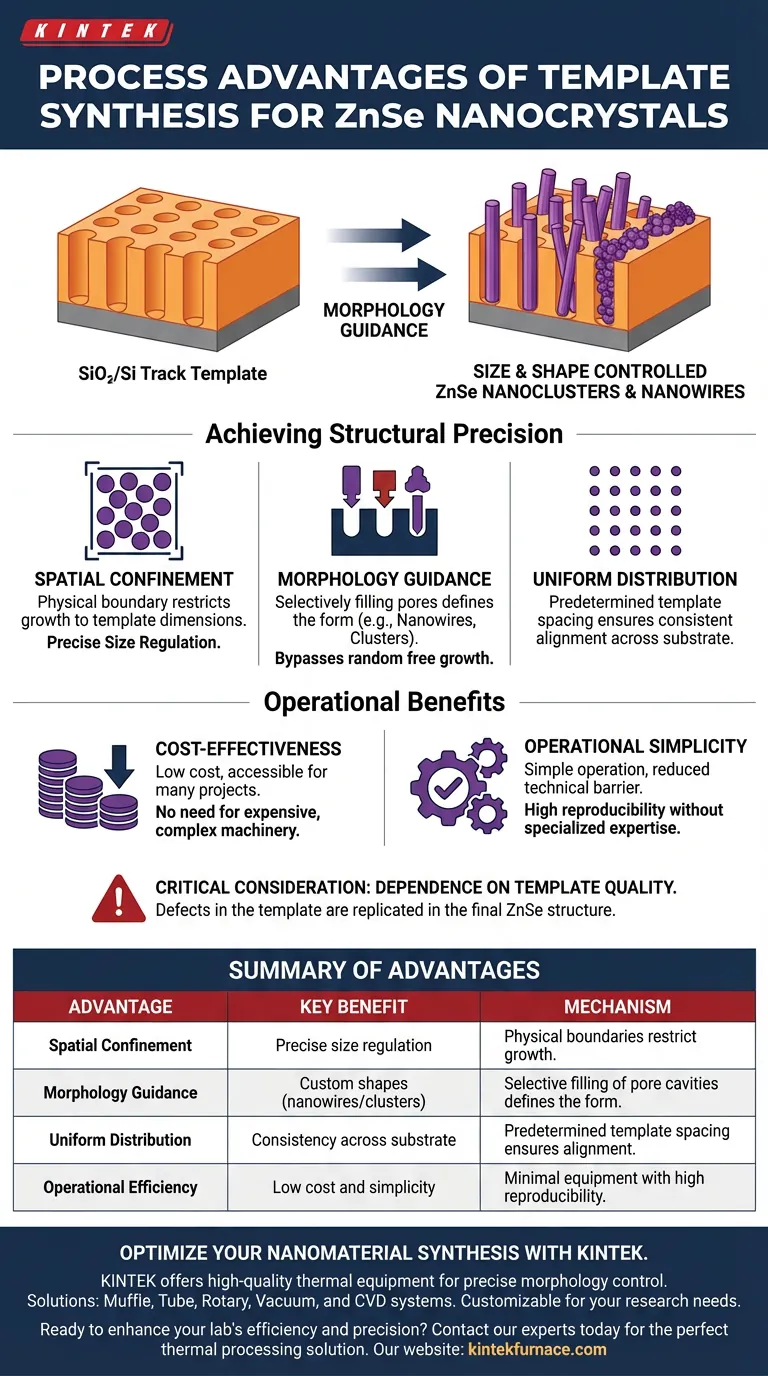
Achieving Structural Precision
Mastering Spatial Confinement
The fundamental advantage of this method is spatial confinement.
Rather than allowing crystals to grow unrestricted, the process uses pre-prepared silica/silicon (SiO2/Si) track templates.
These templates act as a physical boundary, restricting the growth of the ZnSe to the exact dimensions of the available space.
Morphology Guidance
This technique allows you to intentionally shape the nanomaterial.
By selectively filling the pore cavities of the template, you can determine the specific form the ZnSe takes.
This is particularly effective for creating specific structures like nanoclusters and nanowires that are difficult to achieve through uncontrolled chemical precipitation.
Uniform Distribution
Consistency is often a major challenge in nanomaterial fabrication.
Template synthesis ensures that the resulting ZnSe structures are uniformly distributed across the substrate.
Because the template itself is fixed, the spacing and arrangement of the nanocrystals are predetermined and consistent.
Operational Benefits
Cost-Effectiveness
For many research applications, budget constraints drive process selection.
This method is characterized by low cost, making it accessible for a wide range of projects.
It avoids the need for the expensive, high-maintenance machinery often required for advanced lithography or epitaxial growth.
Operational Simplicity
Complexity often introduces variables that lead to errors.
Template synthesis offers simple operation, reducing the technical barrier to entry.
This simplicity allows for high reproducibility without requiring highly specialized operational expertise.
Critical Considerations
Dependence on Template Quality
While the process is advantageous, it is not independent.
The quality of your ZnSe nanocrystals is directly tied to the quality of your SiO2/Si track templates.
Any defect or irregularity in the pre-prepared template will be faithfully replicated in the final semiconductor structure.
Making the Right Choice for Your Goal
Template synthesis is a powerful tool when structural definition and budget are your primary constraints.
- If your primary focus is Structural Precision: Leverage the spatial confinement capabilities to enforce exact size and shape control for nanowires or nanoclusters.
- If your primary focus is Project Efficiency: Utilize this method for its low cost and simple operation to establish a high-quality structural foundation without excessive overhead.
This approach offers a practical balance between high-quality structural control and operational feasibility.
Summary Table:
| Advantage | Key Benefit | Mechanism |
|---|---|---|
| Spatial Confinement | Precise size regulation | Physical boundaries of the mold restrict growth. |
| Morphology Guidance | Custom shapes (nanowires/clusters) | Selective filling of pore cavities defines the form. |
| Uniform Distribution | Consistency across substrate | Predetermined template spacing ensures alignment. |
| Operational Efficiency | Low cost and simplicity | Minimal equipment requirements with high reproducibility. |
Optimize Your Nanomaterial Synthesis with KINTEK
Precise morphology control in ZnSe nanocrystals requires a foundation of high-quality thermal equipment. Backed by expert R&D and manufacturing, KINTEK offers a wide range of laboratory solutions—including Muffle, Tube, Rotary, Vacuum, and CVD systems—all customizable to meet your unique research needs. Whether you are focusing on spatial confinement or scaling up production, our high-temp furnaces provide the stability your templates demand.
Ready to enhance your lab's efficiency and structural precision? Contact our experts today to find the perfect thermal processing solution for your project.
Visual Guide
References
- Aiman Akylbekovа, А. Usseinov. RAMAN ANALYSIS OF NANOCRYSTALS BASED ON ZINC SELENIDE. DOI: 10.52676/1729-7885-2023-4-77-84
This article is also based on technical information from Kintek Furnace Knowledge Base .
Related Products
- Multi Heating Zones CVD Tube Furnace Machine for Chemical Vapor Deposition Equipment
- Stainless Steel Quick Release Vacuum Chain Three Section Clamp
- High Performance Vacuum Bellows for Efficient Connection and Stable Vacuum in Systems
- Ultra High Vacuum CF Observation Window Flange with High Borosilicate Glass Sight Glass
- Multi Zone Laboratory Quartz Tube Furnace Tubular Furnace
People Also Ask
- What is the function of a multi-zone tube furnace in CVD synthesis? Master 2D In2Se3 Nanosheet Precision
- Why are multi zone tube furnaces particularly useful for nanomaterial research? Unlock Precise Thermal Control for Advanced Synthesis
- What environmental protection applications utilize multi zone tube furnaces? Unlock Precision in Waste Treatment and Green Tech
- What temperature-related capabilities make multi zone tube furnaces valuable for research? Unlock Precision Thermal Control
- What role do multi zone tube furnaces play in new energy research? Unlock Precise Thermal Control for Innovation