
At its core, a box furnace is an indispensable tool for a wide range of thermal processing applications. It is primarily used for heat treatment processes like annealing, tempering, and quenching, as well as for sintering, calcining, and curing materials. These furnaces are found in laboratories, research institutions, and industrial settings where precise, uniform heating of a batch of material is required.
A box furnace is defined by its operational principle: it processes materials in static batches. Its value comes from its ability to provide highly uniform and precisely controlled heat within a simple, accessible chamber, making it a versatile workhorse for enhancing material properties.
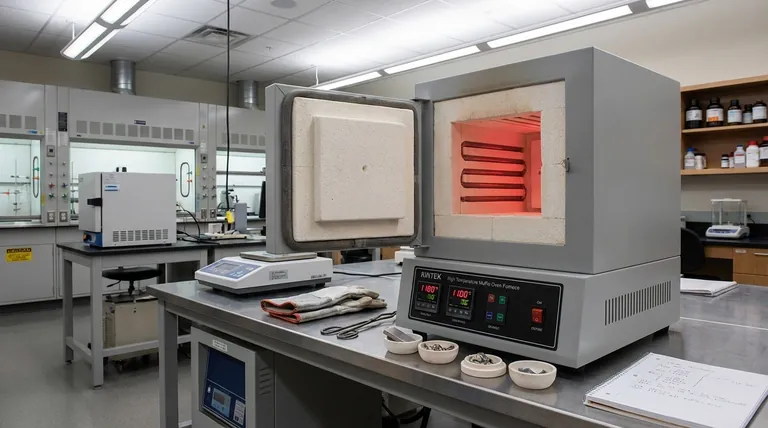
The Design Behind the Function
To understand the uses of a box furnace, you must first understand its fundamental design. Unlike continuous furnaces, a box furnace operates intermittently.
The Principle: Static Batch Processing
A box furnace, also known as a muffle furnace, works by placing materials inside a chamber, closing the door, and running a programmed thermal cycle. The materials remain stationary throughout the heating and cooling process.
This simple, effective design makes it ideal for operations where batches of parts or materials need to undergo the exact same temperature profile before being removed.
Key Components Driving Performance
The furnace's capabilities are a direct result of its core components.
- The furnace chamber or cabinet is built with high-temperature insulation to maintain internal heat and ensure operator safety.
- Heating elements, typically electric, are positioned to provide stable and uniform heat radiation throughout the chamber.
- A sophisticated temperature control system is the brain of the furnace, regulating temperature in real-time to execute precise heating and cooling profiles.
Core Applications and Processes
The uniform, controlled environment of a box furnace makes it suitable for a variety of critical applications that modify the physical and chemical properties of materials.
Heat Treatment of Metals and Alloys
This is the most common application. The goal is to alter the microstructure of metals to achieve desired characteristics like hardness, toughness, or ductility.
- Annealing: Heating and slowly cooling metal to soften it and relieve internal stresses.
- Tempering: Heating a previously hardened steel to a specific temperature to increase its toughness.
- Quenching: Rapidly cooling a workpiece to achieve a specific level of hardness.
Sintering and Calcining
Box furnaces are essential for creating solid materials from powders without melting them.
- Sintering: Heating powdered materials like ceramics or metals to a point where their particles bond together, increasing strength and density.
- Calcining: Heating materials to high temperatures to drive off moisture, volatiles, or to induce a phase transition.
Laboratory and Research Analysis
In research and quality control labs, box furnaces serve as a general-purpose tool for preparing and analyzing samples. Common uses include element analysis, high-temperature materials testing, and dissolving samples for chemical analysis.
Understanding the Advantages and Trade-offs
No single piece of equipment is perfect for every job. Understanding the inherent advantages and limitations of a box furnace is key to using it effectively.
Key Advantage: Uniformity and Precision
The primary benefit is exceptional temperature uniformity. The static chamber design ensures that all materials inside, regardless of their position, experience a consistent thermal environment. This is critical for achieving repeatable results.
Key Advantage: Versatility and Simplicity
A box furnace can handle a wide variety of materials and processes. Its front-loading door and simple operation make it easy to use for numerous applications without requiring complex setup or specialized training.
The Primary Limitation: Batch Throughput
The intermittent, batch-based nature is also its main limitation. A box furnace is not suitable for continuous, high-volume production lines where materials must constantly flow through a heating process.
When Another Furnace Type Is Better
Understanding when a box furnace is not the right tool is just as important.
- Tube Furnaces are preferred for processes involving controlled atmospheres or gas reactions, as their tubular design is better for flowing gas over a sample.
- Drop Tube Furnaces are highly specialized for studying the thermal decomposition of particles (like coal or biomass) as they fall through a precise temperature gradient.
Making the Right Choice for Your Goal
Selecting the correct thermal equipment depends entirely on your specific objective.
- If your primary focus is consistent heat treatment of batches: A box furnace is the ideal choice due to its excellent temperature uniformity and operational simplicity.
- If your primary focus is R&D or general-purpose lab heating: The versatility of a box furnace makes it a foundational piece of equipment for a wide range of analytical and testing needs.
- If your primary focus is processing under a flowing gas or in a continuous line: A tube furnace or another type of continuous furnace will be far more suitable for your application.
By understanding its fundamental design and operational context, you can confidently leverage a box furnace to achieve precise and repeatable thermal processing results.
Summary Table:
| Application | Key Processes | Common Uses |
|---|---|---|
| Heat Treatment | Annealing, Tempering, Quenching | Metals, Alloys |
| Sintering & Calcining | Bonding powders, Removing volatiles | Ceramics, Metals |
| Laboratory Analysis | Element analysis, Materials testing | Research, Quality control |
Ready to enhance your lab's thermal processing with a custom box furnace? KINTEK leverages exceptional R&D and in-house manufacturing to provide advanced high-temperature furnace solutions. Our product line, including Muffle, Tube, Rotary Furnaces, Vacuum & Atmosphere Furnaces, and CVD/PECVD Systems, is complemented by strong deep customization capabilities to precisely meet your unique experimental needs. Contact us today to discuss how we can optimize your batch processing for superior results!
Visual Guide

Related Products
- Vacuum Hot Press Furnace Machine Heated Vacuum Press Tube Furnace
- Mesh Belt Controlled Atmosphere Furnace Inert Nitrogen Atmosphere Furnace
- Vacuum Heat Treat Sintering Furnace with Pressure for Vacuum Sintering
- 600T Vacuum Induction Hot Press Vacuum Heat Treat and Sintering Furnace
- Vacuum Hot Press Furnace Machine Heated Vacuum Press
People Also Ask
- Why use Vacuum Hot Press (VHP) for ZnS Ceramics? Achieve Superior IR Transparency and Mechanical Strength
- What are the benefits of the vacuum environment system in a vacuum hot press furnace? Unlock High-Density Sintering
- What safety features are incorporated in vacuum hot press furnaces? Ensure Operator and Equipment Protection
- What considerations guide the selection of heating elements and pressurization methods for a vacuum hot press furnace?
- What is the primary function of the vacuum environment in a vacuum hot press furnace during titanium alloy processing? Prevent Embrittlement for Superior Ductility



















