
At their core, pyrolysis rotary kiln reactors offer significant advantages in process control and efficiency. Their primary benefits are consistently high product yields, superior energy efficiency, and minimized environmental emissions, all driven by a fundamentally simple and robust design.
The key advantage of a pyrolysis rotary kiln is not just one feature, but how its continuous rotation and indirect heating combine to create a highly uniform and controlled processing environment. This precision is what unlocks higher yields and greater operational efficiency compared to static systems.
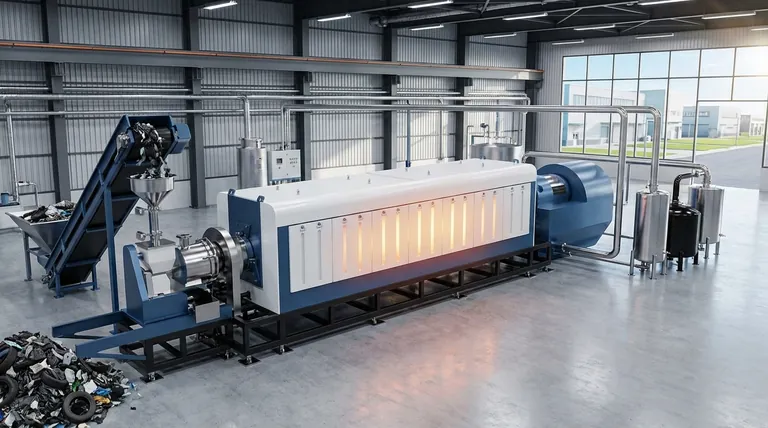
The Core Principle: How Rotation Drives Performance
The defining characteristic of a rotary kiln is its slow, constant rotation. This simple mechanical action is the source of its most powerful advantages, creating an ideal environment for the thermal decomposition that is pyrolysis.
Ensuring Uniform Heating
The tumbling motion created by the kiln's rotation constantly mixes the feedstock, such as waste tires or plastics. This ensures every particle is evenly exposed to the heat source, eliminating hot and cold spots that can plague static reactors.
This uniform temperature distribution is critical for achieving complete and consistent pyrolysis, maximizing the conversion of waste into valuable products.
Maximizing Heat and Mass Transfer
As the material tumbles, it increases the surface area exposed to the hot, oxygen-free atmosphere inside the kiln. This enhances the transfer of heat into the material and the transfer of released gases out of the material.
The result is a faster, more efficient reaction process, leading to higher throughput.
Facilitating Continuous Material Flow
The slight incline of a rotary kiln, combined with its rotation, automatically transports material from the feed inlet to the discharge outlet.
This enables continuous, automated production, which is essential for large-scale industrial operations looking for high efficiency and reduced labor costs.
Key Operational Advantages Explained
The physical design of the rotary kiln directly translates into tangible benefits for waste processing and resource recovery operations.
High Product Yield
Because the kiln provides such precise and uniform heating, the feedstock is processed under optimal conditions. This minimizes the creation of undesirable char or unprocessed material, leading to a consistently higher yield of target products like fuel oil and carbon black.
Superior Energy Efficiency
Most pyrolysis kilns use an indirect heating method. The heat is applied to the outside of the rotating steel drum, not directly to the material inside.
This enclosed design dramatically reduces heat loss to the surrounding environment. The sealed, oxygen-free internal atmosphere contains the thermal energy where it's needed, significantly lowering overall energy consumption.
Controlled and Reduced Emissions
The entire pyrolysis process occurs within a completely sealed system. This is necessary to maintain the anaerobic (oxygen-free) environment required for pyrolysis instead of combustion.
A direct benefit of this enclosed design is the containment of all process gases. This prevents the release of harmful pollutants into the atmosphere and allows for the safe collection and processing of volatile compounds.
Understanding the Trade-offs
While highly effective, rotary kilns are not without their challenges. Acknowledging these realities is crucial for making an informed decision.
Initial Capital Investment
Rotary kiln systems are pieces of heavy industrial machinery. The robust construction, motors, seals, and control systems represent a significant upfront capital cost compared to simpler, batch-based systems.
Maintenance of Rotating Seals
The most critical—and vulnerable—components of a rotary kiln are the seals at the inlet and outlet. These must maintain an airtight barrier while allowing the drum to rotate.
These seals are subject to high temperatures and mechanical wear, requiring regular inspection and specialized maintenance to prevent leaks that could compromise process safety and efficiency.
Feedstock Preparation
The performance of a rotary kiln is highly dependent on the consistency of the feedstock. Material must be properly sized and prepared to ensure smooth flow and uniform heating. Large, irregular, or wet materials can cause blockages or inefficient processing.
Making the Right Choice for Your Goal
Your specific operational priority will determine if a pyrolysis rotary kiln is the optimal solution for your project.
- If your primary focus is maximizing product value and quality: The kiln's precise temperature control and uniform heating are its greatest strengths, ensuring consistent output.
- If your primary focus is large-scale, continuous throughput: The automated material transport inherent in the design is ideal for high-volume industrial applications.
- If your primary focus is environmental compliance and safety: The fully enclosed system provides superior control over emissions, making it one of the safest methods for pyrolysis.
Ultimately, the pyrolysis rotary kiln stands as a powerful technology for converting waste into resources by offering an unmatched level of process control.
Summary Table:
| Advantage | Key Benefit | How It Works |
|---|---|---|
| Uniform Heating | Consistent, high-quality product yield | Continuous rotation ensures even heat distribution, eliminating hot/cold spots. |
| Energy Efficiency | Lower operational costs | Indirect heating in a sealed system minimizes heat loss and energy consumption. |
| Emissions Control | Environmental compliance and safety | Fully enclosed, oxygen-free environment contains and controls all process gases. |
| Continuous Operation | High throughput and automation | Inclined design with rotation enables automated, large-scale material processing. |
Ready to maximize your waste-to-resource efficiency with a pyrolysis rotary kiln?
At KINTEK, we specialize in designing and manufacturing robust, high-performance pyrolysis systems tailored to your unique operational needs. Our rotary kilns are engineered for superior process control, ensuring high yields, energy savings, and environmental compliance.
Let’s discuss how our solutions can help you achieve:
- Higher product value with precise temperature control and uniform heating.
- Reduced operational costs through energy-efficient, continuous processing.
- Scalable, industrial-grade performance for large-volume waste streams.
Contact us today to explore custom solutions for your pyrolysis project!
Visual Guide

Related Products
- Electric Rotary Kiln Small Rotary Furnace Biomass Pyrolysis Plant Rotating Furnace
- Electric Rotary Kiln Continuous Working Small Rotary Furnace Kiln for Pyrolysis Plant Heating
- Electric Rotary Kiln Pyrolysis Furnace Plant Machine Small Rotary Kiln Calciner
- Electric Rotary Kiln Small Rotary Furnace for Activated Carbon Regeneration
- Laboratory Vacuum Tilt Rotary Tube Furnace Rotating Tube Furnace
People Also Ask
- What are the key components of a rotary kiln electric furnace? Unlock Efficient Thermal Processing
- What is the significance of the refractory lining in a rotary kiln electric furnace? Unlock Efficiency and Longevity
- What are the main applications of a rotary kiln electric furnace? Achieve Uniform Heat Treatment for Powders
- What are the differences between direct-heat and indirect-heat rotary kilns? Choose the Right Kiln for Your Process
- What is the benefit of adjustable speed control in rotary kilns? Optimize Efficiency and Quality







