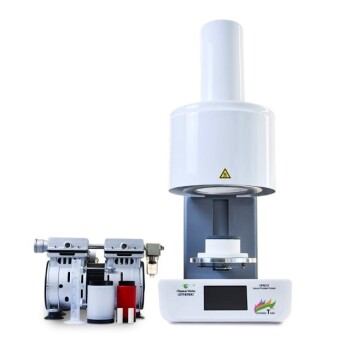
Field-assisted high-temperature sintering is not a single technology, but a family of advanced processing techniques that fundamentally accelerate densification.
The key technical variants integrated into modern laboratory sintering systems are microwave sintering, spark plasma sintering (SPS), and flash sintering. Their core physical mechanism unites the universal thermodynamic driving force of surface energy reduction with the targeted, simultaneous application of electric currents and electromagnetic fields.
These technologies converge on a single principle: combining thermal energy with non-thermal field effects to overcome kinetic barriers. This allows researchers to achieve near-theoretical density and exceptional microstructural control in minutes, not hours—but each variant manipulates mass transport along a distinct physical pathway, making selection a matter of matching equipment capabilities to the specific material and process goals.
The Universal Driving Force: Surface Energy and Thermodynamics
Before exploring how fields intervene, it’s essential to understand why any powder consolidates into a dense solid. This foundation is what every variant builds upon.
The Thermodynamic Imperative
Sintering is a spontaneous, thermally activated process that reduces the total free surface energy of a powder compact. The system moves toward a lower-energy state by replacing high-area solid–vapor interfaces with lower-energy solid–solid grain boundaries.
This surface energy, often described as a curvature-driven capillary force, creates compressive stresses at particle contacts. The result is a driving force that pulls atoms into the neck region between particles.
Kinetic Pathways that Dictate the Result
The thermodynamic will to sinter is useless without the kinetic means to move matter. The dominant mass transport mechanisms—volume diffusion, grain boundary diffusion, and surface diffusion—govern the rates of neck growth and pore elimination.
A sintering system must provide precise thermal energy to activate these diffusion paths while avoiding excessive grain growth. Laboratory furnaces achieve this through meticulous temperature profiling. Field-assisted equipment takes an entirely different approach: it adds new, non-thermal kinetic levers.
The Multi-Physics Toolkit: How Fields Transform Sintering Kinetics
When an electric current or electromagnetic field courses through a powder compact, it triggers physical mechanisms far beyond simple Joule heating. These effects are the true differentiators of field-assisted systems.
Lowering the Activation Energy Barrier
Electromagnetic fields, particularly in microwave-assisted processes, can reduce the apparent activation energy for diffusion. This means atomic transport becomes viable at lower temperatures, accelerating densification before grain growth mechanisms become dominant.
The field effectively “lubricates” atomic movement, enabling a finer final microstructure than traditional radiant heating can achieve.
Anisotropic Diffusion and Phase Transformations
Linearly polarized microwave fields introduce direction-dependent (anisotropic) diffusion. Mass transport along the field vector can be enhanced, potentially engineering texture or influencing the kinetics of solid-state phase transformations.
This non-thermal effect can shift transformation temperatures, opening process windows for phases that are unstable under purely thermal equilibrium conditions.
Inverse Porosity Evolution and “Internal Out” Heating
Conventional radiant heating sinters from the outside in. Microwave and RF fields couple energy volumetrically, leading to an inverse distribution of porosity at intermediate stages. The core heats and densifies first, effectively pushing pores outward.
Coupled with surface-specific energy modifications—such as those induced by electric double-layer effects under constant electric fields or pulsed magnetic fields—this dramatically accelerates pore elimination without trapping gas inside the compact.
The Major Technical Variants in Detail
Each technology translates these mechanisms into a distinct laboratory system. The following three are the most mature and widely employed for research-scale advanced ceramic and metallic processing.
Microwave Sintering
Core mechanism: Volumetric dielectric heating, where the material itself absorbs microwave energy and converts it directly to heat.
Non-thermal advantage: The high-frequency field (typically 2.45 GHz or 915 MHz) reduces diffusion activation energy and enables anisotropic mass transport.
This technique excels with ceramic dielectrics and materials that couple well with microwave radiation. Heating is rapid, often reaching >1600°C in minutes, and energy is deposited “inside-out,” helping to eliminate residual porosity.
Spark Plasma Sintering (SPS)
Core mechanism: A uniaxial pressure-assisted configuration where a pulsed DC current is passed directly through a conductive die and, in many cases, the powder compact.
Key phenomenon: The combination of Joule heating, high contact resistance at particle boundaries, and transient spark plasma discharges generates localized hot spots at necks, accelerating mass transport.
SPS is renowned for producing fully dense nanoceramics and difficult-to-sinter metals in minutes. The constant mechanical pressure adds a further sintering-driving force, collapsing pores and suppressing grain growth.
Flash Sintering
Core mechanism: Application of a critical electric field across a ceramic green body while it is being furnace-heated. At a threshold temperature, an instability triggers a sudden, nonlinear surge in current and power dissipation.
Distinguishing feature: Densification occurs in an abrupt “flash” event, often in seconds, at furnace temperatures hundreds of degrees lower than typical sintering.
This technique harnesses runaway Joule heating coupled with field-enhanced diffusion, but its rapid, self-limiting nature demands precise electrical control. It is heavily explored for ultra-low-energy processing of ionic conductors like yttria-stabilized zirconia.
Navigating the Trade-offs and Limitations
Field-assisted systems are powerful, but they are not a universal panacea. Objectively weighing their limitations is essential for any research plan.
Inhomogeneous Field and Temperature Distributions
Microwave sintering can cause hot spots in complex geometries due to standing wave patterns and dielectric non-uniformities. SPS, while uniform in the die plane, often creates axial temperature gradients along the punch line. Flash sintering’s current localization can lead to catastrophic runaway and sample cracking.
Sample Size and Scalability Constraints
Most SPS presses are limited to small-diameter discs (10–60 mm). Microwave sintering requires careful load design to prevent arcing and ensure uniform coupling. Flash sintering is currently restricted to simple, small bar geometries. Scaling to industrial production often requires an entirely new engineering paradigm.
Process Complexity and Reproducibility
The multi-parameter nature of these systems—temperature, current, voltage, field frequency, pressure—means that small deviations can produce vastly different microstructures. Building a robust processing map remains a research challenge, not a routine operation.
Making the Right Choice for Your Materials Project
Your decision should be guided by your material’s electrical and thermal properties and your intended application. Use this framework to align equipment with your primary goal.
- If your primary focus is achieving near-theoretical density in nanoceramics with minimal grain growth: Spark plasma sintering (SPS) offers the most mature pathway, combining pressure and pulsed current to suppress coarsening while achieving full densification.
- If your primary focus is studying the effect of non-thermal electromagnetic fields on diffusion and phase evolution: Microwave sintering provides the purest environment for isolating field-accelerated kinetics and exploring anisotropy without die interference.
- If your primary focus is ultra-low-energy processing of ionic conductors and exploring emergent sintering phenomena: Flash sintering is unmatched in demonstrating drastic temperature reductions, though it requires careful electrical characterization to avoid instability.
- If your primary focus is a complex-shaped ceramic component that couples well with high-frequency fields: Microwave sintering’s volumetric heating can reduce processing time, but you must invest in advanced simulation-driven cavity design to mitigate hot spots.
The right variant transforms sintering from a simple heat treat into a targeted physical manipulation—choose the one that speaks the same language as your material’s fundamental transport mechanisms.
Summary Table:
| Sintering Variant | Core Physical Mechanism | Key Advantages | Best Suited For |
|---|---|---|---|
| Microwave Sintering | Volumetric dielectric heating via high-frequency EM fields | Lower activation energy, rapid volumetric heating, non-thermal anisotropic diffusion | Ceramic dielectrics and materials with strong microwave coupling |
| Spark Plasma Sintering (SPS) | Pulsed DC current + uniaxial mechanical pressure | Rapid densification in minutes, suppresses grain growth, localized neck heating | Nanoceramics, refractory metals, and hard-to-sinter alloys |
| Flash Sintering | Threshold electric field triggering current/power instability | Ultra-fast densification (seconds) at significantly reduced furnace temperatures | Ionic conductors (e.g., YSZ) and low-energy research applications |
Accelerate your materials science breakthroughs with KINTEK, a trusted leader in laboratory equipment and high-temperature furnace technology. From standard setups to fully tailored processing systems, KINTEK offers a comprehensive selection of customizable laboratory high-temperature furnaces—including muffle, tube, rotary, vacuum, CVD, atmosphere, dental, and induction melting furnaces. Whether you are optimizing sintering kinetics or scaling advanced ceramic processing, our engineering experts are here to deliver the precision and reliability your lab demands. Contact us today to consult with our specialists and customize the perfect high-temperature solution for your application!
Related Products
- Spark Plasma Sintering SPS Furnace
- High Temperature Muffle Oven Furnace for Laboratory Debinding and Pre Sintering
- 2200 ℃ Tungsten Vacuum Heat Treat and Sintering Furnace
- Vacuum Heat Treat Sintering Furnace Molybdenum Wire Vacuum Sintering Furnace
- 2200 ℃ Graphite Vacuum Heat Treat Furnace
People Also Ask
- Why is it necessary to maintain a high vacuum environment during the SPS of SiC? Key to High-Density Ceramics
- How does the heating mechanism of Spark Plasma Sintering (SPS) function? Enhance TiC/SiC Composite Fabrication
- What are the technical advantages of using an SPS sintering furnace? Elevate Al2O3-TiC Material Performance
- What are the advantages of Spark Plasma Sintering (SPS)? Achieve Superior Microstructures
- What are the steps in the discharge plasma sintering process? Master Fast, High-Density Material Consolidation